
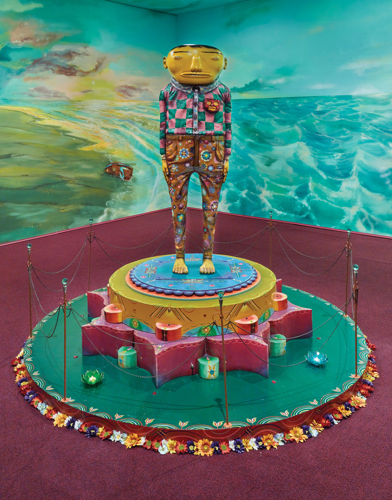
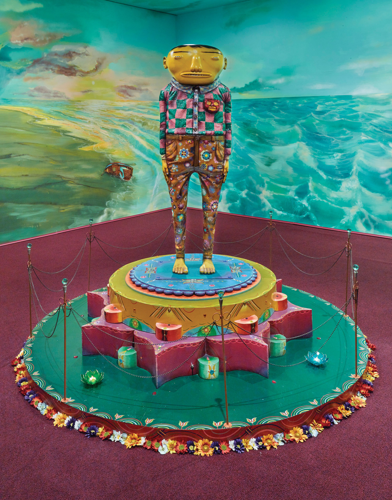

“O iluminado (The illuminated),” OSGEMEOS
Brazilian artist duo OSGEMEOS began their career in the mid-1980s as young grafiteiros — or graffiti artists — in the streets of São Paulo. Since then, the identical twin brothers, Otávio and Gustavo Pandolfo, have built an international reputation both in the street-art world and in the museum world, for their dreamlike creations and fantastical characters.
Currently on view at the Frist Art Museum, OSGEMEOS: In Between offers a whirlwind tour through the imaginative realm of the Pandolfo brothers. The exhibition includes eight mixed-media paintings and two sculptures, and they all capture the illustrative, unapologetic whimsy of their decades-long career.
The Scene caught up with OSGEMEOS — Portuguese for “the twins” — to talk about the history, motivation and inspiration behind the work. The twins often speak simultaneously and finish each other’s sentences. As a result, it’s virtually impossible to distinguish one voice from another when listening back to the recording of our conversation — trust us, we tried. Thus, we present all of their answers together.
You grew up in São Paulo, a massive city that is now well-known for its incredible street art. What was the graffiti scene like when you were breaking into it?
Brazil is different than the rest of the world. We see graffiti as a positive thing. São Paulo has a lot of problems — typical big-city problems. For the people who live on the streets, when you paint something near them, they like it, because it makes their day a little better. It’s better than a grease wall. Sometimes the city tries to cover it up, but we do it anyway. Since the ’80s, we have worked a lot in the city painting murals and walls. We saw that graffiti was a good thing for the city. Artists try to use the city as a canvas.
How did you discover the graffiti scene in São Paulo?
We started out in 1984 or 1985 when we were 13 or 14 years old. We got influenced by breakdancing and hip-hop culture. We’d hang out on the B-boys’ bench in the subway station. We were the youngest, and learned everything from them. We started breakdancing, and eventually we started painting city murals. When we discovered hip-hop, it was very spiritual. It was like we found the right tool to express ourselves. Back then, people used to do a bit of everything. Some of our friends got into it for the music, some for the dance, some for the graffiti. The same guy who breakdanced also did graffiti. It was beautiful to see everyone do a little bit of everything.
We also discovered bands who were influenced by funk and Brazilian music — like The Parliaments and Tim Maia, bands who had their own worlds and showed what they believe. We also listened to opera with our grandfather, rock with our other brother, jazz — we had a variety of influences.
Did you see visual art as your main mode of self-expression?
Since we were children, we’ve always painted in our studios, even before we did graffiti. We did not know what to do with it, but we produced like crazy because we needed to express ourselves. We did not start showing that work until after we met [San Francisco-based graffiti artist] Barry McGee in 1993 in São Paulo.
I know Barry McGee was a big influence and mentor for you both. How did you meet him?
He had a show at Museum Laser Segall in São Paulo and did a residency there. We became, like, best friends. He was the first American graffiti artist we had ever met, and he taught us a lot. He believed in being true to yourself and having your own style — not copying what someone else is doing. Of course, we used to copy back in the day. We’d copy American graffiti and subway art. But after we met Barry, we realized we had to develop our own style. So we quit our day jobs and dedicated our lives to our art.
What kind of jobs were you working?
We were repairing cars, working at banks, cooking in restaurants. It was 1993 and a very difficult time for artists. There was no internet. You had to make a portfolio and try to get jobs. It was hard.
You developed a very distinct style. Tell me about the recurring characters. Do they have stories? What world are they living in?
Our characters have different names and personalities, but they all come from the same mold. Their world is called Tritrez. It’s like a dream world. We worked very hard to find our own look. We were influenced a lot by American cartoonist Vaughn Bodē. He died in 1975. People like Bodē had their own world, lived in their own world. And we’ve been like that since we were children, living in our own worlds.
What is the difference between your approach to public art and studio art?
We see big murals as opportunities for people without access to museums and galleries to see art. It’s a way to talk to people in the street — a tool to use. It is free and for everyone. It should make people happy. And gallery shows are a good opportunity to open our world to people who can’t walk around the streets. When someone comes to our show, they jump inside our world. Every painting is like a movie, where you can fly away in your imagination. It’s accessible to any kind of person.
Art can be hard. After all this time, why do you keep making art?
For us, it’s about spirituality. It’s like our church. We’ve found our way to communicate with people, and share who we are. This is the best way to explain what is happening in our minds. Also, art is a way to open windows for other people and other generations to believe in themselves. Maybe this can show that, yes, you can do your own thing and be in your own world. Don’t stop or give up on that.
We never worried about what we should be. We never worried about whether or not someone would invite us to do a show. The most important thing for us is to share this idea with kids. If they see our work, maybe they’ll think: “I need to do my own thing. If I believe it, I should do it.” That’s what we did. We quit our jobs and pursued art. It was very difficult, and took a long time, a lot of energy and creativity. In Brazil, it is very difficult to get recognized for your art. It was not for money or fame. We were going to do this no matter what. It’s the most important thing.



