
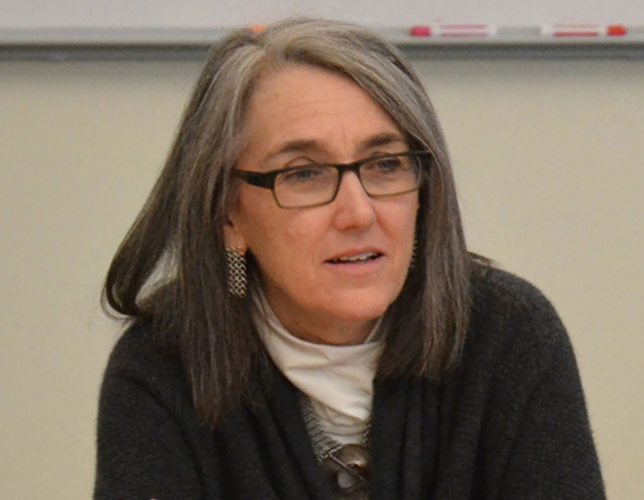
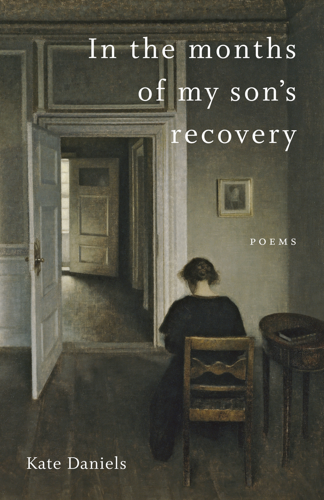


In her latest collection, In the Months of My Son’s Recovery, poet Kate Daniels surveys the difficult terrain of addiction, an affliction that seems as old as humankind, yet keeps baffling us anew. Daniels, who has published four previous collections of critically acclaimed poetry, writes from her own experience with substance abuse — not as an addict, but as someone profoundly affected by a family member’s addiction.
Daniels, who is the Edwin Mims professor of English and director of creative writing at Vanderbilt University, conducts “Writing for Recovery” community workshops in Nashville and elsewhere. She answered questions via email.
In the Months of My Son’s Recovery is focused on a mother’s experience of her child’s addiction, but it’s also a collection about aging and trying to make some peace with life’s inevitable losses. Can you comment on how those two subjects intersect in your conception of the book?
At the most general level, I guess that both of those subjects are about loss, aren’t they? Aging, of course, as you say. But addiction as well. Even if your addicted loved one doesn’t die from the affliction, or disappear from your life, there is always loss involved: loss of trust, loss of hopes for the future, loss of promise and potential, loss of health, loss of relationship, loss of the emotional intimacy of loving and caring for someone in mutual ways. Addiction kills mutuality by taking people away from themselves, as well as separating them from those who love them.
Getting older, of course, seems to be almost totally about loss: physical breakdown, mental decline, the death of friends and family, loss of earlier identities that we might have worked hard to acquire and are reluctant to shed. Like most people, I find aging to be harrowing, but it’s also kind of engrossing. It is both the most predictable, clichéd thing and also brand-new.
Addiction is the subject of a tremendous amount of social, medical and political discourse. Was it ever difficult to find your own voice in all the chatter?
You’re right: lots of “chatter” in different forms about the opioid epidemic at present. For me, the main “texts” were my inner dialogue (which was so terrifying I mostly switched it off when I could), what I heard at the 12-step meetings I constantly attended, and what I was reading about in the media and educational materials relating to addiction. All of those ultimately fed the poems when I was finally able to write them after about two years.
I don’t think I ever felt a sense of conflict between those different sources. Because I’m a narrative poet, I’m used to incorporating information into poems and accessing different sources — my own first-person voice is as important in my poems as researched facts, or the narratives of other characters.
I was struck by “Epiphany in the Atheist’s Kitchen.” How is your work shaped by your spiritual concerns?
My spiritual concerns, and my religious beliefs as an adult convert to Catholicism, are always at the center of my poetry, and my life. I was born with the gift of faith, and it has stayed with me. Who knows why? I try not to spend too much mental energy wondering about the mystery of that. … I do think that my apparently unshakable belief in the meaningfulness of our human life, and my conviction that there is a benevolent divinity at the starting point of it all, naturally inclined me to be able to make use of 12-step programs — although that is the very thing that can be a stumbling block for a lot of people.
You make it clear that the narrator in these poems is “similar, but not identical, to myself,” and yet the material is deeply personal for you. What are your guideposts for rendering personal experience into art?
While I have never written to humiliate or expose anyone in my family, I try to give myself unlimited permission and as much freedom as possible to write whatever comes up at the start of the process. But once I have a decent draft, I always interrogate myself about whether what I am writing about belongs to me, or not. If it belongs to me, I can go ahead. If I am appropriating someone else’s experience for my own ends, I can’t go ahead. I won’t.
I write to try to unravel some kind of mystery at the heart of familial relations and the extraordinarily powerful ties of human relatedness, and the deep crevices and kinks and twists and turns of the human psyche. In my opinion, poetry just can’t be used for bad purposes — it just turns into versified propaganda if you do that, the antithesis of poetry.
To read an uncut version of this interview — and more local book coverage — please visit Chapter16.org, an online publication of Humanities Tennessee.



