
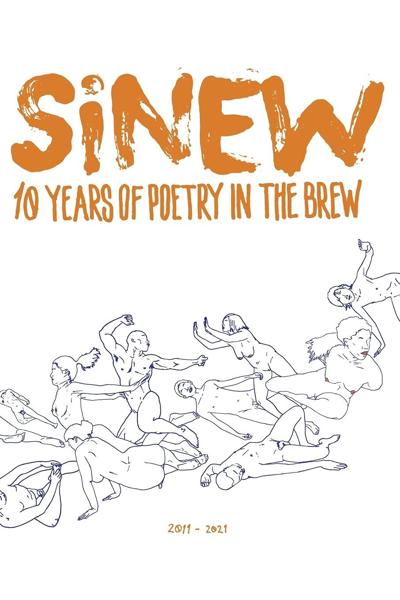


Sinew: 10 Years of Poetry in the Brew is a potent collection of public poetry. This anthology chronicles a decade of open-mic poetry at Portland Brew in East Nashville, including the group’s temporary virtual gatherings during the pandemic. Sinew was released by April Gloaming Publishing, a local nonprofit independent press that is committed to elevating consciousness about the new South. Edited by Jo Collins, Christine Hall, Matthew Johnstone and Henry L. Jones, the collection forms a sort of connective tissue that unites Nashville’s pluralistic literary scene.
Appropriately, the book contains poetry in many forms. “The Body of Water in the Bath” by Caroline Burrows is a pantoum, composed of rhyming four-line stanzas. Conversely, Reese North’s “HEROIN (A Life Cycle)” is free verse, making use of filmic imagery: “Death stands silent by his gate.”
The anthology is delivered in two incarnations: “Flesh” and “Spirit.” The poems contained in the “Flesh” section tend toward an embodied human experience. A notable work in this section is “Skin” by Donna Krupkin Whitney, a retired neurologist. This piece of writing demonstrates the poetics of science. She writes: “Beneath the brown crust / Fibroblasts creep across filaments of fibrin.” Even if the reader does not know that fibroblasts are a type of cell found in connective tissue, they can yield to Whitney’s instruction — that poetry is experienced even on the cellular level. The reader can also revel in Whitney’s skillful use of alliteration: “And enthusiastic epithelial cells link hands to make skin.”
In “Spirit,” prevailing themes tend toward ethereal. “Names.” by Serge Ray Rodrigo, Sergio Ramon Rodriguez and Sir-Reyna Lucio toys with authorship in a fluid and spiritual manner. Readers of this poem need only a few lines to discover that — though this is more readily apparent when delivered via an open-mic forum — it is authored by one poet who emerges in three faces. The lines come forth like a council of commiserating children who express frustration at the desecration of their names.
The poem opens with a declarative statement: “Sergio Ramon Rodriguez is a child.” And then it moves to a recounting of how this child has been rough-hewn by society: “The world cannot pronounce Sergio. So, I let them shorten it to Serge.” Identity is lost, or altered, as to be readable by the world’s systems of encoding. As the poem contains three speakers, it reverberates in a trinitarian fashion, so that the reader is never without advocacy or grace. The poet writes: “Serge guards Sergio” and “Serge protects everyone from… / from…Sir-Reyna Lucio.” Finally, then, it is in this cacophony of declarations that we are introduced to the voice of humanity: “It’s not just a Hispanic Latinx voice. It’s a Black voice. It’s a White voice, a mixed voice. It’s an Immigrant and a Poverty voice. It’s even a Disabled voice, and of course, a Feminine voice.” We are drawn into the triad, representing humankind, and made to understand the importance of naming ourselves.
This theme of self-determination also takes the form of poetic guidance in Tiana Clark’s “How To Write About Black People.” As the epigraph indicates, it is directed toward a white readership, but readers of all colors can appreciate the loving chastisement that Clark delivers: “Here’s how you write about Black people. / You don’t— / Start with my body.” Clark channels the particulars of Black bodies as historically depicted in various media to offer a universal treatise on writing about people. With care, the reader (who is preparing to write about Black bodies), is redirected inward: “You start / with your own, / with the gaze.” In essence, if you begin by writing about your own humanity, you will likely carry that understanding of your own nuanced existence to an examination of Black people. Aptly, Clark utilizes both shape poetry and tighter verse in the composition of this poem. The shape poetry emphasizes Clark’s admonition to white readers to loosen the knots of racial constructs; the lines are split into two diverging columns. It moves into more compressed verse, which has the effect of a plea. Clark writes: “And keep listening. And keep showing up. / And keep asking better questions about yourself / to yourself.”
At a time when politics and persecution threaten to divide, Sinew reminds that poetry will bind us together. This gathering of exceptional verse will undoubtedly garner the interest of budding and veteran poets alike. Those who value stories that are told with honesty, rebellion and love will cherish this collection.



Post a comment as anonymous
Report
Watch this discussion.
(0) comments
Welcome to the discussion.
Log In
Welcome to the discussion.
Keep it clean. Please avoid obscene, vulgar, lewd, racist or otherwise abusive language. Comments featuring hate speech or threatening or violent content will not be tolerated.
PLEASE TURN OFF YOUR CAPS LOCK.
Be truthful. Don't knowingly lie or mislead.
Be proactive. Use the “report” link on any comment that violates our comment policy.
Share with us. We'd love to hear your feedback.