
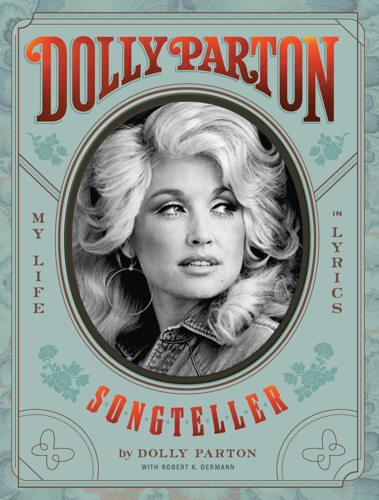
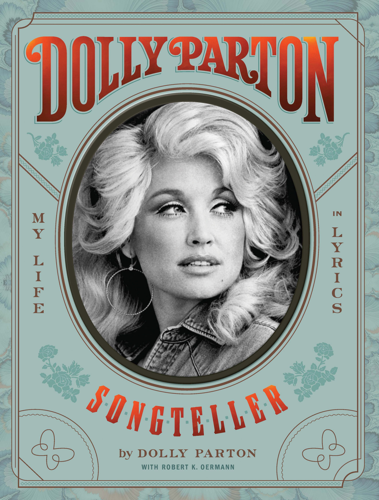


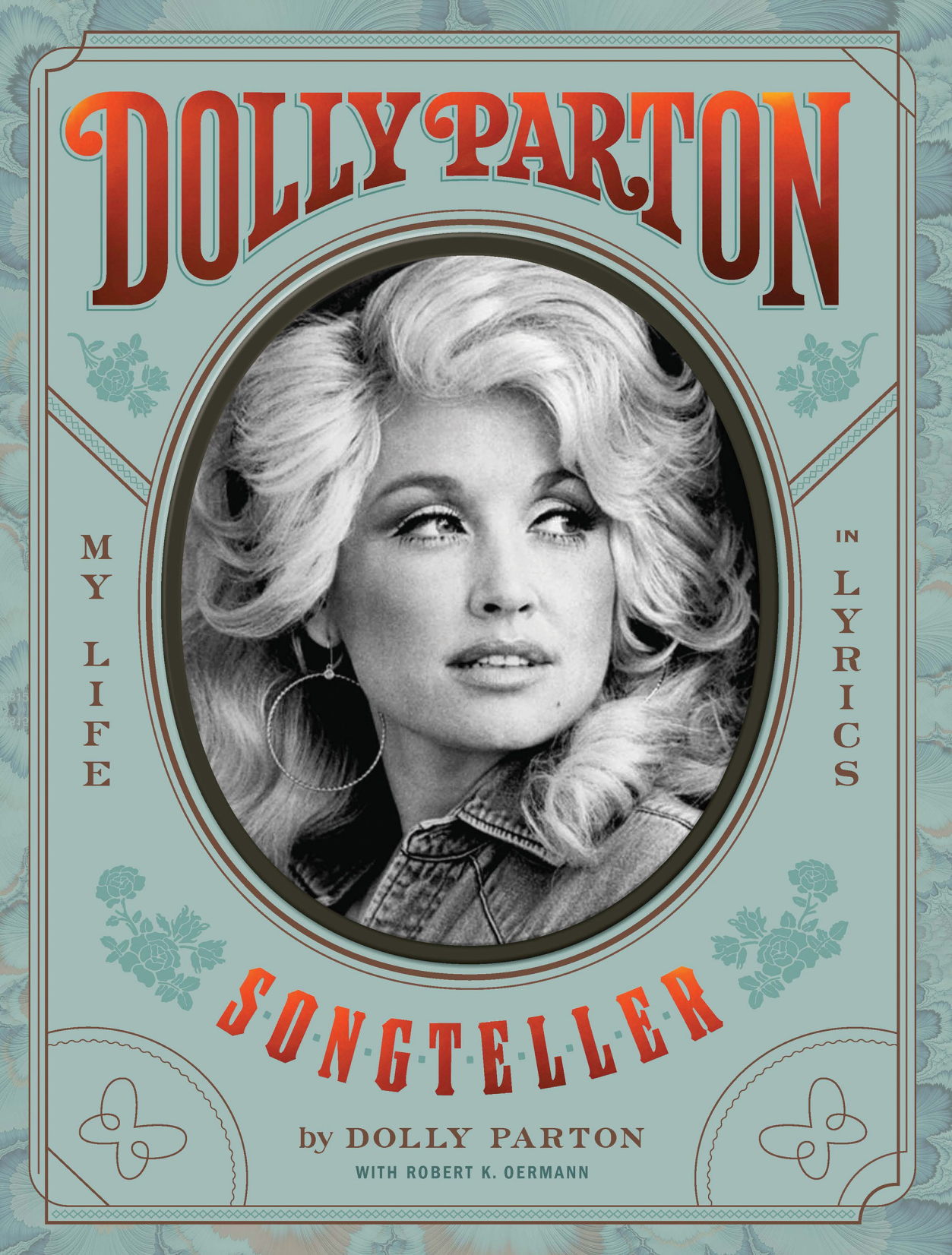
Dolly Parton, Songteller: My Life in Lyrics follows the country legend’s life and career from her earliest days growing up in Appalachia to her most recent creative ventures. Co-written by Parton and Nashville-based music journalist Robert K. Oermann, Songteller includes full lyrics to 175 of Parton’s songs, as well as unabashed anecdotes from the remarkable woman with the “Smoky Mountain DNA.”
In her roughly 60-year career, Parton’s image has gone through varying iterations in the public consciousness. She first gained attention as Porter Wagoner’s pretty young duet partner. To my mother’s generation, she’s the “Islands in the Stream”-singing, 9 to 5-starring crossover superstar with the enviable hair. To my generation, she is an icon: the winner of numerous lifetime achievement awards, and the legend with a Netflix series (2019’s Heartstrings) — she’s also the subject of a viral podcast (WNYC’s Dolly Parton’s America) — to prove her enduring relevance.
But to Parton herself, she has always been one thing above all others: a writer. In the early pages of the book, she explains: “I decided to call my book Songteller because that pretty much sums me up. I love songs. I love to tell stories, and most of all, I just love to write. It’s just who I am.”
Writer Dolly comes through in Songteller. Not only do we get to marvel at lyrics from a small sampling of the 3,000 songs she’s written, but we also get to read Parton’s take on what inspired the songs, where she was when she wrote them and what they mean to her now. Despite the book’s gorgeous and glittering embossed cover and coffee-table format, Songteller reads like a memoir. Parton’s voice — emotive and funny — kept me turning pages.
She begins with stories of her “hardscrabble” upbringing. One of 12 children, Parton was raised in Sevierville, Tenn., at the foot of the Great Smoky Mountains. At her birth, the family paid the local doctor a sack of cornmeal for delivering Dolly. Songteller includes the lyrics to “Dr. Robert F. Thomas,” which honors the late doctor’s legacy and impact on Parton and her hometown.
Parton describes her early days as a teenage entertainer, her aunts and uncles driving the young singer between Sevierville and Knoxville for radio appearances. It takes a village, as they say, and Dolly thanks the behind-the-scenes players from Tennessee who saw her off to stardom.
The pages of lyrics remind readers of Parton’s finesse as a fiction writer. She populates her songs with tragic characters: doomed lovers, poor children, small-town preachers, sex workers and alcoholics. The story often ends badly. “I’ve killed a lot of puppies and kids and ladies in my songs,” Parton writes. “I’ve killed myself a few times. I don’t want to do it in real life, but I can do it in a song. You’re safe doing it that way.”
The creative power struggle of the Porter Wagoner years brings cinematic drama to Parton’s narrative. Wagoner and Parton were a Nashville hit as duet partners, bandmates and co-stars on The Porter Wagoner Show. But the two “fought like cats and dogs.” “Those seven years of being with Porter, it was damn near like being married to him,” Parton recalls. When the two eventually split in 1974, Wagoner slapped her with a $3 million breach-of-contract lawsuit. Parton wrote a hit — “I Will Always Love You,” she explains, is about leaving Wagoner. Despite years of legal battles, the two eventually reconciled, and she still thinks of him every time the song plays.
In a lot of ways, the early ’70s were the beginning for Parton. Newly liberated from Wagoner, she reached a solo hit-making stride. She writes, “It’s possible that ‘Jolene’ and ‘I Will Always Love You’ were written on the same day.” The rest of Songteller takes us through her Hollywood stardom, collaborations with Emmylou Harris and Linda Ronstadt, and the countless projects and collaborations for which she is well-known.
Today, Parton enjoys an exceptional status that very few living entertainers know. She’s respected, worshiped and genuinely loved. She uses her songwriting as a platform to support social causes and wins young admirers with her charity, Dolly Parton’s Imagination Library. (“We’ve given away 130 million books so far,” she writes, “and it’s still growing.”) And she remains a light to older fans who have been with her since the beginning.
Parton is iconic for her prolific creative output, her fashion sense, her explosive success across media and her commitment to equality and fairness. But for me, what sets her apart is her unique genius as an artist. Pairing sky-high wigs, rhinestone suits and sharp-witted humor with gut-wrenching songs about poverty, grief and heartbreak, she is a product of her whims as much as her pain. The unlikely combination shouldn’t work — but somehow, for her, it does. After all, there is no one else like Dolly Parton.
For more local book coverage, please visit Chapter16.org, an online publication of Humanities Tennessee.



Post a comment as anonymous
Report
Watch this discussion.
(0) comments
Welcome to the discussion.
Log In
Welcome to the discussion.
Keep it clean. Please avoid obscene, vulgar, lewd, racist or otherwise abusive language. Comments featuring hate speech or threatening or violent content will not be tolerated.
PLEASE TURN OFF YOUR CAPS LOCK.
Be truthful. Don't knowingly lie or mislead.
Be proactive. Use the “report” link on any comment that violates our comment policy.
Share with us. We'd love to hear your feedback.