



Clay Risen
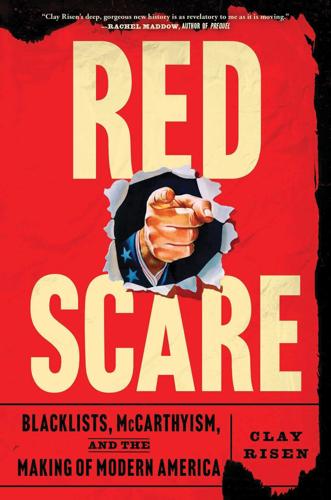
In his preface to Red Scare: Blacklists, McCarthyism, and the Making of Modern America, Clay Risen states an intention to resist “drawing parallels between the past and the present.”
In conversation, that resistance goes by the wayside quickly.
“I was struck this summer when [now Vice President] JD Vance was talking about these Haitian immigrants in Ohio who are supposedly eating pets,” says Nashville native Risen, a historian and editor at The New York Times. “When evidence was brought to show him that this is actually not true at all, he said, ‘Well, the truth of it doesn’t matter because sometimes we have to tell these stories in order to get a larger truth across.’ To me, that was exactly what McCarthy was doing.”
McCarthy is U.S. Sen. Joseph McCarthy from Wisconsin, who used the threat of communist infiltration into American politics, entertainment and elsewhere as a rocket ride to power in Washington, only to flame out when much of the threat was shown to be feverishly oversold.
We spoke with Risen in January. This interview has been edited for length and clarity.
How much of a threat to America was spying by communists in the 1950s?
It’s wrong to say that there was no threat at all from Soviet espionage, or that the American Communist Party was completely innocent of everything it was charged with doing. But I think most were relatively minor cases that should have been dealt with as law enforcement matters and counterintelligence matters. They certainly didn’t necessitate the overarching or overwhelming response from government and the private sector and the public. I don’t think that by 1948 or ’47 there really was much of a national security threat. Look at what the Rosenbergs or Alger Hiss were accused of doing. Those are things that took place in the 1930s and ’40s. That’s not to excuse away anything that they did, but to say what they did early on doesn’t justify the crackdown of the late ’40s and ’50s.
McCarthy doesn’t come across as terribly intelligent in the book. Is that a correct assessment of him?
He was a useful tool for a lot of different groups because he was willing to say stuff they couldn’t. Sen. Robert A. Taft, the Senate majority leader, wasn’t about to get out there and say the sorts of things that McCarthy was. He had too much at stake to be casting wide aspersions, but it was very useful for him to have McCarthy out there doing it. People who wanted to protect their reputations could feed stuff to McCarthy, and McCarthy was willing to say it. He became a puppet for these folks — even though, obviously, I think he did have his own volition and his own ideas about where he was going.

At least three presidents [Harry Truman, Dwight Eisenhower, Richard Nixon] and one presidential candidate, Robert F. Kennedy Sr., had roles in the Red Scare. What did their actions reveal about them?
Truman was a very capable leader, but he was dropped in midstream to a lot of issues that even a year before he probably didn’t anticipate he’d have to deal with. Truman was not in over his head, but I think he was ultimately a little naive. He had faith that the American public was too smart and had too much common sense to be drawn in by the far left and communism, or on the other hand, to be drawn into red baiting and the Red Scare.
It was President Eisenhower who ultimately took McCarthy down. How did he do it?
Essentially, he created a compromise where he reinforced the establishment and pushed aside the far left and far right. That was very much 1950s consensus building. Eisenhower does stand to me personally as something of an admirable character for just ultimately having faith in the establishment and in the ultimate wisdom of moderation. That at least temporarily won the day, but there’s a case to be made that had he taken on McCarthy more aggressively, he could have done more to disabuse more people of these conspiracy theories and witch hunting.
Is there any threat that we could face where you would support taking away civil liberties of Americans, which happened back then?
There’s always a balance between civil liberties and national security. I’m not an absolutist in that sense, but I think with the Red Scare, it illustrates that it’s very easy, once excuses are offered, to make a case for taking away civil liberties. It’s very easy for that to steamroll into overreach on the part of governments at all levels.
To read an uncut version of this interview — and more local book coverage — please visit Chapter16.org, an online publication of Humanities Tennessee.



Post a comment as anonymous
Report
Watch this discussion.
(0) comments
Welcome to the discussion.
Log In
Welcome to the discussion.
Keep it clean. Please avoid obscene, vulgar, lewd, racist or otherwise abusive language. Comments featuring hate speech or threatening or violent content will not be tolerated.
PLEASE TURN OFF YOUR CAPS LOCK.
Be truthful. Don't knowingly lie or mislead.
Be proactive. Use the “report” link on any comment that violates our comment policy.
Share with us. We'd love to hear your feedback.