


Five years ago, Australian filmmaker Jennifer Kent shocked audiences into paying attention with The Babadook, one of the most acclaimed directorial debuts of the past decade. It was one of the first films belonging to a new wave of horror movies with no fixed name — “prestige horror,” “arthouse horror” and “elevated horror” are among the labels this loose movement has received. It’s a diverse lineup — from A24 productions like Hereditary to studio movies like A Quiet Place and Get Out — but what they all share is a certain seriousness. These horror movies don’t just give you blood, guts and jump scares. They come with Meaning and Themes.
Case in point: The Babadook’s titular monster, a storybook phantom come to life, isn’t just a beast under the bed, but rather a clear metaphor for the protagonist’s parental anxieties, a little like Eraserhead with a single mom. No matter how serious The Babadook or its message, you might know the film because of its much more lighthearted second life as a viral phenomenon. Several years after the movie’s release, a Tumblr user posted a screenshot of Kent’s film listed under Netflix’s “LGBT” section, which led shitposters the world over to proclaim the Babadook a queer icon.
I can’t claim to know what Kent feels about that film’s humorous following, but it’s safe to say that The Nightingale, her second feature, stands no chance of becoming a meme. The monsters in The Babadook were supernatural, but here they’re historical — the true horrors of the past are oppressive and overwhelming, with none of the expected release from tension that horror movies are often structured to provide.
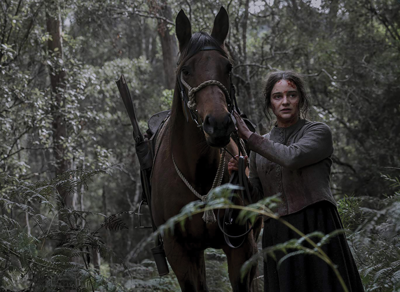
The year is 1825, and the English crown’s attempt to terraform Australia into a floating prison through the ethnic cleansing of the Aboriginal people is well underway. Australia’s flora and fauna are infamously unforgiving, but here the English are the real menace. Our protagonist, Clare, is one of the many Irish convicts forced to carry out a sentence of indentured servitude on the inhospitable island. She has a husband, a baby and the voice of a songbird, but her entire existence is pain.
At this point, I feel like it’s my obligation to inform you that, in addition to a few other scenes of punishing physical violence, Clare is graphically raped three times by her master and his cronies within the first 20 minutes of The Nightingale. Whether or not you appreciate or can even engage with the rest of the film really hinges on your response to that opening.
From there, the violence continues, clumsy and bloody and cruel. Clare’s nightmare finally breaks her, and pushes her to seek violent revenge against her masters. To hunt them down, she must befriend an Aboriginal tracker named Billy. Billy is extremely hesitant to even interact with a white person, let alone help one, and with good reason. But the duo finds a shared kinship in their mutual oppression under the English. The Nightingale is at its best when it ceases to be a horror movie or a period piece and instead becomes a buddy comedy about two people bonding over how much the English have ruined their lives. What Billy and Clare share is the language they have both been forced to speak; Clare finally earns Billy’s trust by expressing her furious contempt for the crown in her native Gaelic, a language that was literally made illegal.
Kent succeeds more in exploring the aftermath of violence, in how colonialism erases and rewrites entire cultures, than she does in studying the act of violence itself. As a genre experiment, The Nightingale pales in comparison to something like Lucrecia Martel’s Zama, which depicts the colonial encounter as a bizarre science-fiction experience. At every turn, the cheap stock imagery of horror movies — like dead animal carcasses and dream sequences in which everything seems hunky-dory until somebody’s face falls off — are there to ensnare us like the venomous beasts camouflaged by the Australian bush.
This is post-colonialism as a rape-revenge movie, a conceit that’s regrettably more intriguing in the abstract than in execution. Brutal karma might come for Clare’s individual assailants, but her personal revenge is no substitute for reparations. Though Billy and Clare are bonded by marginalization, it feels a little odd to me to make a white indentured servant the avatar of suffering under the British in Australia, even as much as the Irish have suffered. The extremity of the violence perpetrated against Clare ultimately feels intended to represent the violence perpetrated against all people under colonialism, cheapening her own experience.
Ultimately, it’s meaning that weighs Kent’s filmmaking down more than genre conventions. Kent was able to lasso the titular menace in The Babadook into an analogy, but historical trauma doesn’t fit her storytelling framework quite so neatly. Clare is colonialism’s Final Girl. The physical, sexual and emotional violence perpetrated against her, no matter how real it might feel, is — like the Babadook — still just an easy metaphor.



