
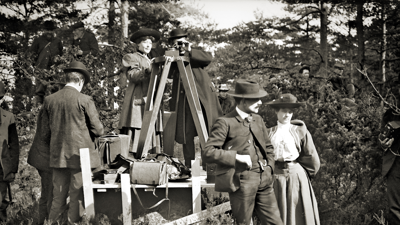


With Be Natural: The Untold Story of Alice Guy-Blaché, director Pamela B. Green investigates the scope of the life and work of cinema's first female director, screenwriter, producer and studio owner, Alice Guy-Blaché. She is credited with inventing the close-up shot and the process of post-production color tinting. She was the first filmmaker to synchronize sound and film. She boldly experimented with visual effects, and she used interracial casts. But she was widely watched not only for these innovations: Her films are emotionally engaging, humorous and satirical.
So why have so few people heard of her?
As a young woman, Guy-Blaché was a stenographer for the engineer and inventor Léon Gaumont, whose company produced photography equipment. When the Lumière brothers held their first private screening of projected motion pictures in 1895 in Paris, Guy-Blaché (then Guy) was in the audience. These first films were made to demonstrate the new technology; the silent documentaries were less than one minute long and showed scenes from everyday life, such as people exiting the Lumière factory at the end of a workday. But Guy wanted to take the medium further and use it to tell stories. Gaumont gave her permission to try her hand at making short motion pictures, as long as she stayed on top of her secretarial duties. Thus an innovative director was born.
Green’s documentary is full of suspense. She races around the world collecting information from historians, archivists and descendants of Guy-Blaché. A taped interview of the director’s daughter is restored. A facial-recognition expert is employed. And all the while, contemporary filmmakers and editors reflect on Guy-Blaché’s legacy, sometimes as they learn about her for the very first time.
Guy-Blaché was all but forgotten in the film canon. While Be Natural is foremost a celebration of the critical work of a pioneer, it also poses some uncomfortable questions. Who writes the history of cinema? Who decides who and what is worth remembering? How do we preserve the stories of all pioneers, especially if they are women and people of color?
It’s easy to feel grim about gender parity in the film industry. The advocacy group Women in Hollywood cites the following stats: Of the 100 top-grossing films of 2018, 96.4 percent of the directors were men; women accounted for 36 percent of major characters, and 35 percent of all speaking characters.
In the 500 top-grossing films, women represented 15 percent of directors, 19 percent of writers, 6 percent of cinematographers, 29 percent of producers and 23 percent of editors. Here’s a depressing infographic from New York Film Academy’s blog about gender in Hollywood, including the statistic that in the top 900 films from 2007 to 2016, only 12 percent featured a gender-balanced cast. When it comes to women of color, these numbers plummet. Just six black directors helmed the 100 top films. Only one was a woman.
Contemporary critics are writing the history of film right now, and how are we doing? According to Women in Hollywood, of reviewers who wrote at least three reviews during March, April and May 2018, 68 percent were men. Here at the Scene, of the 31 new releases we reviewed this year, six reviews were penned by a woman.
“We’ve written an incomplete history, and that’s what we’ve used for the last 50 years of cinema studies,” says film archivist Dino Everett in Be Natural. “And now that we’re learning more about people like Alice and others that haven’t been written about, instead of making them a priority, we’re still preserving Metropolis 20 times.”



Post a comment as anonymous
Report
Watch this discussion.
(0) comments
Welcome to the discussion.
Log In
Welcome to the discussion.
Keep it clean. Please avoid obscene, vulgar, lewd, racist or otherwise abusive language. Comments featuring hate speech or threatening or violent content will not be tolerated.
PLEASE TURN OFF YOUR CAPS LOCK.
Be truthful. Don't knowingly lie or mislead.
Be proactive. Use the “report” link on any comment that violates our comment policy.
Share with us. We'd love to hear your feedback.