
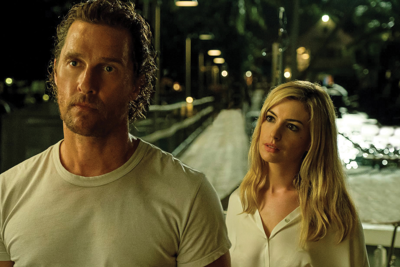


For moviegoers who have seen all the Oscar-nominated films — or don’t care about them — winter can be a dull wasteland. It can also be a time when Hollywood takes rare chances, releasing left-field genre movies that would be pummeled by mega-budget superhero adaptations in the summer. Steven Knight’s third directorial effort, Serenity, is one such effort.
It starts like a particularly clichéd update on ’90s neo-noir and erotic thrillers. Our hero, Baker Dill (Matthew McConaughey), is a macho Iraq War vet who now makes a living on the imaginary island of Plymouth as a fisherman. He takes tourists out on his boat — called, what else, Serenity — and dreams of catching the big fish, which is mentioned around 50 times. When he talks about taking a shower, he really means nude dives off a cliff into the sea. He also drinks as much as a Hemingway character — or maybe Hemingway himself. Enter femme fatale Karen (Anne Hathaway), Dill’s ex-wife. She offers to pay Dill to take her crass, abusive husband Frank (Jason Clarke) out for a ride and dump him into shark-infested waters.
Jess Hall’s cinematography is hyperbolically pretty and colorful, even beyond typical depictions of the Caribbean. But Knight has an odd tendency to alternate between extremely long drone shots and close-ups, edited back and forth jarringly. Both the camera movements and the soundtrack swoon dramatically — to the point of approaching melodramatic Douglas Sirk levels — when one female character is introduced. In retrospect, this artificiality is purposeful. The talent Knight has shown in the past as a writer and director makes it pretty clear from the start that Serenity is completely self-aware about tackling the narrative tropes it uses.
In 2013’s Redemption, Knight got a rare dramatic performance from Jason Statham. Knight’s second film, Locke, upped the stakes by telling the story, in real time, of a man going through several personal crises while talking on his phone and driving. It transcended gimmickry through the strength of Tom Hardy’s performance and Knight’s use of subtly stylized lighting and reflections through the windshield to vary the experience. Point being, this is a creative filmmaker.
Serenity is entertaining, indeed laugh-out-loud funny. When it takes a big turn halfway through, its intent is less clear. It’s quite possible that Knight wants to make a deeper parody, this time digging into the clichés of post-Philip K. Dick/Videodrome/The Matrix “Is this the real life? Is this just fantasy?” science fiction. If Knight is serious about the sci-fi turns that are hinted at, Serenity is a lesser film, because it’s no more profound than a lot of generic cable fare, even if it’s much more exciting.
Serenity takes a really misguided turn in its final 20 minutes. The film never stops trying to mess with the spectator’s head, and I suppose Knight deserves some credit for not returning to consensus reality. However, this kind of confusion-by-design was far more subversive back when when Cronenberg’s Videodrome was released in 1983. Knight’s use of several different genres as an ironic, postmodern playground is genuinely pleasurable. Still, his script’s references to Shakespeare and Magritte and hints of religious allegory play as mere fodder for reviews like this one, or perhaps future academics writing papers on “Gnostic Imagery in Cinema of the 2010s.”
Serenity feels much less flippant when it explores the possibilities of storytelling than it does when it attempts to evoke trauma. Still, this only tastes sour in the film’s final stretch, when it asks us to care about Baker Dill and his family. In its first 90 minutes, Serenity is the kind of fun whatsit that is so often unfairly relegated to Netflix or iTunes in 2019.



