
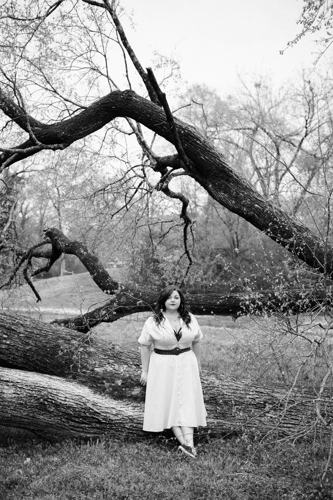
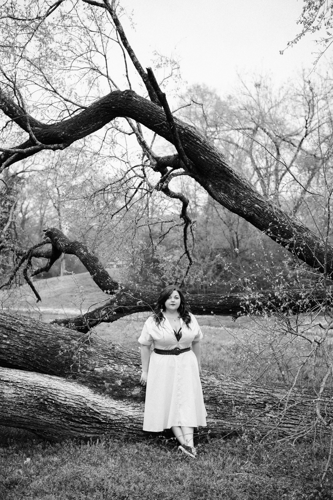
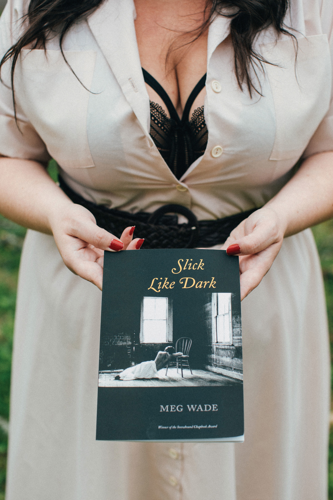

When Meg Wade was in graduate school at the University of Arizona, someone in her poetry workshop called her a “bad woman” — not because of how she conducted herself, but because of the poems she submitted to the class. Wade, an East Tennessee native, writes about faith, desire, violence and the Southern landscape. Her new chapbook Slick Like Dark implores us not to look away from darkness, but to explore what we find in the darkness, and use it for survival.
The book begins with the “banjo claw-hammer horror” of a young woman being raped in a restaurant basement, her skull bashed into a shelf full of peach cans. “A lady carries around this darkness until she gets tired,” the poem reads. “I am so tired.”
In the next 15 poems, the woman tries to take her sexuality back, to feel that her body is hers again. In the process, she finds that grief and desire are twin sisters, and she demands to know where God is in all of it. Slick Like Dark can be read in one sitting — and re-read later on — because the speaker’s journey out of the dark has a narrative arc that reads more like fiction.
The chapbook is dark, but not bleak. It’s grisly, but not morbid. Wade writes: “If something is beautiful / it’s frightening.”
Wade is the co-founder of the poetry-events engine Be Witched, and she teaches poetry at The Porch Writers’ Collective. She also runs the Poetry Prescription Service. For $10 per month, Wade will send you a poem by a contemporary poet each morning, along with a prescription for getting through the day. One reads: “If you can visit horses, go see your horses. If not, call your neighbor, drink your coffee, butter your bread.” You can subscribe by emailing rxpoetry@gmail.com.
The Scene talked to Wade about Slick Like Dark, sex, Dolly Parton and what poets can offer during challenging times.

How did you go about putting Slick Like Dark together?
I grew up watching the Grand Ole Opry at my Mimi’s house, watching Dolly Parton and Patsy Cline, all these women who would take the stage and tell these incredibly vulnerable stories. You know, Dolly Parton is 4-foot-8, and when she sings on that stage, you can’t take your eyes off of her, right?
I went to grad school writing like old, dead white dudes. Finally, I had a professor who said, “Why don’t you write like you talk?” I started going back through all these old influences. I started talking to my mom more. I started talking to my grandmother more — these women that are poets but not writers. The way that they use idioms in their everyday [lives] was super inspiring, like that line [in the chapbook] “even a blind hog finds an acre every now and then.” My mom says that all the time ’cause she gets lost when she drives.
Setting is a big part of your book, both regionally and in a smaller sense, on a single-blade-of-grass level. Where did you grow up, and has it made its way into your poetry?
I grew up in East Tennessee in this little town called Maryville, in Blount County. It’s right at the foothills of the Smokies, maybe 10 miles from the Smoky Mountains National Park. I spent a lot of time in the park and in those woods and those creeks and those rivers and in that sort of dark space. I never wrote about the South until I left the South. ... And then all of a sudden, I would look at the mountains in Arizona and … see every little nook and cranny. And I would think back to the mountains that raised me and how secretive they were and how dark and how things were hidden. You could see them, but they were always covered by trees. You would walk through these rhododendron tunnels and you could barely even see the sky. That had a huge effect on the way that I was going to tell the story, because the landscape was such a character. I needed to be able to create this place that did feel dangerous. … There was always some sort of a threat.
Lately it seems like the only stories to tell are ones of struggle and resilience — or maybe those have always been the stories we tell. But Slick Like Dark definitely shows a narrator living through hell and eventually coming back to herself. Was writing these poems healing for you?
Writing the book definitely changed me, the same way that violence changes people. I didn’t mean to write this book. … The whole chapbook was born out of the line “Desire is a miracle. Here, let me show you.” That was like, All right. This is the meat. This is what I’m trying to get at. I knew if I had a responsibility to show somebody this darkness and this grief and this loss, I had the same responsibility to show them the light and to show them how to come out of that in one way or another, even if it’s only momentarily. Desire and the body was how I could get there.
Your poems are extraordinarily embodied. Women’s bodies are sites of struggle because of violence against women, because cultural and political wars are waged on our bodies and whether we have control over them. Can you speak on how this has become such a part of your work?
For so long I sort of ignored that part of me that could be open about my sexuality because it had encountered violence, and it could be such a source of shame. … I grew up in a very small town in the South, and you couldn’t be open about these things. Once I started writing this book and really took a look at the things that made me feel empowered in my body and in my sexuality, I felt more and more comfortable making those ties between landscape and the body — especially between female bodies and the Southern landscape and how both of them are sites that have been romanticized, but they’ve also seen so much violence. I wanted to be able to lace them together in a way that I and maybe other people could understand, so it didn’t feel so lonely. I’m a person who really enjoys sex. I’m a person who has found my way back to myself through sex. There’s a reason we say Oh God when we have sex. There’s a divine presence that lives very physically, and I wanted the poems to be shaped through that river.
What role can poets play in the world right now?
I think reading a poem is an act of belief, and therefore writing a poem is an act of faith. … I wrote this horny book of sad country songs. I thought to myself, “Well, shit. Why would anyone want to read a horny book of sad country songs right now?” But maybe if the book makes them feel anything, then that’s something. I know for me there are days that I just want to numb out, but I also know that I’m not built for that. I’m built to step up and say, “Let’s feel some things. Let me give you the words to feel some things.”



