
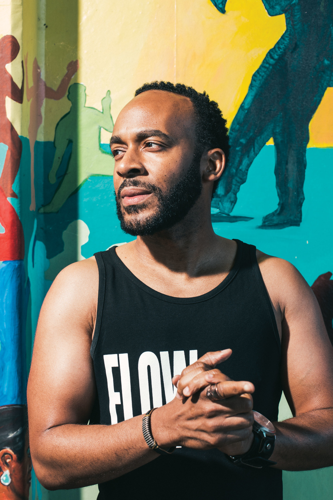
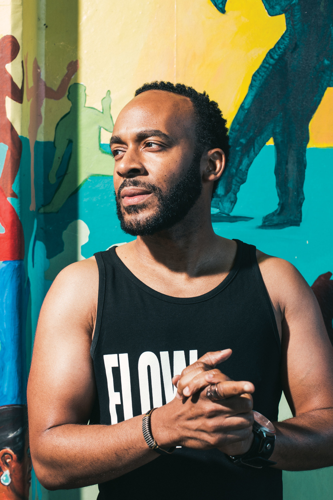


Rapper, actor, activist and spoken-word artist Rashad Rayford (aka Rashad Tha Poet) has been crossing genres in Nashville for 15 years. A veteran of the Nashville hip-hop community, Rayford matches agile raps with soulful jazz. He’s also a mentor with youth-development organization Southern Word, a public speaker and an outspoken member of Nashville’s black community. In the time of the coronavirus pandemic, he’s adding public-health advocate to his résumé.
In a Tennessee Department of Health public service announcement currently airing on TV and viewable online, Rayford addresses the strength and resiliency of black and brown communities while paying tribute to essential workers. The commercial shows photos of health care workers, delivery drivers, grocery store employees, public transit workers and more, and Rayford recites a short poem called “We Will Survive,” which reads as follows:
In the midst of this trying tribulationOur actions have risen to the occasion
Communities colliding like solar systems to heal souls with wisdom
Staying safe and willfully volunteering a smile
The black and brown faces of Tennessee who face this head-on
We are resilient, we are strong,
and together, we will survive.
“It is hitting our community really hard,” says Rayford, “[and the department is] trying to get people educated on how they best can go about being safe. I wrote a piece that speaks to people trying to connect together and use their resources to help in any way possible, but also to [recognize] the people on the front lines. People in our community are usually the ones working essential jobs, so they are more likely to be exposed to this virus.”
Across the nation, hospitals have reported that black COVID-19 patients are dying at rates disproportionate to the population. Racial, ethnic, geographic and economic inequalities that create barriers to care under normal circumstances are now exacerbated, and state officials are looking for ways to be responsive to these communities. The Tennessee Department of Health’s new marketing campaign targets racial and ethnic minorities across the state with a series of commercials that now air on TV and radio stations, and are also being pushed out on social media.
The initiative is the result of a new state task force created by the Office of Minority Health and Disparities Elimination. According to the office’s assistant commissioner, Kimberly Lamar, the task force is charged with lifting the burden of health disparities across the state during the COVID-19 pandemic and beyond. The task force builds upon existing relationships that the office has with a variety of faith community partners, academic health centers and colleges — particularly historically black colleges and universities — as well as other state and external health care programs.
“We have to get away from the one-size-fits-all model in terms of where our messages go,” says Lamar. “We usually send all of our messages through a portal, and they go to whomever they reach in a way that isn’t targeted. A barrier there was that we needed to know, who are the gatekeepers for the community? Where are they receiving information? What are the local newspapers?”
In Tennessee, the rates of infection among racial and ethnic minorities have been roughly proportional to the population, though the rate of coronavirus-related deaths among black Tennesseans has been higher. The U.S. Census’ most recent estimate puts the state’s black population at 17.1 percent. Last week, the state reported that 20.8 percent of those who tested positive for COVID-19 are black. Black patients account for 29.2 percent of coronavirus-related deaths. Hispanic and Latino residents — who make up 5.6 percent of the state’s population — account for 8.7 percent of cases and 2.6 percent of deaths. However, the state’s testing capability has only recently become more robust, and these numbers may continue to change if the task force is successful in encouraging more people to get tested. Also, experts suggest that the lack of comprehensive testing nationwide may be undercutting the reported death toll of the virus.
Rayford notes that black Americans often face psychological barriers as well. The ugly history of race and health care in the United States compounds the challenges that many black Americans have experienced when attempting to receive care in the past. The existence of implicit medical bias is well-documented. People of color who haven’t felt cared for by the government in the past may have difficulty putting their trust in a system that they feel has failed them.
Lamar agrees that building trust is one of the task force’s challenges.
“We are a trusted entity,” says Lamar. “We need to show that we hear the community, we hear your voice, we hear what you’re saying — and show that we are responding to that. It’s the only way we’ll be able to gain their trust. [It may not be] until they see that their voices are being heard and that we are responding to them, and it’s evident in the work that we do, it’s evident in how we communicate, it’s evident in how we design our programs, it’s evident in our outcomes. … It’s going to take time, but that’s the reason that we’re doing this.”
Other commercials in the campaign address prenatal care during the pandemic, social distancing, testing and how to use resources on the Tennessee Department of Health’s website. You can watch them all — most of them in both English and Spanish — on the state health department’s YouTube channel.
The department plans to keep the task force operational in the future, once the pandemic is over. “COVID is a conversation starter, and we’ll immediately be addressing the COVID response,” says Lamar.
But, she says, it will be a “continuing conversation.”



