

The Frist Center's fetching invitation for its newest exhibits is printed in the shape of a 45 rpm record. The A-side announces Warhol Live, the music-centric blockbuster that inspired the invitation's design. The B-side of the card announces Projected Histories, an accompanying exhibit by Vanderbilt assistant professor of art Vesna Pavlovic. Her show opens Friday in the center's Gordon Contemporary Artists Project Gallery.
Projected Histories is an exhibition of conceptual photography that examines historical perceptions of the medium, the diaristic implications of photo-taking, and the deconstruction (and reconstruction) of the film surface itself. It's an apt complement to the Warhol extravaganza, and just like with a favorite 45, this B-side will have viewers returning for multiple spins.
Pavlovic's multidisciplinary background, which includes photojournalism and cinematography, is one of her great strengths. Both practices leave their traces in this show, an overview of recent work as well as a metaphorical catalog of the artist's most ardent themes.
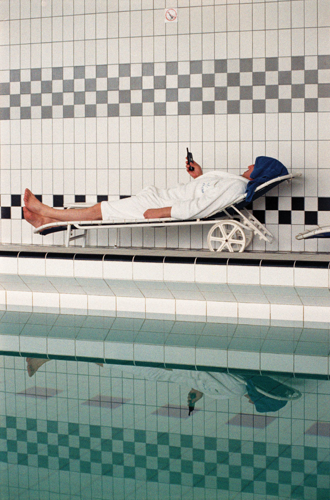
"Herzlich Willkommen Im Hotel Hyatt Belgrad, April 1999" is the show's signature image. It features a man in a spa robe, poolside on a chaise lounge, checking his cell phone messages. But the photo's true subject is given away by the date and location in its title. While the man is relaxing, the war raging outside his hotel had only weeks before been heightened by the NATO bombing of Yugoslavia, Pavlovic's home. Pavlovic snapped the shot while covering the war as a photojournalist. Like many of the images on display, it's not what it appears to be: What seems like a casual, candid tourist photo is actually the documenting of a war.
"Hotels" is a series of interior shots from abandoned Yugoslavian hotels. It demonstrates Pavlovic's understanding of her work as an "anthropological quest," and while the modernist interiors in the images speak to the aspirations of Yugoslav socialism, the bleak spaces and faded colors testify to the movement's slow failings more than its high ideals. While the images are a reminder of photography's capacity for capturing the past, they're also another example of Pavlovic's tendency to point to one thing by showing the viewer another. "They're not pictures of architecture," she told the Scene recently. "They are conveyors of the psychology of their times. They're about history. They're not about hotels."
One of the show's most interesting sections features photos that Pavlovic didn't even snap herself. "Looking for Images" is a selection of slides that were photographed by an unknown American tourist. Pavlovic rescued the slides as they were about to be thrown away during the digitization of Vanderbilt's archives, and they are displayed using a light box. Frist Center executive director and CEO Susan Edwards wrote the exhibit's gallery brochure essay, and her commentary is particularly perceptive regarding Pavlovic's propensity for cinematic allusions. "Pavlovic's sequential grid of the slide images suggests film rate, the imaging device of running twenty-four (or more) frames per second of still images to create the illusion of movement," she explains, adding, "In the hands of contemporary artists such as Jeff Wall, backlit transparencies have been described as single-frame cinematic productions."
These images are juxtaposed with the artist's "Watching" series — photos of crowds watching basketball games. Yugoslavia is passionate about the sport, and some of the shots capture Pavlovic's home crowd watching big-screen TVs in Belgrade as Yugoslavia beat the U.S. in the World Basketball Championship in Indianapolis in 2002. For these spectators, the game was a strike back at America for NATO bombing attacks. Just as Pavlovic's hotel images are really about Yugoslav socialist aspiration, her basketball photos are about national pride, collective pain and much bigger victories and defeats than any scoreboard could suggest.
Pavlovic's "Show Homes" series brings the exhibit full circle, back to idealized interiors and the ambitious dreams they represent. There are no images of Yugoslav hotels here, however; these are staged settings of luxurious American model homes. Half dream, half commodity, a model home is a space where aspiration is represented in unreal environs. Edwards compares the photos to "vanitas or memento mori — reminders of the impermanence of our accomplishments and possessions as well as our inevitable mortality."
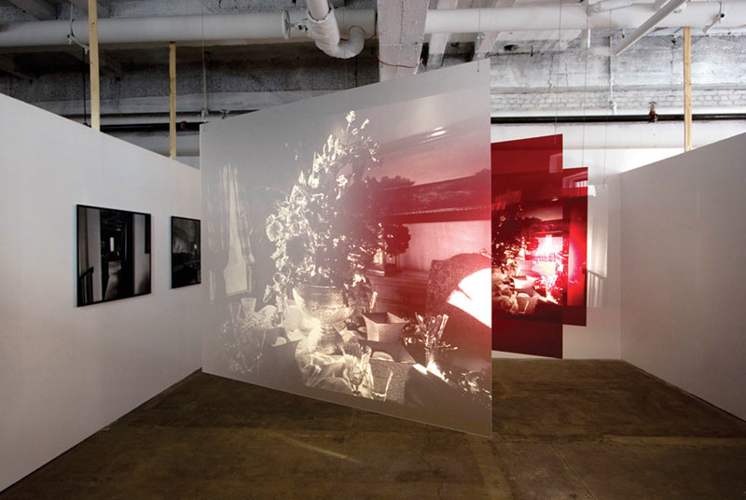
In a corresponding installation, Pavlovic draws attention to the film medium itself, creating sculptural space out of the component parts of two-dimensional images. With "Display, Desire," the artist projects black-and-white images of model home displays onto suspended red and semitransparent white Plexiglass panels that reintroduce color to the monochromatic photos. Viewers can walk between the panels, catching glimpses of their own reflections as a slide carousel clacks forward to the next image. "You become a part of it," Pavlovic says. "You get in there and you find yourself between the layers of the photographic image." It's also a bit like stepping into the body of the slide carousel: caught between pictures, living and dying with each flashing blast of imagery and every dark shuffle in between.
At one time, history and the pictures that documented it went unquestioned, and photography's ability to represent reality, in a way that pigments on a surface never could, signaled the first "death of painting." Nowadays, most of us understand that the messy truth of history is found in a collision of contradictory and subjective stories, and photography has similarly come to be seen as a malleable medium that creates truths as adroitly as it captures them. Today a picture is still worth a thousand words. But what words? Whose words? And why?
Email arts@nashvillescene.com.



