
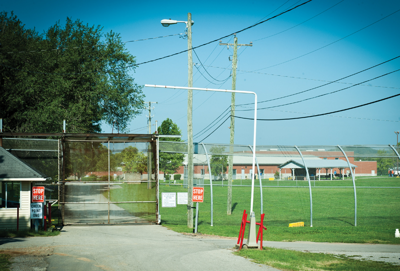

Woodland Hills Youth Development Center is not supposed to be a prison. Or at least it's not supposed to sound like one. When Tennessee Department of Children's Services officials talk about the state-run facility, located off Stewarts Lane in northwest Nashville's Bordeaux community, they use educational terms. They refer to the juveniles it houses, for example, not as inmates but as "students."
And yet when dozens of those students fled and rioted last week, in a series of incidents that focused national attention on the facility and its surrounding environs, nobody used the word "truancy" to describe the situation. Woodland Hills was the site of a jailbreak, plain and simple. Moreover, those who bolted its confines weren't playing hooky. They escaped.
In recent years, facilities such as Woodland Hills have come under scrutiny as uneasy hybrids of educational institutions and reformatories. Those concerns only intensified after the events of Sept. 1. Around 11 p.m. that Monday night, a large group of juveniles left their dorms. They began gathering in the outdoor yard at the center of the campus.
Security guards at the facility are unarmed. They are not authorized to use force against the youths, the way they would be at a prison. So while they tried to contain the mounting chaos, they were unable to stop some 32 students from crawling underneath the perimeter fence. The students escaped. The unrest flared up again days later, as another group of teens left their dorms. A mini-riot erupted, with students reportedly brandishing fire extinguishers and attempting to break into other buildings.
Most of the escaped teens were found the next day or turned themselves in. At press time Tuesday night, three remained at large, all either 17 or 18 years old and carrying a variety of charges on their records. (Most were nonviolent, though one fugitive carried a battery charge.) Metro police urged the public to assist the authorities, not the fugitive youth.
"Without assistance from others, these remaining five do not have the resources to continue sustaining themselves," Metro Nashville Police Chief Steve Anderson said last week.
It's still not clear what brought about the unrest and escapes, if any reason exists beyond the pressure-cooker environment created by trying to keep troubled teens confined. Rob Johnson, director of communications for DCS, says the department's basic impression is that the youth wanted to leave their dorms just as a smaller group did in May, and that they spontaneously decided to make a break for it when they realized the perimeter fence was weak.
But officials are still conducting interviews with youth and staff at the facility. In the meantime, the breakout has done nothing to allay the worries of Bordeaux residents. According to Lonnell Matthews, the area's Metro Council representative, they see Woodland Hills as another in a long line of civic inconveniences the city has banished to their neighborhood, from landfills to detention centers.
"There's a sense that we tend to get things that aren't wanted, but still don't get other amenities that would be welcomed by the community," Matthews said. "Those aren't the type of the amenities that are proposed for the area or that developers look to put in the area."
A drive from one end of Stewarts Lane to the other, cutting through grassy fields just inside the northwest bend of Briley Parkway, is hardly a cruise down a superhighway of hope. It carries you past the Tennessee Prison for Women, the maximum security home for Tennessee's female felons; their population includes Christa Pike, the only woman on the state's death row. It carries you past an Insurance Auto Auction site, where cars salvaged from wrecks or theft sit waiting to be put on the block.
It also leads you to the Woodland Hills Youth Development Center, which houses delinquent male teenagers with multiple felonies. The Scene's request for a tour of the facility was declined, with Johnson citing the recent unrest and a high number of similar requests from other outlets in recent days. From the outside, though, Woodland Hills doesn't exactly look like a prison. At the same time, the high perimeter fence isn't what you'd find at a typical school.
Even so, school is how the state wants the public to think of the facility. In a recent interview with WPLN, spokesman Johnson said DCS was "shifting away from using lockup facilities in the way they may have in past decades," citing the emphasis on rehabilitation and therapeutic services at Woodland Hills. According to DCS, the goal of such facilities in Tennessee is "building skills that allow each student to move to a less restrictive setting as soon as possible.
But juvenile detention facilities like Woodland Hills have raised concerns by modeling themselves after adult prisons, despite the euphemisms used to describe them. That case was made forcefully by award-winning journalist Nell Bernstein in a round of publicity this summer for her book Burning Down the House: The End of Juvenile Prison, which included horrifying accounts of the rampant sexual abuse in such facilities.
Woodland Hills has not been immune to such charges. A timeline of troubles at the facility, published by The Tennessean this week, notes a spike in violence that prompted an internal review in 2012. In an article last week, Slate recalled a 2010 investigation by the daily that found allegations of sexual abuse by female staffers.
Some state legislators have pointed to the closing of the Taft Youth Development Center in 2012 as a key factor. That facility was reserved for the state's most violent youth offenders, but it was also the most expensive — making it a prime target in a cash-strapped state looking for savings.
Republican state Rep. Cameron Sexton fought his own party on the floor of the House that year, trying to keep the facility open. At the time he cited the jobs and the service it provided. In a letter sent last week to interim DCS Commissioner Jim Henry, reported by WPLN, he said he felt "very confident that if Taft was still open, these incidents would not have happened."
Johnson notes that Henry was not commissioner when Taft was closed. But he's not likely to reopen it, the spokesman explains, given that the three remaining youth facilities are not at capacity.
"The department clearly is moving toward a way that reflects best practices, which is for those kids who can get more community-based treatment closer to their homes, in smaller settings, that's the way we'd prefer to go," Johnson says. "What we have to do, though, is make sure that the three [Youth Development Centers] are secure."
Toward that end, Johnson says the department is working to fill vacant staff positions and install a concrete strip at the base of the perimeter fence. A Department of Corrections Strike Force has been at the facility, authorized to use non-lethal force if necessary, and security experts from the department have been on site reviewing security measures.
Such measures, however, only point out the blurred line at Woodland Hills between education and incarceration. Even at its best, the facility is somewhere in between, which makes the approach to security a challenge. Treat it too much like a prison, and it can't be a school. Treat it like a normal school, and it may end up with riots like a prison.
"Clearly, if the students don't feel safe, if the staff don't feel safe, if there's not security, if you don't have that basic level of security, then you can't do the other difficult work that you have to do, which is get these kids educated, attend to their mental health needs if they have them, attend to their well-being," Johnson says.
At the same time, he adds, some of the youth there are potentially dangerous.
And all this sits on Stewarts Lane, amid a community that has long suspected its chief importance was housing the stuff the rest of Davidson County didn't want in its own backyard. Matthews, who represents the area, says he's heard from constituents concerned about the safety of the neighborhood after the escapes. That topic was on the agenda at a community meeting held by state Sen. Thelma Harper on Tuesday night.
Asked about the sentiment that the Bordeaux area has been asked to host a large share of the county's less-than-desirable infrastructure, Matthews recalls the old landfill that riled the area in the '90s, and acknowledges that resentment still lingers. Across the street from Woodland Hills, however, sits a wholesale nursery laden with shrubs, trees and flowers. On Stewarts Lane, it's a welcome glimpse of positive growth.
Email editor@nashvillescene.com.



