
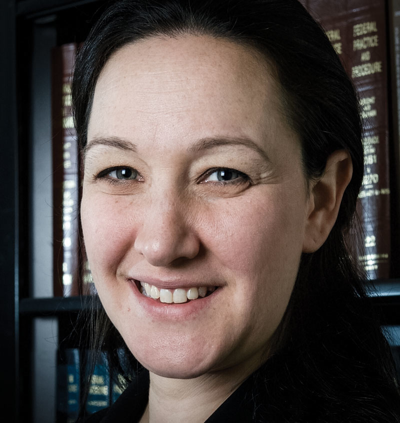
Editor's note: Guest contributor Holly McCall is a veteran communications strategist and Democratic political operative sharing her insights into local politics. She did not work on any campaigns mentioned in this article except where disclosed below.
The fact that women fared well in the recent Metro Council races is no surprise to anyone paying attention to local politics. Having Megan Barry, now mayor-elect, atop the ticket raised the profiles of all women running in down-ballot races.
But one race in particular has been the talk of political insiders for the past two weeks, even though the candidate in question ultimately didn't win. Observers are still wondering how Erin Coleman — a lawyer and U.S. Army veteran who has lived in Nashville only three years, with no prior political experience and zero name recognition — almost won a Metro Council at-large seat. She came in sixth in the runoff, one notch shy of taking one of the five at-large seats. And even more significantly, she outperformed four term-limited council members who lost in the runoff.
Those defeats were significant. Popular District 1 Councilman Lonnell Matthews Jr. was perceived by many to be a shoo-in. He was a favorite of the Dean administration and had served as chairman of the Metro Council Budget Committee. He'd even been anointed "The Next Next Mayor" in a May 21 Scene cover story.
Others predicted either term-limited District 33 Councilman Robert Duvall, a former chairman of the Davidson County Republican Party, or outgoing District 8 Councilwoman Karen Bennett would take the supposed "conservative" spot among the five-member at-large group. That's the slot most recently held by Charlie Tygard.
On Election Night, however, Bennett placed seventh. Matthews, who placed seventh in the general election, dropped to eighth overall. After urging conservatives to "single shot" — vote for him alone, instead of selecting five candidates — Duvall fell to No. 9, without a bullet. In last place was Sylvan Park Councilman Jason Holleman, himself the karmic victim of a 2011 Scene cover story titled "Bulletproof."
Boosting ahead of them all, vaulting four slots higher to sixth place in the runoff, was Erin Coleman.
Coleman's surprisingly strong finish sheds light on the strange particulars of countywide electoral politics, a game of numbers, niche constituencies and strategy. Running for a countywide at-large seat is notoriously difficult — maybe harder than running for mayor, some say.
Both Jerry Maynard and Ronnie Steine are two-term at-large council members. Both term the race "a popularity contest" in which issues rarely factor.
"There's a belief running a race where you get five votes is easy," says Steine, who also served as vice mayor from 1999 until 2002. "But this is a large, complicated county, and there's a tendency on the part of a district council person to think they have a niche."
Of the 10 district council members who started the race, five made the runoff. Only one, Erica Gilmore, won a seat. Gilmore's District 19 encompasses the downtown area, home to most recent large municipal projects, including the Music City Center, Ascend Amphitheater and the new Bridgestone corporate headquarters. Maynard says Gilmore's council seat was one of the few that actually provided countywide name recognition.
"Erica was in a district that received more attention and investment than any other," Maynard says.
But for other candidates, gaining the electorate's attention is "a crazy math problem," says Emily Passini, partner with Greenlight Media Strategies. Passini and Greenlight worked on Coleman's race as well as the campaigns of three of the five successful at-large candidates, John Cooper, Bob Mendes, and Jim Shulman. [Full disclosure: The author managed Cooper's runoff election and worked on the mayoral campaign of Charles Robert Bone.]
Davidson County's growth over the past eight years made the math problem even crazier for this year's at-large candidates. In 2007, Tim Garrett won 11 percent of the at-large vote in the general election. He thus won a seat outright, with 18,900 votes. By comparison, in the 2015 general election, Gilmore placed first with 36,675 votes. But thanks to the ballooning population, she still missed the 10-percent-plus-one-vote benchmark needed to avoid a runoff.
Any candidate basing campaign strategy on what worked in 2007, Passini says, was starting with a flawed premise.
"There's still a thought that you can win a race with a 4-by-8-foot sign in the back of your truck and an ice cream social," she says. "Running countywide is a big task, and if you don't respect that, you won't be successful."
Enter Team Coleman. In late 2014, Erin Coleman, a savvy U.S. Army veteran, engineer, lawyer, small-business owner, wife and mother, decided she wanted to run for Metro Council after she found out her husband's business would keep them in Nashville. Politics have always been important to the self-described progressive Democrat: As a commanding officer, she says, she urged her soldiers to vote. With the local election coming up, she turned to business acquaintance Mark Brown for counsel.
Brown is an old hand in state and local Democratic politics, a Bredesen alum who now runs his own public affairs consulting business. He was part of the team behind the "Titular Head," the giant foam-rubber likeness of then-Gov. Don Sundquist that bedeviled 2002 GOP candidate Van Hilleary at public events.
"We knew each other's politics and had talked about her running," Brown says. "She asked me what I thought. I said, 'You're crazy: You've got three young kids, a new business, and a husband who loves you.
" 'But if you want to do it, you won't be frolicking through the daisies.' "
Coleman, undeterred, and Brown sought advice and put a team together. Lisa Quigley, chief of staff to 5th District Congressman Jim Cooper, was the first to tell Coleman to go for an at-large seat.
"Right out of the box, I told her not to run for a district seat," Quigley says. "I looked at the landscape of people who were running for at-large, and there were very few progressive women, and the ones that were, were African-American. I thought she could be the next Megan Barry: Neither had run at the district level."
Next, Brown brought in Passini. Like Brown, she'd been around the block a time or two. In 2006, she served as the Tennessee House Caucus director. In 2007, she managed David Briley's mayoral race, and in 2010 she was political director for the Democratic Legislative Campaign Committee directing strategy in 13 states.
The team started with a few suppositions. True, Coleman lacked name recognition and the financial resources of some other candidates. But she had a unique set of characteristics they could market.
"We knew from the beginning she was an unknown quantity, and it would be a steep climb," Passini says. "Mark and I decided we weren't going to overpackage her, since her story is so compelling."
Team Coleman also knew that as a progressive woman, Coleman had a profile that would resonate in West Nashville. So they made a decision to geographically focus. They would also target seven highly competitive district council races, including District 23, which matched Mina Johnson against Jim Roberts (Johnson won), and District 24, which featured a hot contest between Kathleen Murphy and Allen Grant (Murphy won).
With limited contributions — Coleman raised $80,000 through the runoff, while other candidates spent hundreds of thousands of dollars — Brown and Passini looked for strategies to increase her exposure. They decided direct mail would be the most economical way to introduce Coleman to voters.
"You know exactly where your mail is landing and who is reading it," Passini says. "TV is more of a shotgun approach: Your ads are seen by people who won't vote, and with at least $10 million spent on TV in the mayoral race, we knew we couldn't compete."
Calculating it would take 12 to 15,000 votes to make the runoff, the three formulated a micro-targeted list. As Coleman is Jewish and a veteran, they started with 9,000 Jewish households with registered voters and 14,000 households with a veteran — lists no other candidate in the at-large race was using. Households with women were targeted too. (Single men still may not know who Erin Coleman is — they didn't receive a single piece of Coleman mail.)
Even so, the old-school Brown didn't want to limit the strategy to mail, as targeted as it was.
"I'm firmly convinced the best way to reach voters is through retail politics and knocking on their doors," Brown says. The Coleman campaign — largely Brown and Coleman themselves — reached 10,000 voters through 25 hours a week of "retail politics" (i.e., personal appearances). They also used a core group of about 12 volunteers to make live calls, doing two sets of 15,000 calls each time.
Once the field was whittled to 10 candidates in the runoff, "we knew there would be a power play in North Nashville and we had to be in the voters' ears," Coleman says. Volunteers called the two biggest precincts in North Nashville, Cathedral of Praise and Bellshire Elementary School, and Coleman mail went to North Nashville for the first time, going to everyone who had early-voted in the general.
The efforts damn near paid off with a win. Coleman won votes from more than 60 percent of the people she targeted in the runoff, increased her votes by 110 percent over the general, and positioned herself as a viable candidate for another race — whether Metro Council or a loftier perch.
Other factors worked in Coleman's favor. Several sources say the dynamics of the mayor's race, financial resources and the baggage that comes with holding elected office negatively affected candidates with higher profiles.
Matthews declined to discuss his campaign, citing "irons in the fire" that might be affected. His campaign manager, Brian Sexton, didn't return calls or e-mails. Steine theorizes the perception that Matthews was inevitable hurt more than it helped.
"People took for granted his success, and there was an underestimation of other candidates," Steine says. "His lack of resources meant he wasn't able to market his many strengths."
Steine and others say the city's rejection of mayoral candidate David Fox's conservative-leaning campaign hurt both Duvall and Bennett. Courthouse veterans further say Duvall's "single shot" strategy seldom works — not least because it infuriates other candidates who might otherwise build an informal coalition, in much the same way that African-American candidates Gilmore, Matthews and Sharon Hurt did. Bennett failed to make the wisest use of her resources, spending money on cable TV ads without already saturating other media.
In the winner's column, Shulman, a former district councilman, lacked substantial financial resources but came into the at-large race with name recognition and a serious work ethic. Hurt, CEO of the Jefferson Street United Merchants Partnership, placed in the top five Aug. 6 and went on to win the fourth-place seat, to the surprise of some who neglected to factor in her long ties to community groups in her home neighborhood, Bellevue.
In spite of her sixth-place finish, many deem Coleman the big story of the race — proof that even in an election season besotted with money at the local level, a newcomer with limited resources can still elbow her way in.
"It may have been too much to expect election," Ronnie Steine says. "But Erin was a big winner."



