
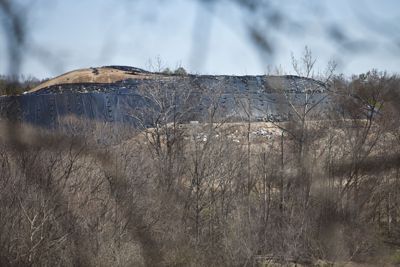

The story of a controversial industrial landfill in Camden, Tenn., went almost exactly the way the residents living in its noxious proximity feared it would. Although regulation came down from the Tennessee Department of Environment and Conservation last week in the form of a five-figure fine for the landfill's operator, it's not likely to get the bad taste out of Camden residents' mouths.
A Scene cover story ("Something Stinks," March 07, 2013) told the story of their fight against the site run by a company named, with no irony intended, Environmental Waste Solutions. For some in the small town 90 miles west of Nashville, the landfill is practically in their backyard.
In 2010, neighbors started reporting a nauseating stench emanating from the site, an odor they said burned their eyes and left children and pets vomiting in their yards. After a year or so, a group of residents filed suit against TDEC Commissioner Robert Martineau and EWS, which was founded by Nashville businessman Scott Sohr. The plaintiffs, all of whom lived within 300 yards of hundreds of thousands of tons of secondary aluminum smelter waste — a byproduct of the aluminum recycling process — contended that the site had been approved and expanded in violation of a decades-old but little-known state law meant to give local residents and officials input on whether a landfill can operate in their neighborhood. Moreover, they worried the site was a health risk and filed dozens of sworn affidavits detailing "sharp, pungent" and "overwhelming" odor from ammonia fumes that made it difficult to breathe and forced them inside.
The story sounded familiar to environmental activists who had watched time and time again as landfills easily won approval in Tennessee and even more easily expanded their footprint later. Moreover, TDEC's reputation was not exactly that of a tough regulator. And in Camden, skepticism was well-earned.
The fight would drag on for more than a year, but in May 2013 Davidson County Chancery Court Judge Carol McCoy sided with the residents, ruling that TDEC had approved expansion of the site without sufficient evidence that state law had been satisfied when it was initially approved. But that victory was short-lived. An appellate court overturned the ruling, and the waste kept piling up.
Years later, after promises from EWS that steps were being taken to ensure the site wasn't a hazard to nearby residents, complaints kept coming, eventually bringing TDEC officials back to the site.
An order handed down from TDEC last week states that EWS "was issued notices of violations and a time schedule for performing remedial activities but has failed to comply." Department investigators, responding to complaints by visiting the site in November of last year, found flaws in the landfill's gas treatment system for the mound of waste now known as "Black Mountain." The system was disconnected in several places, they reported, which allowed gas to potentially be released into the environment. Investigators also cite areas where cover material, meant to mitigate odors, was insufficient and left waste exposed.
More complaints followed, leading to another visit, which led to more citations. In all, the order lists more than a dozen violations of rules, as well as the terms and conditions of EWS's permit. The order lists remedies as well as a punishment: a civil penalty of $84,560, half of which is to be paid within 60 days. In addition, TDEC tacked on damages of $1,766.29.
Elizabeth Murphy, a Nashville attorney who has represented the Camden residents fighting the landfill — and who has worked on similar environmental issues for years — called the development "very surprising." Nevertheless, she says it's not sufficient, as it focuses mostly on the landfill as a nuisance to neighbors without further investigating whether it's a health concern.
"TDEC wants a cash payment for over [$42,000] for what?" Murphy writes in an email to the Scene. "The state has been a partner with EWS for over six years. TDEC worked with EWS to ensure the landfill opened next to a residential neighborhood and stayed open after it repeatedly broke the law. Neighbors and local officials begged the state to shut it down in 2011 [and] assess health risks. Gov. Bill Haslam would not return phone calls. I'm pretty sure that if the landfill owners or state officials had burning eyes and children vomiting from gases in their own neighborhoods, they'd want more than money."
TDEC spokesman Eric Ward pointed to other actions EWS will be required to take. The order states the company must stop receiving any waste or recyclable material in a certain storage building that had become a problem; EWS must also submit revised plans for gas management, operations, dust mitigation and odor.
Scott Sims, an attorney representing EWS, said the company will appeal the order.
"EWS strongly disagrees with the Commissioner's Order and Assessment and plans to appeal it due course," Sims says in an email to the Scene. "EWS operates its facility in a safe and compliant manner and has a history of working well with TDEC and other regulatory bodies to ensure that is the case, and EWS will continue to do so in the future. EWS's commitment to regulatory compliance has never wavered. EWS continues to strive for 100 percent regulatory compliance, although human error and unforeseen circumstances do occur from time to time."



