
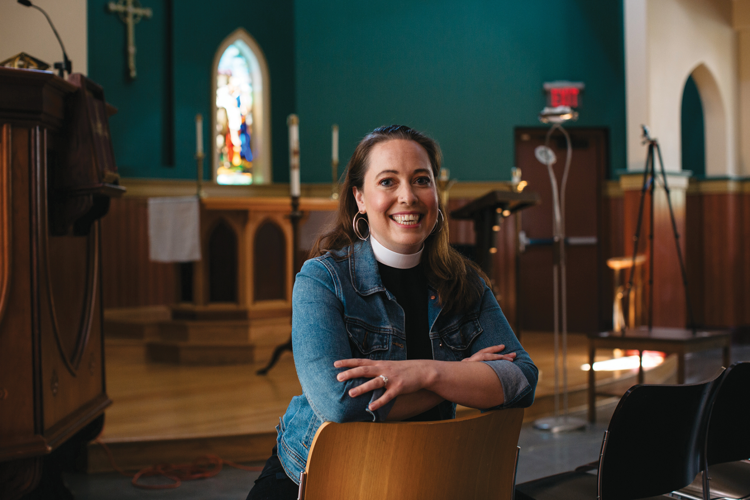

When I ask the Rev. Kira Austin-Young, who leads St. Ann’s Episcopal Church in East Nashville, what the past month-and-a-half or so has been like, she goes immediately to the supernatural.
“Um, it’s been hell,” she says, laughing.
“The last kind of normal day I remember was, like, March 1,” says Austin-Young. “We had church, my fiancé and I went for a walk in Shelby Bottoms, and the sun was shining and we went out to dinner. It was just a normal day. And then, Tuesday morning.”
Tuesday morning was March 3, when a devastating tornado ripped through Nashville in the dark of night. Two people were killed, hundreds were displaced, and buildings and homes from North Nashville to East Nashville, Donelson and beyond — those that weren’t completely destroyed — bore the scars.
Austin-Young says she managed to sleep through the whole thing, but awoke to a barrage of text messages that gave way to panic about the state of her East Nashville church. For more than 150 years, St. Ann’s has stood east of the river, and this was not its first storm. In the spring of 1934, a tornado destroyed the church’s bell tower. In 1998, a tornado claimed the church’s historic nave and chancel, which had stood since 1882. A stone carving commemorates the old structure with the words, “God was not in the tornado but in our response.”
On March 3, 2020, the church was spared — although it lost a large hackberry tree, the only tree that had survived the 1998 tornado. But ever since that morning, Austin-Young — who is also a chaplain for Vanderbilt University Medical Center — has been shepherding a flock through what is essentially an unprecedented moment in modern history.
“From there,” she says of March 3, “everything changed.”
Am I right to assume that you’ve been sort of learning how to lead a church congregation during a crisis on the fly here? We’re in uncharted territory, right?
Yeah. I mean, we all kind of joke how we missed the “How to Minister During a Pandemic” class in seminary. Normally, in kind of a normal ministry situation, you have any given group of people that may be in crisis at a given time. Somebody’s going through a divorce, somebody’s had a death in the family, somebody’s having an issue with addiction in their family. So your pastoral energy is channeled in specific ways. But since the tornado and now with COVID-19, literally everybody is in crisis. Including me.
My understanding is you’re a chaplain at one of the hospitals, right?
I’m a contract chaplain for Vanderbilt. … My normal role there is I’m the Wednesday night overnight chaplain. So from 10 p.m. to 7 a.m. I’m on call from home. Mostly when I get called in in normal times it’s for deathbed situations, emergency situations, things like that that are critical needs at a given time. I actually haven’t been called in since COVID-19 protocols went into place, in part because one of the main things I do as a chaplain is really minister to families of patients, particularly in deathbed scenarios where the patient isn’t necessarily responsive but the family might need support. And because there aren’t any visitors allowed, there hasn’t really been a lot of immediate need for the type of chaplaincy work that I do.
But in my conversations with the other chaplains, I think they’re really trying to do a lot of staff support. Because the people who are medical workers, the nurses and doctors and staff, are really having their own kind of struggles with the situation and how to be health care providers right now. We haven’t necessarily gotten to this point yet in Middle Tennessee, but you know stuff that I’ve listened to about situations in Italy where you’re making decisions about who lives and who dies, who gets a ventilator and who doesn’t — there’s a lot of what we call moral injury that comes with that, even if you’re trying to do the best that we can or you’re following hospital or state guidelines. You’re still the one who’s kind of saying, “You get the ventilator, you don’t get the ventilator.”
I wonder how you’re thinking about grief in this time, and how we’re all feeling certain sorts of grief.
Yeah, I think just the acknowledgement that we’re all grieving. Unfortunately, I think we get into this situation where somebody always has it worse, so I don’t feel like I’m necessarily allowed to grieve that my long-planned trip to Europe with my kids was canceled, because somebody else over here has a loved one in the hospital. We kind of do this comparative grief thing where we don’t necessarily allow ourselves to grieve what may seem like a privileged thing to grieve, but it’s still grief. We still have to let ourselves feel that and acknowledge it and name it.
I think one of the things — whether or not “normal” was good for everybody or promoted human flourishing for a lot of folks — we are kind of grieving a loss of normalcy, a loss of knowing what the next day is going to be.
Speaking of grieving things that we had been planning on, I noticed you mentioned on Twitter that you were supposed to be baptizing babies right before Easter.
Yeah. Traditionally, Easter vigil, which is the first service of Easter, takes place after sunset on Saturday night. It’s one of my favorite services of the whole year. It can be anywhere from like 90 minutes to three hours long. But traditionally, in the early church, that’s when converts to the faith were baptized. So it’s one of the traditional occasions for baptism, and even when there isn’t a baptism, we renew our baptismal vows at that service. It’s just a really powerful service and even more so when there are actual baptisms.
So, instead I did the service in my backyard. My fiancé built me a fire pit just so I could have my Easter vigil fire. There’s a long song that gets sung, so I just lit this fire and chanted this song in my backyard and renewed my baptismal vows. We kind of tell the story of our faith, and of God’s acts of liberation and restoration in the world, starting from Creation and going through the flood and leading the Israelites out of Egypt and Ezekiel and the dry bones, and then it all culminates in the proclamation of the resurrection. … I kept reminding myself, there have been a lot of Easters in the world and around the world and in the history of Christianity that have looked [different]. There have been Easters under religious persecution, and there have been Easters in prisons and in hospitals, and it’s still Easter.
You talked about restoration. It’s impossible not to notice that we’re in the middle of a historic event and there’s going to be something on the other end of this. It seems like a lot of the work to be done right now is figuring out how we’re going to get through this but also to figure out what kind of world we’re going to have after this.
Absolutely. All through Holy Week and the latter weeks of Lent, we’re reading through some of the exile prophets, and during Holy Week we’re reading through Lamentations. And that hits differently this year. It hits in a way that I’ve never really fully appreciated before, this kind of sense of being in exile some ways. All throughout the Bible and especially through those prophets, God is saying to the Israelites, “I despise your festivals.” It’s not about religious observance, it’s about justice and about justice for all of God’s creatures.
I’ve been thinking a lot about what it would look like for us to be more committed to economic justice and the folks that we are saying are essential workers and yet a lot of them are not making a living wage. How might this time affect our relationship with climate change? I feel like very few of us, myself included, have been willing to make the sacrifices needed to make a difference in terms of climate change, and now we’re being forced to make some of those sacrifices. We’re not driving — I don’t remember the last time I filled up my tank on my car. We’re working from home, as difficult as that is. What would it look like to acknowledge that maybe productivity — the kind of productivity that our economic system values — is not the most important thing?
I saw you mention in a tweet following Easter that the burial liturgy is an Easter liturgy. I was quite moved by that, and I wonder if you could explain it.
I love our burial liturgy so much because the way that it’s formulated is that death is not the end. It’s very much a proclamation of the Christian truth that death is not the end, that we find the meaning of life in Christ’s resurrection, and that in our baptism we’re baptized into the death and resurrection of Christ. In the rubrics, in the back of the liturgy, one of my favorite things it says is, “But grief is not unchristian,” and points to the fact that even Jesus wept at the grave of his friend Lazarus. So the burial liturgy is an Easter liturgy, but it’s not a celebratory liturgy. So that kind of tension. We celebrate the resurrection, but we’re also grieving the loss of something.
That’s kind of what this Easter felt like to me. We were saying alleluia, and one of the phrases of our liturgy is that, “Even at the grave, we make our song alleluia, alleluia, alleluia.” And I saw something that a friend of mine wrote, addressing some of the kids in her parish who kind of said, “I don’t really feel like saying alleluia this year, it doesn’t feel joyful to me.” And she kind of said, “Alleluia isn’t necessarily about joy, it’s actually about protest.” It’s about protest against death and darkness and the forces of evil, and so we say “alleluia” not because we’re happy, but because we believe that there is more.



Post a comment as anonymous
Report
Watch this discussion.
(0) comments
Welcome to the discussion.
Log In
Welcome to the discussion.
Keep it clean. Please avoid obscene, vulgar, lewd, racist or otherwise abusive language. Comments featuring hate speech or threatening or violent content will not be tolerated.
PLEASE TURN OFF YOUR CAPS LOCK.
Be truthful. Don't knowingly lie or mislead.
Be proactive. Use the “report” link on any comment that violates our comment policy.
Share with us. We'd love to hear your feedback.