
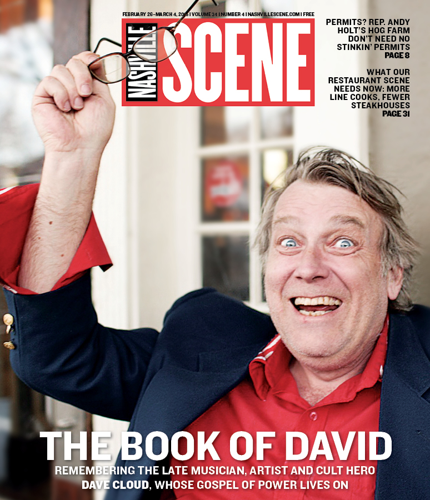

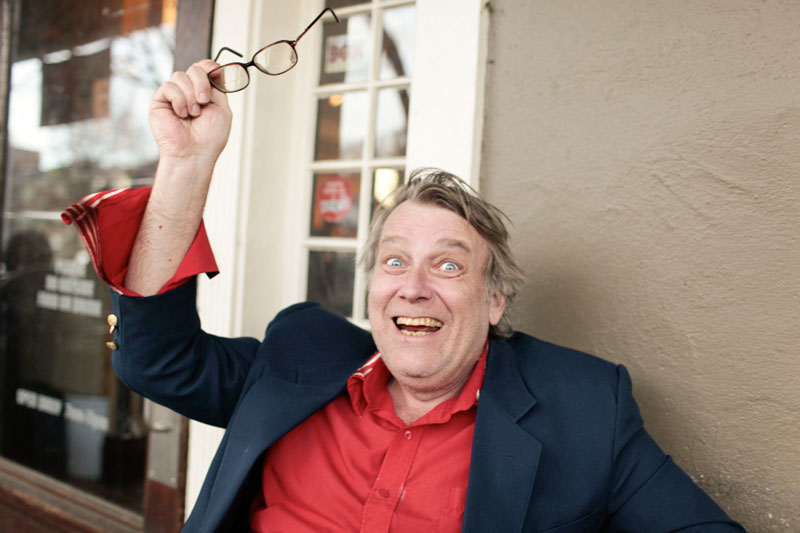
Last week, after days of revolving-door visits by friends and admirers, Dave Cloud was unhooked from life support in his room at Centennial Medical Center. Several hours later, just after 9 p.m. on Feb. 18, he succumbed to the melanoma that had wracked his body and spirit but couldn't defeat his furiously active mind. He was 58.
For generations of underground Nashville musicians, it was like losing an uncle, a wit, a boon companion, a provocateur, a lightning rod for ideas and inspiration, a beating heart and a barely corked id in one terrible blow. When people raise the post-It City rallying cry of "Keep Nashville Weird," Dave Cloud embodied what they mean. Twenty years ago, while Nashville was lusting after the acclaim and approval of coastal arbiters, Cloud was bashing out untutored, incantatory garage rock in venues like Springwater and Lucy's Record Shop. Nobody at the time suspected how crucial those clubs would be to the city's reversing fortunes — or how much of a cult figure Cloud would become in Scandinavia and other ports of call.
And yet even when he was backed by members of Lambchop, Silver Jews and other vanguard indie bands, Cloud bowed to nobody's fashion. Whether he was playing '60s bubblegum tunes or easy-listening standards, they came out in his own Martian time signatures and pulverizing arrangements, animated by the innocent primordial current of rock 'n' roll. Just two months before he died, he was doing what he loved at The Stone Fox, channeling the cosmic groove between bouts of chemo-induced sickness.
Cloud leaves behind a trove of recorded memories: crackling albums with his band the Gospel of Power, roles in Harmony Korine's Gummo and Trash Humpers, video snippets ranging from international Budweiser commercials to locally produced short films. Friends and admirers embraced him as a one-man resistance front against art snobbery and pretention. He could unnerve people with his sexual candor, his intensity of focus and a risky, self-destructive streak that close friends say he had worked hard to temper in recent years.
Yet many more people came away enchanted by his teddy-bear warmth, invigorated by a creative energy that could turn any patio party, gravel-lot bottle pass or late-night outing into spontaneous improv sessions and life-changing encounters. He could be courtly or coarse, sophisticated or vulgar, elevated or lowbrow. What he could never be was the same damn thing you'd seen a hundred times before — or like everyone else.
The Scene asked some of those who rode along in the whirlwind of Dave Cloud's life to share their memories. May the Gospel of Power power on.
Matt Bach, guitar/bass/drums, Gospel of Power: Having been a close friend and bandmate of Dave Cloud's going on 20 years, I have so many crazy and great stories to recount. You knew something exciting would happen if you fully entered his world. But I think the thing that made a lasting impression on me was the first time I saw him perform at Lucy's Record Shop around '95 or '96. I was already a musician with some "fully formed" ideas about what was good vs. bad music ... typical young-person arrogance.
That night, though, changed me forever. My friend Chris Davis kept telling me about this guy I had to see and meet, and it just so happened that Dave and James Clauer, known as C.O.B.S. (Cruel Oval Brown Stomachs, named after a line from a poem by local legend Robert Logue), were playing a show at Lucy's right before the Christmas holidays. We showed up to a sparsely populated room with a Lost in Space-esque robot (played by Garth Williams) serving eggnog from a platter. Already, I knew this was going to be something. There was a huge sheet hanging from the ceiling concealing the stage, and I could see the silhouettes of figures setting up gear.
All of a sudden, the robot starts "malfunctioning," throwing the eggnog everywhere and mock-attacking people. I start to hear the rumblings of that classic Dave Cloud riff — E-G-A — and James pounding away at the skins. Then the curtain falls to reveal Dave and James doing what I might now call "conceptual rock." It was the most mind-blowing thing I've ever witnessed, even to this day. The timing of it all, and the imagination behind it, were something to behold.
I was literally speechless, except for the hoots and hollers that I let out uncontrollably. It was as if the music pulled it out of me. I decided then and there that I had to get to know Dave. After the show, we sat in my car and talked. He was reciting long passages from Shakespeare at breakneck speed. This cat was on another level, musically, conceptually and intellectually. I can't put my finger on it, but I think we started a band a few days after that. Chris Davis on drums, me on bass and Dave on guitar and vocals. As many people close to Dave know, he was an avid tape-player ping-ponging genius. Chris happened to notice the words "Gospel of Power" on one of those cassettes — Dave's dad is a retired Methodist minister and would give his old sermon tapes to Dave to record over — and that became our band name.
This all brings me to what Dave meant to me as a person and musician. It was during one of our first practices that I noticed how Dave could take any pop, jazz or classical tune and play it on just one string of the guitar. (Often, his guitar only had one or two strings.) The drone was Dave's best friend, and he owned it. I had played in more technically oriented bands back home in Shreveport, La., and in Nashville, but Dave just turned my world upside down. He could wring the most melodic stuff out of just his voice singing over a droning note.
This is not to say that Dave didn't have a sophisticated sense of harmony. He knew the lyrics and chords to most any song you might ask him to play and was fond of discussing how to construct chords and progressions. These early lessons taught me that it's all about the song and not necessarily how perfectly it's performed. Anyone who ever saw him perform knows Dave never played a song the same way twice.
But it didn't end with the music. Dave taught me to take chances, especially in the face of naysayers, of whom there have been many over the years. In essence, he liberated me as a person and showed me that it's OK to march to the beat of your own drummer. We had a 20-year stretch of doing this in many capacities, from playing at Springwater many nights a week at 1 in the morning to touring parts of Europe.
All the way up to the end of his life, Dave bucked the system. He was given his melanoma diagnosis, and what did he do? He met me and the band every Saturday to work on what would become our new record. He played a show at The Stone Fox two days after he had had a chemotherapy session, throwing up before and after we played. Not many people would have had the balls or the courage to do this, but Dave did. For that alone, he is my hero and inspiration forever.
I miss you so much, Dave. But heaven's band just got an incredibly hip new member. Peace be with you, my friend.
Sarah Cozort, writer, former roommate: Dave Cloud and I met one night at Betty's Bar and Grill off Charlotte during a period when Leslie Keffer was still the spitfire behind the bar, The Mattoid had not yet returned to his native Finland, and I was infected by youthful wanderlust — not to travel far afield, but deeper into what seemed the perverse underbelly of this magical city. I was panning for dirt, but what I found was a golden center, of which Dave was an integral part.
We were fast friends, and I ended up living with him and his family for six months. During that time, I was incorporated into his daily routines. Often Dave and I would head out around 7 or 8 in the morning, first stopping by Bongo Java before running sundry errands. He would comment on the people and places we passed. Once, driving down Blair, he pointed to a house, where he said late one night in his early 20s, after a typically raucous DIY-style Nashville house show, he wound up in his first and last fistfight.
His depiction of the night was vivid and engaging — so much so that I imagined the boys on the lawn, a gaggle of charming degenerates dressed as though they might be rejects from the cast of Welcome Back, Kotter duking it out. I couldn't help wondering if this was the genesis of his delightfully hilarious and spiritedly pacifistic "phantom kung-fu," in which he would fight the air in shamanistic ritual. Another time, driving through the Village, we passed The Villager and he mentioned — almost off-handedly — that this was, in fact, the first place he had played a show.
These were our mornings, full of coffee and stories and drives that felt like grand adventures through the "Old Nashville" of his memories, of which he never tired, and the "New Nashville," for which he held an infectious childlike curiosity. After I moved out of the Clouds' home — across the river to Cleveland Park, while several of my West Nashville friends and acquaintances refused to "cross the river" — Dave and I established a new routine. He would swing by on Sundays, and we would go out for lunch or sit on the porch with a guitar, make up songs, and people-watch.
It occurred to me during this time that Dave was wonderful at transitions — transitions in relationships, between songs during a performance, and all of the transitions that are part and parcel of being merely mortal. Through his understanding and acceptance of the limitations imposed on him by his body and his circumstance, he honed his strikingly warm and intelligent sense of humor. As with so many great performers, it was his ability to tap into an abject yet empathic sense of the human, which transformed him into someone of convention-defying rarity, whom I will always be grateful to have known and loved.
Chris Crofton, musician, actor/comedian, Scene advice columnist: I can't remember the first time I saw Dave Cloud, but it must have been in late 2001, shortly after I moved from New York City to Nashville, and it was definitely at Springwater. I liked him right away. He reminded me of artists I loved — Jonathan Richman, Daniel Johnston and David Yow.
We ended up working together many times over the years, and he became a friend of mine. I remember when we were riding in a car together for a scene in a short film by Michael Carter called "Balls Deep." We thought there was a camera on us but it turned out they were only recording sound. We were acting up a storm for nobody. I was eating Sweet'n Low packets and Dave was gesturing wildly, yelling about an imaginary BOGO sale happening at his obsession of that day — the clothing store Bert's. It was July and it was boiling hot, but we both gave it our all. Dave always gave it his all.
Dave was a peerless storyteller. I remember him holding court at the Belmont Bongo Java. He transformed the front deck into a stage for his ingenious improvisations, and he filled everyone around him with joy. Dave Cloud was an artistic adventurer who inspired everyone who came into contact with him to be wilder and more creative. He deeply loved music. But most importantly, he was a very loving person. I don't remember him ever having a bad thing to say about anyone, and he was always extremely kind to me. Godspeed, Dave — the world will not be as colorful or warm without you.
Chris Davis, drummer, Gospel of Power; experimental arts promoter, FMRL Arts: Bliss was David Cloud's middle name. Even though he could be touchy about this name, it was an apt descriptor of him as an engine of creative joy that made the cares of the world fall away for those lucky to know him or to see him perform. Dave was one of the funniest people I've ever met. He was also unfailingly kind and hardworking. And he clearly knew how to have a good time and how to lift the people around him through story and song.
I was lucky to know Dave well. We played together in the first incarnation of his Gospel of Power, a name borrowed from one of the hundreds of sermon tapes Dave would overdub with his own music. Playing with Dave was so wonderful and wild. We rocked The Farm's Soy Cafe so hard that hippies crossed a field to ask us to turn down, while assuring us that they loved what we were doing. We met through a mutual friend, James Clauer, who was the other half of Dave's pre-GOP band, C.O.B.S. Most people know Dave as an uninhibited live performer, a karaoke god, or as an actor in art films. Dave was this and much more to the broader community of Nashville. His influence upon successive generations of Nashville musicians and artists is incalculable — so many of the very successful visual artists and musicians I know will tell you that seeing Dave Cloud blew their minds wide open to the vastness of possibility.
David's father, the Rev. Fred Cloud, and his stepmother Barbara are progressive activists with strong roots in Nashville's religious and political communities. They work to help people in need, and Dave did a lot to help them in these efforts, as a courier delivering time-sensitive documents and making phone calls even in his last few weeks. Dave was also an important part of Nashville Talking Library recording texts for sight-impaired Nashvillians — medical textbooks, Shakespeare, and inscrutably, a nearly 30-volume encyclopedia of cosmetology, perhaps proof that Dave's surreal sense of humor was always present.
Dave believed strongly in equality; he treated everyone with the same nonjudgmental kindness and decency. Dave was a father figure to more than a few folks who came from broken and abusive homes. Dave's family, on occasion, would take a family into their home to help them transition to a better life. Dave interacted with children from these families daily, helping their parents by giving rides to and from school and extracurricular activities. He got to know them and was intensely supportive of them.
To paraphrase a lyric Dave penned about high-heeled shoes: "[We're] hopelessly addicted to you; [We] will always, always, always be blue." As a Cloud you've returned to your place in the sky. I'll love you forever.
Loney John Hutchins, musician, Cleft label chief, 444 Humphreys St. art space: I moved back to Tennessee in 2000, soon encountering Dave at the Springwater very late one evening. My first comprehension of the man was a baritone voice booming through the back wall of the bar. I had to know what was gurgling Lou Reed's "Satellite of Love." I opened the patio door to see a bespectacled silver man entertaining a semicircle of smiling rock 'n' roll types. I quickly understood him to be a master of oration: "I'VE BEEN TOLD! THAT YOU'VE BEEN BOLD! WITH HARRY! MARK! AND JOHN! ..." His eyes did light the balmy patio with ribald expression.
Dave Cloud represented everything I ever wanted from a music scene, which was a whole lot of weirdness entertaining itself, perfectly content to be overlooked by Music Row. You could also tell people really loved him, his bandmates, his friends, the bartenders, even the two Vandy kids he'd just freaked out five minutes previously. He seemed like some prematurely aged Nashville kid who'd made good on the other side of a decades-long cultural apocalypse, finding a fountain of youth in the watering hole by the Parthenon.
My time in a world with Dave Cloud involved the advent of social media. Gaps were bridged in a way that had never been before in Nashville, and Dave was someone who glued everyone's collective imagination together. House parties collided. More kids wanted to sneak into shows. There was no defined genre, and everything was welcome — if your folk band had kazoo solos, if you only played rockabilly, or if you just had a microphone, an FX pedal and a mouth. If your band name was The Sex, the Dynamite Operators or Ke$ha. If you went to Hillsboro or MBA, if you were from Gallatin or Helsinki — all purveyors of righteous good times were encouraged, "But hey! You gotta stick around later in the night for Dave Cloud."
After a while you could tell if someone really knew Nashville if they'd had a Dave encounter. He wasn't just for the dive bar champions. People knew him — musicians, painters, doctors, real estate agents, carpenters, pastors, librarians, drivers, drifters, academics, stoners, nerds, businessmen, veterans, celebrities, tough guys and lots and lots of sexy sweet beautiful women.
Everyone understood the man's lifestyle and recent health issues, but his passing feels sudden. There's more to be said about what he meant to this community.
Ben Martin, drummer: My friend. My big buddy. This impossible tube of a man charming his days away on the porches of Bongo and some dive bar. The consumption. The hunger. The beast within never denied. The impossible was possible thru his effect on anyone who spent 20 minutes in the room. Sometimes 30 was too much for some. But you will never forget what he said. What he wore. The boom of his voice. His way was HIS WAY. A whirling dervish with a love jones. The fucking man. I have enjoyed so many adventures with him and my bandmates I can't begin for this tribute. I'm heartbroken by the loss of a true friend. One of the last truly native eccentrics, and a rock 'n' roll elephant I don't get to share another mile with. Too soon.
Mark Nevers, producer/engineer: It was the mid-'90s, the amateur musician dope fiend/alcoholics from the 1980s had long since abandoned the dream and given in to the life of the cul-de-sac, cubicles and AA — but not Dave Cloud. He was a professional post-midnight sorcerer. What other people called success was never part of the conversation. He had shit to do, songs to belt out, cigarettes to smoke, and weird fucking stories to tell while Paul Booker endlessly tuned his guitar. It was just another night during that brief moment when Victor Victoria's was alive with Nashville underground bands mingling with bass-fisherman transvestites and Dave was at full power. He was wearing an aloha shirt and conjuring up Elvis. He wasn't just singing Elvis, he was bringing him back to life and making him sing for the ticketless cast-out rejects of the world.
Taking that kind of spirit, energy and bizarro live show and making it survive the recording process is not an easy deal. Engineers and producers all over Nashville are constantly screwing up artists by putting them in time and tuning them and whatnot — hell, some people need tuning, for God's sake! But not Cloud. Studio machines would overload and explode trying to normalize him. That's why I admire my friends Matt Bach and Matt Swanson's recordings with Dave so much, pure honest and raw, with no fingerprints of an ingrained instinct to fuck with things that ain't broke.
As the years slipped away, I would see Dave driving down Belmont in his little gray pickup truck more than I did at Springwater or Matt Swanson's front porch. I would see him at coffee shops and just about everywhere else in a two-mile radius of Blair Boulevard. Dave was the kind of guy you liked seeing at Harris Teeter — no "let's get together" crap talk. He would just cruise by with the tiniest of eye contact and a simple, "Hey, Marky," even if it had been a couple of years since we had last talked to each other. It didn't matter. He was a man on a mission, and somewhere in the cosmic after-show nudist camp, he still is.
Laurel Parton, designer, filmmaker, bandleader, Trauma Team: For over two decades Dave Cloud has been a friend who never judged, but only loved. Dave was Hercules, a teddy bear, a genius prima donna whose shoulders I didn't mind rubbing before the big rock show.
We collaborated in song, shared the stage; his imagination was as long as it was wide, and couldn't be confined.
Dave was a hopeless romantic who enjoyed discussing: envy and desire, sweet surrender, first loves and afternoon delight.
His Rock God spirit was fueled by his desire to love; casual conversation would result with an epic song title, followed by laughter, lyrics and more laughter and a twinkle in his eye.
The idea light shined bright with Dave Cloud. He was my heart.
Mike Shepherd, bassist, Apollo Up: Uncle Hunter — Hunter Harvey, a DJ on several Nashville stations starting in the 1970s — called him "My friend Cloud." I can't recall if this was 1991 or 1992, but my gut tells me it was Easter. I can't recall if the tape arrived before or after my folks and I met Hunter and Dave at Fox's Donut Den, but I think both things happened on a Sunday. I woke to the sound of a tape on my dad's stereo, a strange voice singing "Try a Little Tenderness" as though it was an incantation. My parents were upset, but my sister and I were intrigued.
I was 15 and he was 35. Dave and I would talk for hours on the phone about recording comic books on tape for the blind. He told me I had a great voice for comic books. I thought it was weird he would say it, but I was flattered.
I saw him at Blue Sky Court, singing songs for pretty girls. He seemed so old, but he was younger than I am now. I saw him at Lucy's Record Shop and at house shows, playing guitar and hollering his peculiar tunes.
I went to college, and made my college friends drive with me from Murfreesboro to this wild frontier called East Nashville to see him play at Joe's Diner. He invited me to the parking lot where we drank tequila with the band.
I moved from Murfreesboro back to Nashville. Dave came to the house one night. He fell asleep on the couch as soon as he arrived, then woke up a few hours later and left.
I fell in love with a girl named Sarah, and she took me to her birthday party at a friend's house where Dave was playing in the basement. Jay Phillips and I got to fill in as his rhythm section for a few songs, and it was a dream come true. We asked him to play our favorite songs from his record we loved, and he said he didn't know them. Sarah asked him to play "Crimson and Clover," and he did.
I saw him at Springwater. Apollo Up was playing that night, and he said we should call our band "The Fucked Ones." I saw him in art films and Budweiser commercials. I saw him around.
When Uncle Hunter died in 2009, I called Dave at his parents' house with the news. He called me back in the middle of the night, distraught because he didn't think he had the right shoes for the funeral.
I played a show at the Springwater last October, and Dave was holding court on the back patio like he always did. He introduced me to a stranger as his Cousin Michael. He looked ashen and tired. I hugged him, and we laughed.
Matt Swanson, bassist, Gospel of Power, Clockhammer, Lambchop; produced or co-produced Cloud's first four albums and released the first two on his own label: It has been a glorious 17 years of climbing up an imaginary rope ladder into Dave Cloud's whimsical tree house, an exquisite and finely appointed place where I watched this magician pull countless rabbits from his bottomless hat. Strange doors opened in even stranger places, and he strolled in first, headlong, ever the fearless libertine. We simply followed, laughing. A consummate musician, a zigzag wanderer, a walking encyclopedia in penny loafers and no socks, an insatiable gourmand in the kitchen of unsavory things. He was my Cap'n Kangaroo and my Iggy Pop, my beatnik guru and my best friend. The Ultimate Frontman. Years of recording audio books for the visually impaired at the Nashville Talking Library not only seasoned his baritone voice, but also permanently secured his position in the pantheon of truly righteous dudes.
How lucky I am to have been by his side when he met The Stranglers, or when he belted out "Disco Inferno" in nothing but his boxers in the building where the Sex Pistols used to rehearse, or when Lenny Kaye complimented him after seeing him play. Or simply hanging out on a Saturday morning, talking back and forth through the screen door as he smoked another cig, pontificating on the minutiae of another day. Wisdom, wit and wizardry.
"Gumball" was the one-word code I uttered over the phone to let Dave and the band know his latest record had arrived at my doorstep. He would race over in less than 5 minutes and stay for hours, usually declaring the album "gold" after the first listen. And he should know.
Kurt Wagner, singer-songwriter, Lambchop: The one thing I know about bad weather, snow and ice or bitter cold, is that someday it will be gone and the days will be better. The day will come when the severity of the situation will cease. It can't last forever, and one appreciates the more pleasant circumstances of the normal mundane "day to day" that is our existence. I find this of some comfort as it applies to other unpleasant events in life, such as not smoking in airports or being treated for an ailment. I find solace in knowing that one day I will smoke again or will breathe without coughing or pooping my pants.
Sadly I've found this rationale doesn't apply to losing someone in your life who inspires you or unerringly makes you laugh and makes your life a richer, more vibrant place. Dave Cloud was one of those rare people I've come to know whom you could count on bringing his own unique form of expression to any encounter one could have with him, from a chance meeting in the grocery store to the curbside outside Lucy's Record Shop, to the couch on a Sunday afternoon watching the Titans' Music City Miracle. In his company you were assured of an experience that was much more joyous than without his wit and unique observations. And those moments have left us now.
We have the memories of his days and we have the recordings and films that he created, all with the help of a loyal group of friends who understood his faults and weaknesses and hailed and elevated his genius to a level unattainable on his own. They are the ones who will never see such clouds gather and the sky open up and the storm pass into sunlight again. They as well as my wife Mary [Mancini] and myself will never have the treasured experience of his kind words and demeanor. His loss will not go easy and our days will not be better for it, but our hearts will remember this man who changed our world for the better.
Thanks, Dave.
Favorite Dave Cloud quotes:
"What would you do if you had $500 and you were a werewolf? I think I'd go to Christie's Cabaret." —Jorge Blum
Having known Dave for 48 years, I still think my all-time favorite quote came from the summer we were 21 (1978). As we were leaving the home of another friend of mine, he turned and said, "I want to thank you for inviting me, and to tell you there's nothing in life more important than comfortable underwear." —Rudy McNeely
From "Spontaneous Combustion," an article by Jim Ridley in the Dec. 12, 1996, Nashville Scene:
With his glasses, his greased-back hair, and a paunch barely concealed by a leather jacket, David Cloud looks more like an unlicensed orthodontist than a rock star. But don't let his gentle appearance fool you. On a rainy Saturday night two weekends ago, Cloud arrived at Lucy's Record Shop with a bulging Coleman cooler. He mopped his brow, smoothed his hair, and dumped his payload of dry ice into a plastic garbage can. With a whoosh, a mushroom cloud of fog engulfed the room, and a couple of jaded kids threw themselves to the floor and leapt from the billowing carpet of mist like dolphins. ...
For viewers used to the Nashville club-date routine, David Cloud's Gospel of Power must've looked and sounded like a broadcast from Mars. It was, instead, the latest outbreak of a rock 'n' roll insurrection. Two years ago, Cloud and a group of fellow sabotage artists launched a revolt. They took up instruments; they seized the means of production. And they declared war — a war on everything pompous, pretentious, and boring in the local music scene. They had one common goal in mind: to disrupt the deadly ritual of seeing a rock 'n' roll show in Nashville. ...
"I wouldn't've done it if I didn't want to connect with people," says David Cloud. He doesn't want his band to be too loud; he wants to play songs as fun and accessible as those he hears on oldies stations or big-band station WAMB. When he sings "Hey There, Lonely Girl" a cappella at the close of his show, he does it out of a sense that pop music, however distorted by bloat and bombast, still has the power at its core to speak to, and for, anyone receptive enough to listen.
"The only way I invented something," he insists, "was by not knowing how to play it."



