
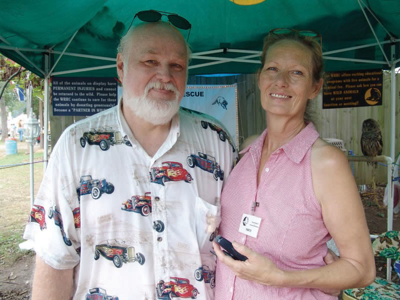
Marty Rush, who turned a love for wild animals into a nationally known rescue/rehabilitation operation that ran out of her Mt. Juliet home, died Jan. 8 at Summit Hospital after a brief illness. She dedicated more than 30 years to the care of animals, first as director of volunteers for the Cumberland Wildlife Foundation, then at her home, where she lived with her husband, songwriter-producer Alan Rush, and two children, Gregory and Carrie.
Friends and associates remember Marty Rush as an advocate for respect and compassion toward all living things.
"She taught thousands of kids about raptors and other animals and why they were important to our world," says Doug Markham, public information officer for the Tennessee Wildlife Resources Agency.
"She always emphasized that every animal has its place," adds Nancy Garden, former director of education at Owl's Hill Nature Sanctuary in Brentwood, "even the skunks and snakes and spiders, things they might not like."
After Cumberland Wildlife Foundation closed its doors and its eagle hacking program was transferred to Dollywood, "people started calling Marty at home," her husband Alan remembers. She obtained state and federal permits and turned their home and yard into the Wildlife Rescue and Rehabilitation Center. It served as triage, ICU, recovery ward and therapy clinic for everything from mice to mountain lions, from cardinals to vultures — essentially every mammal and large bird native to Tennessee.
"I can honestly say there were only a few she never got," her daughter Carrie recalls, "and that would be a black bear and a bobcat. And besides the native birds, she'd get migrants, including a seagull, broad-winged and Harris' hawk. Along the way, there was a ptarmigan, an alligator, an emu and a Patagonian mara. She usually didn't take in domestic animals in, but she'd help them find a home."
Rush spoke to groups ranging from pre-schools to retirement homes, from scout troops to college classrooms, letting people get up close and personal with animals and sharing a message of conservation and respect. She did presentations at the Wilson County Fair and the Tennessee State Fair, and had an exhibit and program at the Nashville Lawn & Garden Show for more than 20 years.
Her compassion was limitless. Among the creatures she nursed, Carrie remembers, was a blind white duck. A blind white duck with half a bill.
"It was in a cage but one night a raccoon chewed off half its beak," she says. "My mother spent a year and a half preparing food for that duck and hand-feeding it three times a day. It died on the operating table having a prosthetic beak put on."
"She never turned anything down," says former Owl's Hill director Jean Buchanan, "and if she had a starling, it got the same attention as a barn owl or great horned owl. She was never going to turn anything away."
During the years Buchanan was at Owl's Hill, the center released 181 birds of prey to the wild. Of those, Buchanan estimates 150 of those came from Rush.
"Her house," Buchanan says, "was wall-to-wall cages and animals. People would drop them off in the middle of the night and she wouldn't even know who had brought them. She brought them to us when she thought they were ready to go."
All of those animals, of course, required a lot of food.
"Hunters would donate carcasses," Carrie says. "Sometimes they'd keep the good stuff and give her the rest, and she'd be out there with giant cleavers hacking it up. Sometimes they weren't field-dressed at all, and the animals would get the benefit of the entire animal."
"I would call her when I saw a deer on the side of the road," says Carolyn Sells, a friend from when Rush worked on Music Row. "She and Alan might come get it, or she might say, 'Freezer's full right now, but thanks for calling!' "
Carrie remembers her mother once having to tube-feed a bird of prey. That meant liquefying the food. So Rush got an old blender and concocted a raptor smoothie — of frozen dead mice.
"We did have separate blenders," Alan adds.
Marty Rush was born Martha Joan Ragland on Jan. 22, 1946, in Oklahoma City, one of seven siblings. She was predeceased by two brothers, John and Walter, and by her parents, Hal and Jessie Ragland.
"They were very poor," Alan says. "They had two small houses, like sharecropper cabins, and they slept in one and had the kitchen and living area in the other. They had an outhouse. When it was time to go back to school, her dad would take some cardboard and draw around each of their feet and go buy shoes. They each had one pair through the school year, and in the summer, they would be barefoot."
She went to McGinnis High School and married Alan on March 14, 1966. Alan had signed a songwriting deal with Combine Music, and they moved to Nashville.
"When the kids got big enough," Alan remembers, "she started working," and she spent a number of years at Combine Music and Monument Records. The Music Row community served as extended family — but so did some of the animals that, because they couldn't be released, became "permanent residents." Like the crow named Waldo who thought she was his mom.
"Even when he was 14 years old, he greeted her like a baby crow would," Carrie recalls. "He always wanted Mom to hold him, and he'd jump up on her and sit on her lap when he could."
"She had a groundhog named Pig Boy who just ran around the house like a dog and hibernated in the winter," Buchanan says. "And she had this barn owl named Bobby, and he was just her special owl. She brought him out and did programs with the summer campers, and when he got old and arthritic she wanted to know if we'd build him an exhibit so he could retire him to Owl's Hill. He was with us for another three or four years before he died."
"She had adopted the wildlife-rescue catchphrase, 'Saving tomorrow's wildlife today,' " Alan says. "It was her motto."
"She was amazing," Buchanan says. "There will never be another like her."
A memorial celebration will be held 4-7 p.m. Saturday, Feb. 20, at the home of Wayne Hamblen, 1518 NW Rutland Road, Mt. Juliet. In lieu of flowers, contributions can be made to gofundme.com/MartyRush.



