
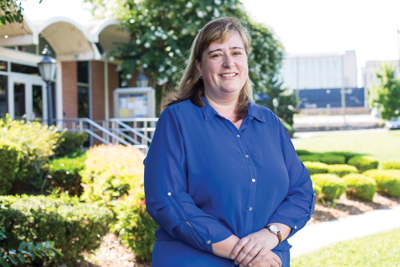


Judith Tackett
In 2005, cities all over the United States were building 10-year plans to end chronic homelessness. Under then-Mayor Bill Purcell, Nashville decided to do the same by creating the Metro Homelessness Commission. After the 10-year period was over — and chronic homelessness was still a major problem in the city — the Metro Council enacted an ordinance to continue the commission’s work, which is an effort to coordinate and focus the city’s solutions for homelessness.
Last week, the commission hired its newest director, Judith Tackett, who started as a contractor for the Metro Homelessness Commission and worked her way to communications coordinator in 2011, and assistant director in 2014.
What do you see as the wider goal of the commission moving forward? I am working to focus our work on a systems approach. Frankly, the transition phase we’re in now, with us working on the Continuum of Care, we don’t know who we’ll be working for next year. The Metro Homelessness Commission and the Continuum of Care board have the same goal of building a housing-retention system, but you have the Continuum of Care board that gets U.S. Housing and Urban Development funding, and then you have the Metro Homelessness Commission side that gets Metro funding. So you have this dual governance system, and for the last two years we’ve been having the conversation about how to unify that.
What are the challenges there? Challenge No. 1 is the education level. When we sit down and talk about what our goals are, there are more similarities than differences, but the way we talk about homelessness and the terminology can be very different. Take the term “housing first.” There’s so much misinformation about what housing-first is. Housing-first is taking a person and wherever they enter, you focus on the housing piece and planning, but it’s not housing only. You have to have the service piece at the right amount and right level. It’s an individualized approach. Some people see it as, “Here’s housing and good luck,” and it’s really a much more supportive approach than that. And also, when we’re looking at homelessness, we’re really looking at what we consider literal homelessness: in cars, on the streets, in shelters and encampments. And with that, we’re mostly using the HUD definition for homelessness. We want to put our focus on that.
How has the data piece changed since the commission started? At the beginning, there was already talk of building a homeless-management information system. A lot of cities looked at that, and ours — like most cities — was homegrown. And since then, every city has pretty much abandoned that approach and purchased a vendor that is set up as a homeless-management information system. But the biggest part of creating something like that is letting the service providers know why you need the information, what you’re going to do with it, and how you’re going to protect the privacy of people.
What we did when [former director] Will Connelly came in as director is tried to show that when we use data to focus in on a population, when we have a common goal, we can actually achieve quite a bit and know what we’ve achieved. So we were able to measure the housing placement rate per month. At first it was 19 people per month experiencing chronic homelessness getting into housing in early 2013. Then we kicked off How’s Nashville in late 2013, and we were able to see that average go up to 45 per month. And we’re in the 50s per month now.
Ultimately this data will get us to a point where we have annual data and numbers we can trust — right now there are no annual numbers on homelessness that I trust.
What do you think needs the most work when it comes to homelessness in the city? Where I feel most insecure is actually the data. As a city, we need to look at what is the data landscape around homelessness right now. It should not be happening that I can’t sit here and give you exact details about the data. One of the reasons for the resistance to data is that there is a solid message from advocates and people who care out there around how many people are experiencing homelessness. I can’t get behind it. You can’t just put everything together, shake it up, and come out with a huge number and be OK with it. We need specific numbers about how many people are chronically homeless, how many veterans we have, et cetera.
But even with the data and everything systems-related I’ve talked about, we can never forget about the person. When I get overwhelmed by all of these tasks we need to do, I have to step back and remind myself that this is why I go to work every day.



Post a comment as anonymous
Report
Watch this discussion.
(0) comments
Welcome to the discussion.
Log In
Welcome to the discussion.
Keep it clean. Please avoid obscene, vulgar, lewd, racist or otherwise abusive language. Comments featuring hate speech or threatening or violent content will not be tolerated.
PLEASE TURN OFF YOUR CAPS LOCK.
Be truthful. Don't knowingly lie or mislead.
Be proactive. Use the “report” link on any comment that violates our comment policy.
Share with us. We'd love to hear your feedback.