

Earlier this week, Baltimore's top prosecutor Marilyn Mosby said she will stop prosecuting marijuana possession cases in the city, no matter the quantity. She also said she'll seek to vacate thousands of previous convictions for the charge.
Don't expect Davidson County District Attorney Glenn Funk to make a similar announcement soon.
In an interview with the Scene following the news from Baltimore, Nashville's DA says his office has taken steps to try to avoid incarcerating people for marijuana possession, and to minimize the lasting consequences of the charge. But the office will continue prosecuting the cases, particularly those in which a person has a larger amount of marijuana with the intent to sell.
“When it comes to prosecuting simple possession of marijuana, we see it more as a health issue than a crime issue," says Funk. "Possession of drugs is one of those issues, similar to mental health, where because our society doesn’t really know exactly how we want to deal with it we tend to drop it in the lap of the criminal justice system.”
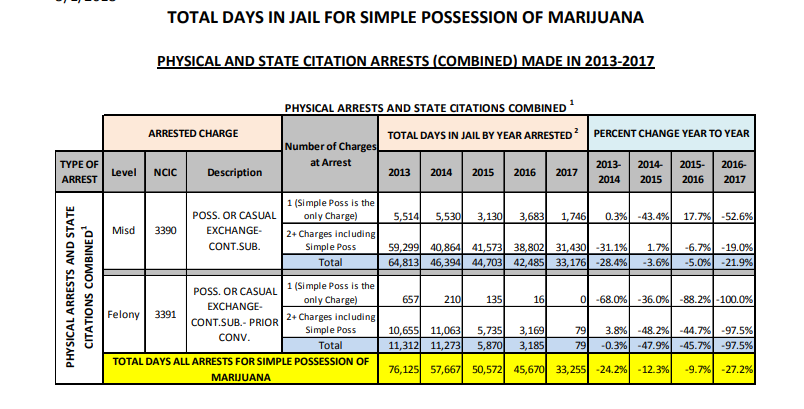
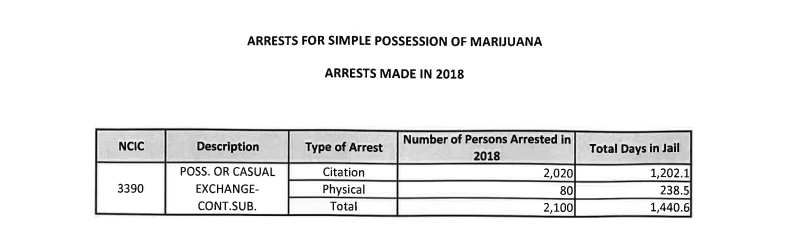
The numbers back up his claims about reducing incarceration in marijuana cases. Since Funk was elected in 2014, the total number of days spent in jail by people arrested for marijuana possession has steadily decreased. In 2014, Nashvillians charged with simple possession or casual exchange of marijuana served 5,740 days of jail time. Last year, that number dropped to 1,440.6 days. (See charts below.)
“We’re trying not to incarcerate people for simple possession of marijuana, and we’re also trying to make sure that they don’t suffer long-term collateral consequences of having a narcotics conviction on their record based on a simple possession-of-marijuana charge,” Funk says. “If it’s a larger amount and they’re selling marijuana, we still prosecute those cases. Some cases we may even incarcerate with regards to larger amounts of marijuana. But still, if it’s not 100 percent sure that the person is selling the marijuana, then we’ll treat that as a simple possession.”
Funk says most of the jail days resulted from scenarios in which a person agreed to a guilty plea under the condition that it would be vacated if they attend a class, but failed to attend the class, which resulted in a contempt charge from a judge. Funk expects the numbers to continue to go down in part because his office no longer uses that sort of plea deal. (The Scene reported on the so-called "under advisement" pleas here.)
“We’re trying to strike a balance between respect for the law and trying to give people counseling where they will make healthy choices in the future, and try to do it in a way where they will not suffer too great of a consequence for the fact that they picked up this charge,” Funk says.
We asked Funk, why not follow the lead of prosecutors in Baltimore and Manhattan and dismiss the cases altogether?
“Incarceration is a severe sanction," Funk says. "Incarceration should reserved for the most severe cases. The victim cases, the violent crimes, gun crimes. We do not want Nashville to essentially become a shipping depot for major marijuana because for whatever reason law enforcement, including our office, did not take it seriously. So we are taking it seriously, and we are prosecuting the folks that are the marijuana traffickers. And at the same time those who have a simple possession case, we’re not going to just ignore the law — we’re going to try to find the balance that protects the community while at the same time doesn’t harshly penalize folks for what it is essentially a health offense.”
Asked whether it was realistic to predict that Nashville would become "a shipping depot for major marijuana" if prosecutors further de-emphasized those cases, Funk said essentially, it depends on the type of marijuana case one has in mind.
“I believe that if we stop prosecuting sale and the possession for resale it definitely would happen," he says. "With regard to, if we were to just stop prosecuting the simple possession of marijuana, then that would not necessarily lead us to becoming the shipping depot for the Southeast. But at the same time, it’s a situation that the state legislature obviously takes seriously. They took it so seriously that they not only left this on the books, but they struck down Metro’s ordinance. And we are certainly going to look at, in the future, some options to potentially minimize the impact on those charged, especially first-time offenders, those charged with a simple possession-of-marijuana offense.”
In 2016, the Metro Council passed an ordinance creating a civil citation for simple possession of marijuana, essentially giving police officers the choice to avoid criminally charging people for having small amounts. But the state legislature passed and Gov. Bill Haslam signed a law nullifying those ordinances seven months later.
Below are charts showing data provided by the DA's office, representing the number of days spent in jail for simple possession-of-marijuana charges. As you'll see, the chart showing data from 2013 to 2017 also reflects cases in which a person had a prior conviction or was charged with additional crimes.