
Adam Tamburin’s piece at The Tennessean like a kid worries a loose tooth. This quote from the United Daughters of the Confederacy especially sticks in my craw:
"The final terms of that deal were announced Monday after anonymous donors gave $1.2 million toward that purpose. Despite the payout, the organization said it was "disappointed that an institution such as Vanderbilt University would attempt to whitewash, sanitize and rewrite American history."
I have learned a lot about the way we talk about Nashville’s history over the years. Imagine a vast forest filled with well-worn paths through the underbrush. These paths cross each other, run parallel to each other and are all vaguely going to the same place — an understanding of Nashville’s history. Various people have set themselves up as caretakers of certain paths or at least certain portions of paths. And then there are a bunch of us who like to explore the paths. We’re constantly sharing notes. “Hey, I found this really old path that went by some interesting places but I couldn’t get any farther down it than 1870. Does anyone know if there’s a path that will bring me around this barrier and back to this path?” or “Oh, wow, did you know that this path and this path join up if you take them far enough?”
Everyone is not as interested in taking as many old paths as they can. That’s fine. But a lot of people are interested in at least taking some of the paths. Everyone who lives in Nashville is at least a tiny bit interested in Nashville’s history.
What the UDC is doing and has done for a long time is to roll a huge beacon down a path they like to a place in history they care about and they turn that beacon on so bright that people see it through the trees from far off and assume that’s the only way through the forest. That beacon is so bright that other paths are hard, if not impossible to see. And if you shield your eyes from it and see something else in the woods, they piss and moan about “rewriting” American history.
The people who worked to rename Confederate Memorial Hall have been much kinder to the United Daughters of the Confederacy than they could have been. I mean, you want to talk about whitewashing, sanitizing, and rewriting history, let’s talk about why Confederate Memorial Hall stood on that very place. Let’s shield our eyes from the blinding light of “honoring the Confederacy” and look down the nearby paths kept clear by the likes of Bobby Lovett, David Ewing, Eugene TeSelle, and Bill Carey to the history of Roger Williams University.
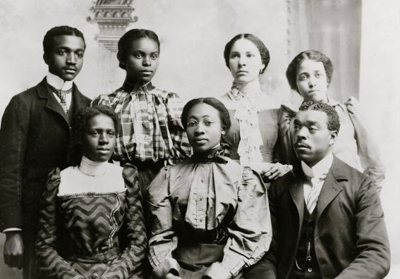
The earliest iteration of Roger Williams University was founded in 1864 by Baptist minister Daniel Phillips (no relation that I know of) to serve Nashville’s bustling black community. It grew and moved locations a few times and in 1874, Phillips bought a plantation on Hillsboro Pike to transform into a permanent home for the college.
The website, Lost Colleges, has a description of the school:
"In 1874 Nashville Normal and Theological Institute was able to purchase 30 acres of the Robert Gordon’s farm on Hillsboro Road for a new campus. The 1884-85 catalog describes two buildings. Mansion House, part of the Gordon property, was enlarged to measure 48 x 80 feet. It served as the girls’ dormitory and contained apartments for faculty. Centennial Hall, next door, measured 49 x 185 feet. Like Mansion House, it was four floors above a basement with a mansard roof. The ground floor contained school rooms, while the upper three floors were dormitory rooms."
Bill Carey in his The Tennessee Magazine article on the college explains part of the important cultural work of the school:
"Even though not everyone in the surrounding area was thrilled about the presence of an African-American college, the relationship with Vanderbilt was cordial, at least according to one Roger Williams professor. 'Vanderbilt football coaches coached the Negro team,' he recalled in the 1930s. 'Roger Williams students went to games at Vanderbilt and sat with the others on the bleachers — a practice which would not be allowed today. Individual students, white and black, formed friendships that outlasted school days.'"
Okay, so let’s recap. Sitting across Hillsboro Road from Vanderbilt was a black college that rivaled Fisk at the time in size, with beautiful buildings, a bustling curriculum and activist students who intended to change the country. Roger Williams students palled around with Vanderbilt students and sat in the bleachers at football games and I read that professor as saying that they sat intermixed with the white students at football games, not just in the same bleachers, but sitting together. Raise your hand if you really think everyone in Nashville was cool with that. (No one should have their hands up right now.)
In 1903, someone shot at the chapel. In 1904, someone shot the college president’s wife through a window of her own home (she was not killed). A month later, at the start of 1905, someone burned down Centennial Hall. In May of that same year, another building on campus burned down. The terrorism has its effect and Roger Williams got the message that it was no longer welcome on that plot of land. The school began efforts to sell off the land and in 1910, 25 acres of the campus was sold to the trustees of Peabody College. The other acres were subdivided for homes, and the deeds to those homes all forbid those home from ever being sold to black people.
In 1913 the United Daughters of the Confederacy began raising money to put a building on Peabody’s new campus.
Whew, doggie, no wonder they’re shining their light so bright now on “It’s not about Nashville history, it’s about national history.” Because if you look at Nashville history, it sure looks like these assholes got together to put a giant symbolic middle finger to black people right on the site of a beloved black college some “mysterious” group of people had just spent a few years getting rid of. It, in fact, looks like a really vulgar display of gloating victory — white people destroying a black college and running black people out of the neighborhood and then putting up a shrine to the heroes of white supremacy right on that very spot.
This is not unknown history. Everyone whose works I’ve quoted from or who I talked to for background on this post is still alive. It’s actually pretty easy to find out a lot of interesting stuff about Roger Williams and the early history of Peabody College, if you know not where to look, but to look at all. But so strong is our tendency to believe people when they say they mean no harm by things that are obviously meant as harmful, I have no doubt that even this post is going to do very little to keep the truth of the matter in the forefront of people’s minds.
I imagine the city will remember this as the time a bunch of elderly eccentrics who’ve never meant any harm getting their feelings hurt as history was changed to reflect more PC times, instead of seeing just who was the initial rewriter of history here. But we should not forget exactly what — Roger Williams University — the United Daughters of the Confederacy were literally covering up when they put Confederate Memorial Hall on Peabody’s campus in the first place.



