
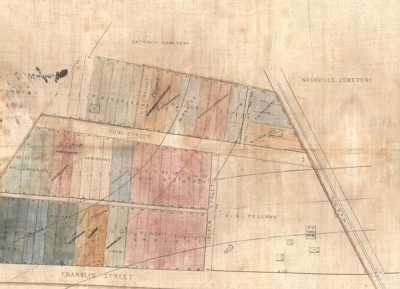

I was browsing the online map collection at the Tennessee State Library and Archives — Unofficial Motto: More Nifty Things Than You Can Shake a Stick At! Please, Do Not Shake Sticks in the Library —when
I found this mapof the old Catholic Cemetery.
This was quite a surprise to me as I didn't know we had an old Catholic Cemetery. I thought everyone was buried in the city cemetery until after the Civil War. But no! Apparently, at some point, the Catholics put up their own cemetery. I've been trying to dig up some information on it and so far all I've found is this brief mention when Calvary out by Mt. Olivet opened: "Many Catholic families removed to it the bones of their ancestors from the old Nashville Catholic Cemetery on Cherry Street, now Fourth Avenue South." If many families removed the bones of their ancestors, that makes it seem like some ancestors remained.
The history of Catholics in Nashville starts, of course, with fur-trading diplomat, Timothy Demonbreun, who was Catholic, but also was, shall we say, in need of a lot of ministering to in the Biblical sense and instead sought out "ministering" in the "Biblical sense" with ladies that were not his wife. Needless to say, early Catholics not interested in being seduced by Timothy Demonbreun had ambiguous feelings about him. He tried to give money toward the first Catholic church in town — no dice — but may have hosted the first mass in town.
Catholic history in Nashville does not improve after Hot Pants Demonbreun. The History of the Catholic Church in the United States written by John Shea in 1890 describes the early years of the Nashville Diocese as an "arduous duty" that "devolved on Father Richard Pius Miles." When Father Miles was ordained Bishop in 1838 and — I'm not even kidding you, folks — the priest who gave the sermon during the ordination preached about how much Bishop Miles' job was gong to suck because of all the non-Catholics, oh, and, sorry, but the Catholic church in town is in terrible condition. Bishop Miles seems to have done an okay job under bad circumstances. In 1839, Shea reports that Bishop Miles "was gratified to be able to celebrate Christmas in his improved church with some little dignity."
The trouble with burying anyone in Nashville back then is immediately obvious to anyone who's looked in a hole downtown before they filled it with a building — it's all rock. So, St. Mary's, the first Catholic church in town, simply could not have had a churchyard cemetery. As far as we know, all Nashvillians buried "in town" were buried first in the old city cemetery, located near what is now Jefferson St. kind of behind the Geist & Sons Blacksmith shop.
Shortly, we figured out that it's a bad idea to put dead people near the stream you want to drink out of and, in 1822, the new city cemetery (now often referred to as the old city cemetery) opened. This was unsegregated, as well. You died in town. You were buried here.
But my bet is that, once we got a Catholic Bishop, we got a Catholic cemetery shortly thereafter. The location the TSLA map shows is very near the city cemetery, so, obviously, there's ground to dig in there.
The map tells us one more thing about the status of Catholics in antebellum Nashville, though. Look at that map again. It took me a minute to figure out where exactly the cemetery was, because I didn't recognize Hume, Lincoln, or Franklin St. So, I went to a map made after the Civil War in the TSLA's collection. There's the city cemetery. There's Franklin Street, now, obviously, Chestnut. Nothing of that little subdivision still exists.
I checked other Civil War era maps of Nashville. Those streets and the cemetery aren't marked. They would have been, if my reckoning is right, past the old Sounds stadium and next to the tracks. They existed before the war. They didn't after Fort Negley went up.
No wonder the Catholic Church moved the cemetery out to Lebanon Pike. Yes, of course, it's more room, though, after the war, once the fort emptied out, there was a lot of room right there. But if you've just spent those war years watching an army and a camp full of refugees trod all over your dead loved ones, it's understandable how you might not feel like that spot was sacred anymore.



