
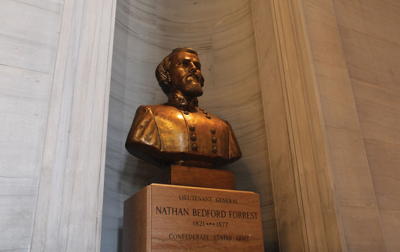


Nathan Bedford Forrest bust currently on display in the state Capitol
One-hundred-forty-two years after Nathan Bedford Forrest’s death, Tennessee Republicans remain steadfast in defending the state’s right to publicly honor the Democrat, slave trader, alleged war criminal and early Ku Klux Klan leader.
As protests over state racism consume cities around the nation, many elected Republicans are either actively opposing efforts to end Forrest celebrations or delaying and watering them down.
This week, Gov. Bill Lee and his Senate Republican allies backed off a plan to eliminate Nathan Bedford Forrest Day from Tennessee’s list of days of special observance. Instead, Senate Majority Leader Jack Johnson (R-Franklin) pushed an amended bill that keeps the holiday on the books while eliminating a requirement that the governor issue a proclamation declaring the day. (Lee’s signing of the proclamation in 2019 led to national uproar, including from fellow Republicans like Texas Sen. Ted Cruz.) The move led Nashville Democratic Sen. Brenda Gilmore, who is black, to remove her name as a sponsor of the bill.
“I signed on to Senate Bill 2199 as a co-sponsor because, once and for all, it fully removed Tennessee’s special day of observance for the KKK grand wizard and brutal slave trader Nathan Bedford Forrest,” Gilmore said. “He deserves no honor or recognition in state law. Unfortunately, the new amendment attached to this legislation protects this offensive observance and keeps Nathan Bedford Forrest Day completely intact within state statutes.”
Democrats in the state legislature are also seeking to remove the bust of Forrest, prominently displayed outside the entrances to the House and Senate chambers. They too were met by resistance from many Republicans.
Bills and resolutions “urging” and “requesting” the removal of the Forrest bust failed. All that’s left is a measure from white Republican Rep. Bill Dunn that recommends that the Capitol Commission, which oversees the space, limit honorary busts and statues to those commemorating elected officials. (Forrest, who served as an alderman in Memphis before the Civil War, would seem to qualify under those recommendations too.)
Lee, for his part, offered little in the way of guidance. Though his predecessor, fellow Republican Bill Haslam, was explicit in his statement that Forrest’s bust should be removed, this week Lee offered “dialogue” rather than action. (Haslam did routinely issue the required Nathan Bedford Forrest Day proclamation, as have past governors.)
“What’s really important is that we not draw lines and choose sides,” Gov. Lee said. “It’s that we understand that these answers are complicated and they require dialogue. So what I would do is, I would sit down with those who advocate keeping it. I would sit down with those who advocate getting rid of it. I would consider my own experiences and my opinion about it that should be formed and shaped by that dialogue going forward.”
If Lee seeks dialogue with Sen. Raumesh Akbari (D-Memphis), she might reiterate her point from earlier this week. Akbari told her Senate colleagues who were about to vote to keep Nathan Bedford Forrest Day on the books that the historical figure “made his fortune on selling black folks like we were tractors.”
“I want you to know how that feels,” she added.
Some Republican lawmakers were less willing than Lee to listen to their black counterparts. Republican Rep. John Ragan of Oak Ridge is one of the lawmakers who has opposed stripping Forrest of his honors. When a constituent emailed him to question him on his position, the lawmaker responded with a column from the Daily News Journal, in which the author argues that Forrest reformed his racist beliefs later in life. Among the researchers who contributed to the article was the president of the Memphis chapter of the Sons of Confederate Veterans.
Republican Jerry Sexton of Bean Station sought to pivot the conversation to abortion before catching even some of his GOP compatriots by surprise.
“It was not against the law to own slaves back then,” Sexton said. “Who knows, maybe some of us will be slaves one of these days. Laws change.”



