
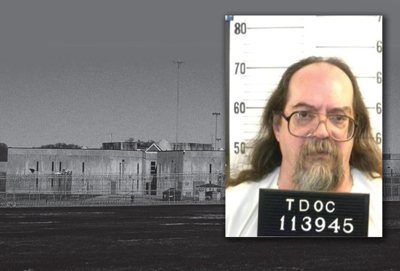


Billy Ray Irick has been executed, 32 years after he was convicted of the rape and murder of 7-year-old Paula Dyer in Knox County.
Irick received lethal injection Thursday night at Riverbend Maximum Security Institution, just shy of his 60th birthday. He was pronounced dead at 7:48 p.m. In the end, he spent more of his life on death row than he did on the outside and was scheduled for execution multiple times. The Scene offered Irick the chance to give a written statement ahead of his execution, but he declined through an attorney.
At roughly 7:27 p.m., Riverbend Warden Tony Mays asked Irick, “Billy, do you have any last words?” Irick initially said he did not, and Mays gave the signal to administer midazolam, the first drug in the lethal three-drug cocktail. At that point, Irick said, “I just want to say I’m really sorry, and that — that’s it.”
Irick’s blinking then slowed until his eyes eventually closed. For the next five minutes, he snored loudly, his belly visibly contracting with each breath. At 7:34 p.m., Mays conducted a consciousness check, which consisted of loudly shouting “Billy” twice and pinching Irick above the collarbone. Approximately two minutes later, Irick jolted and produced what sounded like a cough or a choking noise. He moved his head slightly and appeared to briefly strain his forearms against the restraints. Around 7:37, the color in Irick’s face changed to almost purple. After that, he did not appear to be breathing, and Mays shut the blinds in the execution chamber. Several minutes later, the warden announced Irick’s time of death over a PA.
“That concludes the execution of Billy Ray Irick,” said Mays. “Time of death, 7:48 p.m. Please exit now.”
Following the execution, Kelley Henry, the lead attorney representing prisoners who are challenging Tennessee’s lethal injection protocol, issued a statement addressing what she characterizes as the troubling aspects of Irick’s execution.
Multiple media witnesses described physical movements which suggest that the midazolam did not render Mr. Irick fully unconscious. Among those descriptions were that Mr. Irick “gulped for an extended period of time” was “choking” “gasping” “coughing” and that “his stomach was moving up and down.” Witnesses described movement, including movement of the head, after the consciousness check. This means that the second and third drugs were administered even though Mr. Irick was not unconscious. The descriptions also raise troubling questions about the State’s attempt to mask the signs of consciousness including by taping down his hands which would have prevented the witnesses from observing the failure of the midazolam. The witnesses observations are indicative of pulmonary edema from the midazolam as described by Dr. Edgar in his trial testimony.
Although Irick's guilt was not in doubt, there were serious questions about his mental health. Irick was first referred to a mental health facility when he was 6, and his adolescent years included multiple violent outbursts. He was examined by a mental health expert after his arrest and ruled competent to stand trial. But that expert, Dr. Clifton Tennison, said he no longer had confidence in that assessment after reviewing affidavits signed by members of the victim's family in 1999 that raised doubts about Irick’s mental state at the time of the crime. The family said Irick had been “hearing voices” and “taking instructions from the devil,” and an investigator learned that a machete-wielding Irick had chased a young girl down a Knoxville street in broad daylight just days or weeks before Dyer’s murder.
Irick was one of more than 30 death row prisoners suing the state over a new lethal injection protocol, arguing that the three-drug protocol would cause immense pain amounting to cruel and unusual punishment. Medical experts testified at trial last month that because the first drug in the protocol, midazolam, is not a general anesthetic, it would not spare a person from feeling the effects of the second two drugs.
Dr. David Lubarsky, a leading anesthesiologist called to testify by attorneys representing the death row prisoners, said receiving the second drug — the paralytic agent vecuronium bromide — without being under general anesthesia would feel like “being buried alive.” The third drug, the caustic chemical potassium chloride, which ultimately stops the inmate's heart, would make a person feel like they were being burned alive from the inside, he said.
The execution proceeded despite pleas from Tennessee's Catholic Bishops, the European Union's delegation to the United States (which issued "an urgent humanitarian appeal" on Irick's behalf) and a variety of mental health organizations. Meanwhile, Gov. Bill Haslam, the Tennessee Supreme Court and the U.S. Supreme Court all declined to intervene.
Irick is the first person executed in Tennessee since 2009. The state executed two convicted murderers that year, Steve Henley and Cecil Johnson, both by lethal injection.



