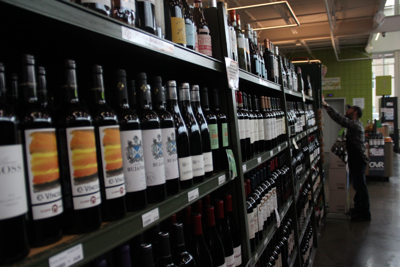


Wine for sale at the Turnip Truck in East Nashville
Drink no longer water, but use a little wine, as the Apostle Paul wrote in his first letter to Timothy.
One of the last restrictions on Tennesseans’ sabbath activities falls this weekend, as Jan. 6 is the first Sunday grocery stores can sell wine in the state. Tennessee grocers have been able to sell wine since the summer 2016, but the enabling legislation exempted Sundays. Wine aisles across the state lay fallow on the Lord’s Day, often with signage informing customers that the product was not for sale.
Former state House majority leader Gerald McCormick, who sponsored the Sunday sales bill, says that the initial grocery-stores expansion helped build momentum. “It wasn’t just lobbyists or a company that wanted something done,” he says. “It was really people’s constituents. They thought it was silly that they couldn’t buy wine when they went to the grocery store.”
Then, last year, the state legislature again expanded grocery stores’ freedom, allowing Sunday wine sales beginning in 2019. Liquor stores in the state were allowed to open on Sundays starting in the summer, and wine and spirits have been available on Sundays for much of the year at those specialty stores.
That concession for retail package stores was part of a complicated unraveling and re-tangling of mostly untouched alcoholic beverage laws dating to the years following the repeal of Prohibition.
“Like any compromise, nobody got exactly what they wanted and [everybody] walked away pissed off about something,” says Will Cheek, a Nashville lawyer focusing on alcoholic beverage law, of the original wine-in-grocery-stores push. “Everybody knew that the grocery stores wanted to sell wine on Sunday, and it was just a matter of time before that piece of it fell.”
But it wasn’t so easy. An unlikely coalition of moral objectors to alcohol and many retail package stores opposed any further liberalization of the laws. Liquor stores across the state are frequently small, owner-operated outfits, and the arrival of wine in grocery stores siphoned off some of their business.
The addition of Sunday sales meant many of them, some with just one or two employees, would have to open seven days a week just to compete.
“We feel we can compete, because of our volume, with those large chains,” says Charles Sonnenberg, owner of Nashville megastore Frugal MacDoogal. “However, most of the Tennessee individuals who own package stores are mom-and-pops who work their very long hours [and] now have to be there seven days a week. They are suffering dramatically, and this will further make it more difficult for them to compete and make a profit.”
Whether the package-store owners like it or not, Sunday sales are coming to grocery stores this weekend. And observers predict it may not be the last law to fall.
Cheek tells the Scene that spirits in grocery stores would be the next fight. He predicts another battle will come over the required 20-percent markup on wine, a provision included in part to prevent grocery stores from using wine as a loss leader.
Rachel Schaffer Lawson, a Nashville-based hospitality industry attorney, and Clayton Byrd, former executive director of the Tennessee Alcoholic Beverage Commission who is now special counsel at Adams and Reese, predict changes to laws about alcohol delivery. On-demand alcohol delivery service Drizly launched in Nashville in 2016.
“Unfortunately, the laws tend to lag behind changes in culture and changes in technology, so it may be a while before we see more of that,” Lawson says.
Byrd further predicts “more liberalization in the three-tier system,” the name for the firewalls between alcohol manufacturers, distributors and retailers in the state.
Liquor-store owners and other observers are also turning their attention to Washington, D.C., as the U.S. Supreme Court is set to hear oral arguments in a Tennessee-based case later this month that could have wide-ranging implications. The underlying lawsuit questions the state’s ability to limit who can obtain retail liquor licenses in Tennessee.
In the meantime, area grocery stores are preparing (so much as it requires any preparation at all) for Sunday wine sales. Representatives for Kroger and Turnip Truck say it was particularly confusing for tourists arriving on the weekend and hoping to purchase wine. But locals and regulars took time to adjust too.
“Recently, I asked my husband to stop by the Turnip Truck and pick up some wine for a brunch we were going to, and they [said], not until next week,” says Kim Totzke, chief operating officer at Turnip Truck. “This is what I do, and I still forgot. If it’s already in the store, we sell it other days, liquor stores are able to sell it. … It only makes sense.”
Melissa Eads, a local spokesperson for Kroger, says Sunday has become the busiest shopping day of the week at most stores.
“It’s awesome,” Eads says. “It was just a matter of time.”
McCormick, who left the state House for a job with Nashville lobbying firm and consultancy The Ingram Group, describes the retail liquor industry as “part of the most protected industry in the history of the state of Tennessee, probably.” During the intermediary period when wine sat on grocery store shelves but was unavailable for purchase on Sundays, McCormick says he witnessed multiple instances in which customers were turned away. The customers, he says, would find out “it’s the legislature that’s done it.”
“I’d try to hide my face and hope no one recognized me standing there in the grocery store,” he recalls.