
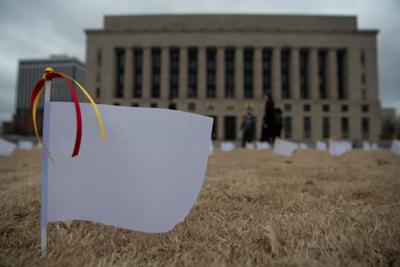

Blake Farmer over at WPLN interviewed Dr. Lisa Piercey, the outgoing Tennessee health commissioner. It’s stunning. As you can imagine, Dr. Piercey is a little defensive about the fact that she stands alongside Gov. Bill Lee on a pile of almost 26,000 corpses. The state has lost the equivalent of Springfield or Goodlettsville to COVID-19. I’m sure that’s a failure that is hard to live with.
But, oh boy, listening to her demand we hold off on whether to declare her tenure an utter failure is something else. She told Farmer: “If we’re only measuring it on physical health, that’s one thing. But the whole person is a lot broader than that. Let’s talk in a few years when we know how the mental health impact bears out, how the interruption in jobs and education, how that pans out. So let’s talk then.”
This is depraved. Twenty-six-thousand Tennesseans are dead. The mental health impact of that is devastating.
I know people say this all the time, but I still think it’s worth pointing out. About 58,000 U.S. troops died in Vietnam, and the grief of it changed the whole country. Something demographers point to when explaining why Gen X is so small: There were 58,000 fewer men who could be our fathers, and the men who came home suffered long-term mental health consequences that affected family size. Two generations of art had the carnage of the Vietnam War hanging over it — from “Fortunate Son” (1969) to “Rooster” (1992), for example, and we’ve been watching John Rambo fictionally deal with the aftermath of the war from 1983 to Rambo: Last Blood in 2019.
When I was in high school, I asked one of the women in our church about her son. He had died in Vietnam. She told me that all she remembered of that whole terrible time were two sounds — the knock on her door and then the sound of her coffee cup breaking as it hit the concrete stoop. She knew that many things had happened between the knock on the door and the time when she started remembering again. She must have gotten up to answer the door, for instance, or how would she have been on the front stoop to drop her coffee cup when the person at the door told her that her son was dead? But she only remembered those two sharp noises.
I also feel like I should bring up 9/11 here, with 2,977 people killed — but frankly, even 20 years later, I don’t know how to talk about it. My brother worked at the airport in Nashville when the attacks happened. My cousin was (and is) and American Airlines flight attendant who regularly flew L.A. to New York. I watched the second tower fall on a small TV in an office down the hall at work. I remember that all we knew was that planes were in the air being used as missiles. And I could not get a hold of my brother or cousin. That feeling ... it makes me cry to think about it now. I have friends who were in New York, who saw the towers fall, and they can’t talk about it.
During Nashville's May 2010 flood, my yard flooded. Right at the moment when we realized we had waited too long to leave, with rain still pouring out of the sky, the water surrounding my house dropped by a good foot. It made no sense, and we should have felt relieved, but it felt ominous. And indeed, Whites Creek down in Bordeaux had jumped its banks and moved with such force through the neighborhood that Robert Woods was killed trying to escape, and a house was moved off its foundation into the intersection of Buena Vista Pike and Hummingbird Lane. For several months after, I had this fear that the ground in my yard wasn’t solid, and at any moment, it might crumble away and deposit me in a vast underground river. About two dozen people were killed in that flood in Kentucky and Tennessee.
These are all hard things to talk about, these shared tragedies. But this is how people grieve mass-death events. They are deeply traumatic, and they take years and years to process, and the pain lingers. And one of the reasons the pain lingers is because, along with the enormous losses of life, we have lost some bit of belief about the world and our place in it.
With Vietnam, we learned that we couldn’t just automatically win every war we entered. With 9/11, we learned that we aren’t safe from attack within our own borders. With the flood, we learned that we will suffer natural disasters greater than we can imagine.
For me, the very hardest part about COVID-19 has been learning just how many of my fellow Tennesseans will not inconvenience themselves for the safety of others. Because, yeah, as much as I blame Gov. Lee and Dr. Piercey for the mountain of deaths they presided over, I blame the Tennesseans who wouldn’t wear masks, who won’t get vaccinated, who have been openly hostile to anyone trying not to die from this disease.
And the idea that we somehow might end up better off because we acted this way? The way we’re acting has to be indicative of very poor mental health. I mean, I’m certainly no expert on mental health (though, obviously, I have firsthand experience with ways of being mentally ill). But a very fundamental task of your brain is to help you understand the world and make accurate predictions of what consequences your actions might have. If you fell out of a boat 50 yards from shore, it might not be unreasonable to think you could just swim to shore. If someone in the boat pointed out that you don’t swim very well, your decision to swim to shore might be stupid, but it’s not a sign of mental illness. But if you were tying yourself to the anchor as you insisted you could swim to shore, then it would be clear that the disconnect between reality and your view of it is too significant for you to adequately take in and process information.
And is that not where we are with our fellow Tennesseans? Their beliefs that masks don’t work, or that they ruin kids’ mental health (as if dead family members don’t ruin kids’ mental health?), or that COVID is a lie, or that the vaccine is the government’s attempt to mind-control them — these beliefs don’t line up with reality, and these beliefs have caused people to harm others.
The truth upsets the COVID deniers and anti-vaxxers — the truth that they’ve been deeply and fundamentally selfish and it has killed people, often people who they love and care about. It is upsetting. It’s grief- and rage-inducing. But grief and rage are the appropriate emotions for people in society-wide long-term death events. If we do as Dr. Piercey asks and hold off on judging her until we see what the long-term mental health implications are, I think it’s fair to ask what Dr. Piercey will use to measure our mental health.
Will the people who are still grieving this behemoth traumatic event be seen as mentally unwell? What about the people who have managed to cram themselves so far into a delusion that they live happily among a sea of death that they contributed to?
Because if we make it through all this happy and fine, it’s not going to be the vindication Dr. Piercey wants. It’s going to be a grave indictment of us and our delusional callousness toward each other.



Post a comment as anonymous
Report
Watch this discussion.
(0) comments
Welcome to the discussion.
Log In
Welcome to the discussion.
Keep it clean. Please avoid obscene, vulgar, lewd, racist or otherwise abusive language. Comments featuring hate speech or threatening or violent content will not be tolerated.
PLEASE TURN OFF YOUR CAPS LOCK.
Be truthful. Don't knowingly lie or mislead.
Be proactive. Use the “report” link on any comment that violates our comment policy.
Share with us. We'd love to hear your feedback.