
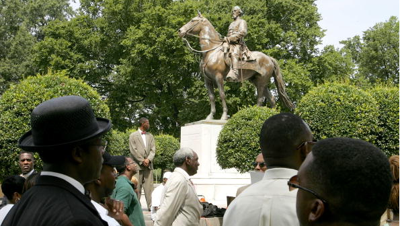
Embed from Getty ImagesOver at The Intercept, Liliana Segura has a really brilliant article on Nathan Bedford Forrest — the person and the political symbol. The whole thing is worth your time to read and if the last paragraph doesn’t make you queasy, I’m just going to have to assume you don’t have a stomach.
I want to focus on these paragraphs, here, though:
Among his many biographers, several have sought to make sense of Forrest’s outsized image. He was, in the grand scheme of things, a relatively minor player in the Civil War and was censured for war crimes. Yet he would swiftly become celebrated as one of the greatest generals of all time. In a deeply researched article for the Journal of Southern History in 2001, historian Court Carney describes how Forrest came to embody the pinnacle of Southern manhood; although less famous than Stonewall Jackson or Robert E. Lee, “Forrest exemplified the outlaw rebel spirit more than the taciturn but exalted figures of Lee or Jackson ever could.”There is little dispute about Forrest’s motivation for joining the Confederate army. “If we ain’t fightin’ to keep slavery,” he reportedly asked, “then what the hell are we fightin’ for?” Nor do Forrest’s defenders generally deny that he was the Klan’s first grand wizard. But they take umbrage at the widespread claim that he founded the KKK, emphasizing that Forrest was asked to lead the group after its formation in 1865. More importantly, they stress that he later disbanded the Klan, although there is much debate as to why.
Some argue that the dominant focus on Forrest as a Klansman obscures his more verifiable lifelong record of racial oppression. “We should think more broadly about what we are rejecting when we take Forrest from his pedestal,” writes historian Elaine Frantz Parsons, offering a monstrous array of little-known details about Forrest as a slave trader. As for his own eventual rejection of racism, such a legacy might be more credible if any of the monuments were built to celebrate his supposed conversion. Instead, like most Confederate memorials, they mark moments of backlash against racial advancement — and have remained touchstones for white nationalists. Yet defenders of Forrest tend to want it both ways: glorifying his militant image while insisting he disavowed it all in the end.
I’ve made a similar point before about Forrest’s popularity here in Tennessee. I firmly believe that his popularity, as well as being a “fuck you” to black people, is a fuck you to elite white people. Forrest didn’t need fancy schooling. He won battles when other “gentleman” Confederate generals were losing left and right. He was trash that made good. And that’s what makes him so potent as a symbol. He is a symbol of white supremacy, but he’s a symbol of the supremacy of the ordinary white man.
That, I think, is what makes him so hard to dislodge. If he were just a racist symbol or just a class symbol, he’d have less support. But as it stands now, when people are pissed off because of his racist symbolism, the people who are convinced Forrest is just like them rush to defend him.
And whenever snooty-patooty white people get all “Why do we have a [Forrest Hall/Forrest Ave./Forrest Hills subdivision]?” racists rush in to help defend Forrest.
You can especially see why, in a state like Tennessee, where the school systems are shitty and we are often thought of by the wider nation as a bunch of backwards hillbillies, some of us would feel loyal to a guy who made and remade himself in spite of his humble beginnings.
White people in Tennessee who love Nathan Bedford Forrest love him because they love the lies they’ve been told about him and they respect the people who told them those lies. Segura, for instance, may do a great job of showing how Forrest never stopped profiting off of the labor he stole from people who had no choice but to work for him.
But are you going to believe facts or the stories your grandpa, who you love and trust, told you? Stories he may have heard from his grandpa, who he loved and trusted?
It’s why this fight is so frustrating. The fact is that Nathan Bedford Forrest was a white supremacist who profited directly from the misery of black people and the destruction of black lives, who then went to war so that he could continue to enslave people and then he, at the least, oversaw a war crime so horrific against his fellow Tennesseans that his defenders have spent 150 years failing to find a way to excuse it.
His defenders are people in a fever dream, who insist we accept their dream logic as the first step in any discussion. The racist slave trader was really a civil rights icon. The first grand wizard of the Ku Klux Klan was really the enemy of the Klan. The man who made rape jokes about Frederick Douglass’s family members was really a great respecter of black women. The parks and statues honoring him all came into existence at the same time as white pushback against black social advancement, but that’s just an odd coincidence.
They are committed to believing the lie, not because they can’t accept that Forrest was a white supremacist murderer, but because they can’t accept that they could love someone evil, that their parents or pastors or teachers would teach them to love evil.
But there’s no way to change the fact that statues that honor Nathan Bedford Forrest honor a white supremacist who murdered black Tennesseans. And every time a white supremacist murders a person in this country, those of us not caught up in the fever dream are going to ask how we can continue to honor that.



