
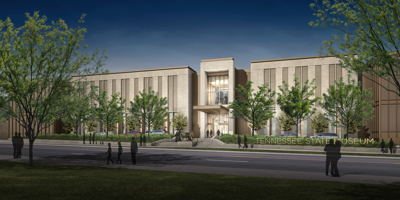
The competence of the Douglas Henry Tennessee State Museum Commission has been repeatedly questioned over the past six months, and I've done a lot of reporting on its missteps.
They dragged out hiring a new museum director far longer than any other state agency would have. They didn't notice the then-Commission Chair, Rep. Steve McDaniel gave the outgoing museum director, Lois Riggins-Ezzell, and her deputy director, Mary Jane Crockett-Green, possibly illegal 25 percent raises until months and months later (and then they just papered over the "error" with no discussion). They were going to keep Riggins-Ezzell on in retirement; then they weren't. Then the Tennessee State Museum Foundation hired her for some unspecified duties, and she was going to have an office at the museum, until she wasn't. They didn't even examine the bid-winning executive search firm's response to the RFP before hiring the company. And all of this is setting aside the fact that Riggins-Ezzell has made nepotistic and questionable hires for years and has maneuvered to stack the commission with her longtime supporters, most of whom question nothing, debate nothing, and make boneheaded suggestions like giving Crockett-Green another raise for running the ship for two months (or however long it takes until they find the poor soul willing to step in and try to reshape things).
State governance is often a mess — my god, just look at the Legislature — but a state agency overseen by a board of volunteers, many of who are unqualified to serve? It's a raw sewage spill filling up the entire basement.
Throughout all this, the current chair, Tom Smith, a developer and pal of Gov. Bill Haslam, has vacillated between naïveté, attempting to corral the less detail-oriented members of the commission, and throwing up his hands in the air. He's tried to talk me out of reporting stories because the negative press might hurt the search for a new executive director, he refused to talk to me for months until he suddenly started taking my calls again in late November, and he rather hilariously once referred to the Post as "the 'twitter blog' Nashville Post" in an email to commission members.
All of this has been rather farcical — it's a state museum, no lives are on the line. Sure, some taxpayer dollars have been wasted, but the museum budget — even with the new $160 million building under construction — pales in comparison to other agencies.
Still, as a journalist, Smith's continued willful misunderstanding of the state's Sunshine laws are driving this reporter batty (and he's honestly better than the actual staff of the museum, who seems to have never had any training on how open records and open meetings work). In September, he directed commission members to completely refrain from emailing each other, as I reported at the time:
"It has come to my attention that one or more Commission members have been communicating with other Commission members by e-mail," Smith wrote (in an email) last week. "Per my conversations with the Attorney General's office these e-mail communications could be viewed as discussions and/or deliberations in violation of Tennessee’s Open Meetings Act and otherwise foster a perception of a lack of transparency by this public body."Accordingly, in order to ensure that we are in full compliance with Tennessee’s Open Meetings Act, as Chairman, I am directing that that there be no further email communications between and among members of this Commission in their capacity as members of this Commission," Smith added (emphasis his).
However, Tennessee law doesn't say that communications between officials — whether via email, phone or text message — are a violation of the Open Meetings Acts, only that communications that include deliberations are.
"It certainly provides complete protection for the body," says Deborah Fisher, the executive director of the Tennessee Coalition for Open Government, of the blanket email ban. "But it's odd to cite transparency as a reason for it, because email is at least a public record."
Smith's email ban — which hasn't happened for most practical purposes — was all the more ridiculous as he had clearly had behind-the-scenes discussions with other members to negotiate Riggins-Ezzell's forced retirement. At the most recent meetings of the commission in December, Crockett-Green's temporary promotion (and raise) seemed like a sure thing at the end of the five-person search committee meeting. But by the time the full commission met, after several whispered conversations in the hallway (complete with dirty looks shot at this reporter while trying to overhear), one of the former supporters of the temporary promotion, Rep. Charles Sargent, had changed his mind and voted to delay any vote until the DHSMC's January meeting. Surely it wan't because Smith said something to him outside the meeting? Never.
The January meeting, originally scheduled for Jan. 9, was pushed to Jan. 24 to give the search firm more time to narrow the list of potential replacements for Riggins-Ezzell to hopefully present to the commission. But now Smith has added a bonus meeting to the agenda a day earlier — and unlike emails to each other, because it doesn't count as deliberation, it's apparently not open to the public.
In an email sent Thursday afternoon, Smith writes:
Ladies & Gentlemen of the Commission:First of all I'd like to wish each of you a Happy New Year!
On Monday, January 23, 2017 you are invited to an informational session conducted by the State's Department of General Services and the project managers of the new Tennessee State Museum to hear from the development team/architects/display planners on the progress of the new Museum. This meeting will be held in conjunction with the Tennessee State Museum Foundation Board who have also been invited. This is an informational meeting only and will be held at the General Services offices/conference room in the Tennessee Tower in downtown Nashville at 3:00 pm CST.
Please contact Sharon Dennis for parking and the specific location in the Tennessee Tower.
This is not a formal DHSMC meeting and attendance is of course, not required. No deliberations will occur at this informational session and it is not an open, "public" meeting. It is just to give anyone on the DHSMC who is interested the opportunity to catch up on the exciting progress of the new State Museum.
I hope to see you there!
Tom Smith
In some ways, this "secret" meeting isn't too much of a surprise, given that the state "steering committee" overseeing the design and construction of the museum has been meeting in closed, unnoticed, unrecorded meetings since the fall of 2015 — and, yes, Smith is on that committee. ("This group isn’t a statutory committee or a subcommittee of a statutory committee. Thus its meetings are not open to the public and meeting notices aren’t publicly posted," explains David Roberson, the spokesperson for the Department of General Services.)
But for the entire governing body of a state agency to be invited to meeting with staff from another state agency without public notice? That's not normal.
"While it’s true that that governing body members can talk to each other outside of a public meeting and even share information about government business without deliberating and violating the Open Meetings Act, it does seem odd that you would call everyone together for an in-person meeting on a update of a major public project and say the public or journalists cannot attend," writes Deborah Fisher, the executive director of the Tennessee Coalition for Open Government, in an email.
"So he’s trying to prohibit commission members from talking to each other outside a public meeting, even just to share information via email. But he’s holding a closed meeting for the entire board to get an update on a major project. This does not seem like open government to me, or good government. Nor what is intended by our Sunshine Law," Fisher concludes.
I contacted Smith about the closed status of the meeting, and he now says it is not happening.
"I just this morning learned that due to scheduling issues with members of the development team this information session is cancelled. An email to the commissioners will go out anytime regarding that. It was really no big deal and was just an invite to hear about progress. Not happening now," Smith writes in an email.
He later adds, "It was not a meeting. We were invited to an information session by the state. Since it wasn't a meeting it wasn't subject to open meetings act as there was to be no deliberation just being provided with an update."
Meanwhile, in her first week unofficially running the museum, Crockett-Green has terminated the museum's two part-time employees (including her sister), apparently saying it was under Smith's aegis so there would be funds to pay for the executive search firm — except those funds were already budgeted months ago. This follows the firing in November of curator Rex Weeks, who repeatedly filed complaints with the Department of Human Resources over Riggins-Ezzell's management.
Crockett-Green did not return a call for comment. Smith first emailed, "It's my understanding part time state employees serve at the will of their direct supervisor and may be terminated at any time without cause. I'd encourage you to get the state personnel 'facts' before you write an incorrect story."
When pressed on the specifics as to whether he knew about the firings in advance and whether they took place to pay for the search firm, Smith replied, "I was informed that 2 part time employees were being let go due to their jobs no longer being necessary. I don't have the authority to hire or fire or 'approve' such. I was provided this info as all Commission Chairs have been informed in the past of extraordinary matters in their conversation with the Director (or in this case the person at the museum who is Director of Admin). Perfectly routine.
"The museum is always looking for ways to minimize unnecessary costs. If these part time folks no longer had work to do then letting them go would in my opinion be an appropriate action. And certainly the extraordinary item of paying a search firm from a small operating budget such as ours puts us in a constant money-saving mode in all areas of operations I'd think. Simply being good stewards of taxpayer dollars seems to me. Mary Jane does not have 'my approval for future firings'. That's not my job."
If the museum is hit with lawsuits over the firings — which at this point is under consideration by more than one party — Smith might be rethinking how to best steward taxpayer dollars.



Post a comment as anonymous
Report
Watch this discussion.
(0) comments
Welcome to the discussion.
Log In
Welcome to the discussion.
Keep it clean. Please avoid obscene, vulgar, lewd, racist or otherwise abusive language. Comments featuring hate speech or threatening or violent content will not be tolerated.
PLEASE TURN OFF YOUR CAPS LOCK.
Be truthful. Don't knowingly lie or mislead.
Be proactive. Use the “report” link on any comment that violates our comment policy.
Share with us. We'd love to hear your feedback.