
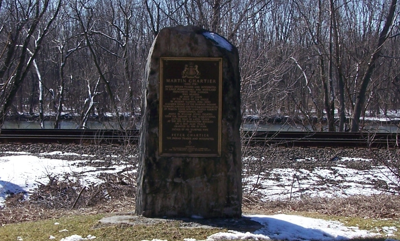

This marker for Martin Chartier stands just outside of Lancaster, Pa.
One weird problem that plagues Nashville’s early history — and I think we’ve talked about this before — is that there’s a bunch of information historians have that is so well-known to them that they assume everyone knows it which, actually, everyone does not know. And, in fact, if you’re a history buff like me, you might not even realize the question has been settled until you come across the information by accident.
Such is the case with Martin Chartier, who, it turns out, is well-known by scholars of early French explorers and the Native Americans they loved to have been the first white guy here. Like here we are being all “Oh, was it Timothy Demonbreun? But you know there was some trader named Charleville here before him and then, who knows?”
Well, the scholars of early French explorers and the Native Americans they loved know, but I guess no one ever thought to ask them or they’ve just been too busy eating cheese and drinking wine and working out the going rate for a beaver pelt to tell us or something.
But Martin Chartier. He’s our guy.
Martin Chartier was a French guy who’d come to Quebec with his dad in 1667. In 1674, he was with the Jolliet expedition that explored the Illinois territory. In 1679, he was with LaSalle as LaSalle ran around looking at things. Martin helped build two forts — Fort Miami and Fort Crievecour — and then he got pissed off and mutinied and burned Fort Crievecour down in 1680. Perhaps he had an inkling of what a hell-hole Peoria would become and was attempting to kill it in its cradle. We don’t know, but no one who’s been to Peoria blames Martin for his dramatically adverse reaction.
No one seems to know where Martin was — other than hiding from the French — for about a decade, but he pops back up in the 1690s with a Shawnee wife and at least one kid — Peter Chartier, who went on to be a Shawnee leader who spent a lot of time in Pennsylvania. Here is the known fact, so boring to scholars — Peter Chartier was born in the Shawnee trading post along the Cumberland run by his dad.
That Shawnee trading post?
That’s the fort Charleville used as a warehouse when he got here. That’s the old French Lick trading post Demonbreun worked out of when he got here. That’s the wooden structure Nashvillians tore down so they could loot the mound, but that wooden structure stood in some state of repair for almost a hundred years. It’s right here. Well, not any more, but where it used to be was right here. A lot of old sources say it was on top of the large mound — now gone — that sat seventy yards off the river, seventy yards north of French Lick Creek. On Sunday I went out to find the location of that old mound, based on those directions and, though there’s no historical marker there, it’s pretty easy to find. If you are on 2nd Avenue, just south of Jefferson and you get onto the greenway, you can see the low spot just south of the fish statue where the creek used to run (and still does, in a sewer tunnel). So, just come north from there a little shorter than a football field. You can see the river’s edge from there, so you just need to come west a little bit. By my reckoning, that puts you just south of the Jefferson Street bridge in a parking lot..
Let’s imagine it in Martin’s day. The salt lick stretched from where the ball field is now north. French Lick Spring sat just on the other side of what is now Jefferson. From Capitol Hill north to where the swamp started — what is now Metro Center — would probably, due to the enormous amounts of wildlife coming to the lick, have been a giant meadow. Martin and his friends and family perched up on that mound would have had a good view of anyone coming by river, trying to cross the river, or approaching from the west. Strategically, it was a good spot with great eye lines, plus you were surrounded by meat.
Okay, so there’s Martin Chartier in North Nashville, fur trading. The Chartiers, like I said, would go off to Pennsylvania, but here’s another thing I learned which the scholars of early French explorers and the Native Americans they loved seem to take for granted that everyone knows, which we don’t. Not all of the Shawnee in Chartier’s band went to Pennsylvania. Many of them were like, “Hey, we have a fort and a good spot and, once you leave, there won’t be any white guys here. That works for us.”
So, when Charleville, who may have been named Jean or may have been named Charles, shows up at the French Lick (and I never could discover whether it was called that because of Charleville’s presence or if it was already called that because of Chartier’s) in 1710 to trade with the locals, the locals were Shawnee who would have been used to having a French guy around, because one of them had been fucking a French guy for the past twenty years.
Since Charleville didn’t have the sense to marry a woman who would give him a famous son, what we know about him is a lot less. Like, we don’t even know what his first name was for sure. Every source I could find about him said that he came up from New Orleans. New Orleans was founded in 1718, so, unless Monsieur Charleville was a time traveller, probably not.
The other reason it doesn’t make sense for Charleville to have been from New Orleans is that the Southern French intermarried with the Creek and the Creek and the Shawnee were mortal enemies. Would the Shawnee have accepted a trader among them who could have been allied with their enemy? It seems unlikely. But might the Shawnee have accepted another French guy from the north? Maybe.
The trouble with trying to deduce anything here is that, of course, massive networks of French trading families were establishing themselves up and down the Mississippi River. There have been Charlevilles in New Orleans for hundreds of years and we’re trying to guess if a Charleville might have been in the area a few years earlier and sent to French Lick (for lack of a better name for it). But surely Charleville did trade with New Orleans.
And in 1714, according to some sources, he and many Shawnee traders were killed by the Chickasaw (which certainly suggests he was, indeed, trading in New Orleans, since you had to go through them to get to New Orleans). But according to other sources, he survived the attack and lived to be an old man in St. Louis. If he was in St. Louis for the rest of his life, that kind of suggests he came from the same bunch of people who settled Kaskaskia (in 1718, Kaskaskia became the capital of the Upper Mississippi, for some context about how important it was) and, indeed, when Timothy Demonbreun later lived in Kaskaskia, there were quite a few Charlevilles in town.
Okay, so now we have a really good idea of how Timothy Demonbreun learned of this spot. Frenchmen had been here on and off since 1690 and, at the least, he knew relatives of the second guy who’d traded here.
But, in researching this post, I think I may have accidentally stumbled on why Timothy Demonbreun was here. See, I was trying to figure out where all the French people in the south would have been in the decades before Demonbreun decided to come here. And so I was looking at the French intermarriage with the Creeks.
Now, remember, Southern Indians intermarried with European fur traders in mutually beneficial arrangements that gave European traders access to vast quantities of furs farmed by people with generations of expertise in hunting on this land and gave Indians access to global markets for their furs. The two biggest markets in the early 1700s were the French, who controlled the Mississippi and parts of the Gulf, and the British who controlled the port at Savannah. The Cherokee, for instance, intermarried with Scottish fur traders. The Shawnee, as we’ve been discussing, intermarried with the French.
The Creek, at first, intermarried with the French, because, in 1717, the French opened Fort Toulouse on the eastern border of French territory in what is now Alabama, what was then Creek territory and everyone got along really well. Captain Marchand married a Creek woman in 1720. In 1722, his men mutinied and killed him, but not before he’d fathered a child (or maybe two) with the Creek woman, Sehoy. Marchand’s bad fortune notwithstanding, this cemented Creek trading with the French for a generation.
But when Marchand’s Creek daughter grew up, she married a Scottish guy, Lachlan McGillivray. Dun dun dun! Now, in the mid-1700s, the Creek don’t trade with the French; they trade with the British in a series of trading posts McGillivray set up in Northern Alabama.
Who else is living in Alabama at this time? Peter Chartier, son of Martin, and some of his band of Shawnee! In 1755, Peter Chartier decides that living so near the Creek sucks and he’s going back to Nashville, er, French Lick, where, and this is pretty damn interesting — there’s still a Shawnee settlement. In 1756, the Chickasaw manage to drive the Shawnee from that settlement (it’s not clear, but it seems like the Chickasaw had been somewhat uneasy with the small band of permanent residents for a long time, but not enough to run them off until Chartier and his group showed up. Then the Chickasaw were like, “Oh, hell no”), but the Shawnee, at least in some small number, have had a permanent settlement just north of what is now downtown since at least 1690 — almost seventy years..
Shortly thereafter, in the early 1760s, Lachlan McGillivray, the Scottish guy married into and trading with the Creeks in Northern Alabama, retires to Savannah. McGillivray’s son (who’s going to be important historically, if not in this post) wasn’t old enough to take over the business. So, it’s not clear who’s going to be trading with the Upper Creek — France or Britain. And, sure, the Shawnee have left, but how gone are they really from a place they’ve lived for seventy years?
Might a man with an enterprising mind and the cockiness of youth have an opportunity to reestablish French trade with the Upper Creek if he were to, say, sit in a spot where people knew to look for a French trader? And if the Shawnee came back? That’s fine, too, right?
So, here comes Timothy Demonbreun, sidling on up to the same old fort some Frenchman has always used for this very purpose — to seduce the locals. Oh, wait, no. To build a trading empire.
I still believe Timothy Demonbreun is the most important early Nashvillian we know too little about, but we now know this: He was here for a reason and that reason was that Lachlan McGillivray’s retirement opened up an opportunity for the French to reclaim some of the fur trade McGillivray had taken from them ... the European fur trade first started in the area by our new friend, Martin Chartier, First White Guy of Nashville.



Post a comment as anonymous
Report
Watch this discussion.
(0) comments
Welcome to the discussion.
Log In
Welcome to the discussion.
Keep it clean. Please avoid obscene, vulgar, lewd, racist or otherwise abusive language. Comments featuring hate speech or threatening or violent content will not be tolerated.
PLEASE TURN OFF YOUR CAPS LOCK.
Be truthful. Don't knowingly lie or mislead.
Be proactive. Use the “report” link on any comment that violates our comment policy.
Share with us. We'd love to hear your feedback.