
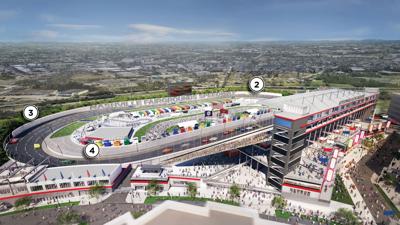


Nashville Soccer Club owner John Ingram wrote to members of the Metro Council Wednesday to express “significant concerns” about Mayor John Cooper’s plan to help fund major upgrades at the Nashville Fairgrounds Speedway.
Cooper, who seeks to lure top-level NASCAR races back to the city, filed his legislation related to the plan last week, and the Metro Council will consider it in the coming months. As part of the proposal, Speedway Motorsports (a track operator that runs Bristol Motor Speedway) would operate the facility, located adjacent to Nashville SC’s Geodis Park.
The state of Tennessee and the Nashville Convention & Visitors Corp would both chip in $17 million, though debt service over the life of the project is estimated to top $160 million. Under the proposal, Metro plans to pay off the debt via sales taxes collected on site, advertising and sponsorship revenue, ticket taxes, gross revenue sharing and yearly payments from Speedway and the Nashville Convention & Visitors Corp.
In his letter, Ingram emphasizes that he and the Major League Soccer franchise are “not against racing.” He also cited the team’s work with neighborhood groups that “are worried about the campus and the effect of further expansion.”
Specifically, Ingram said he is concerned about the financial implications of having two similarly sized stadiums adjacent to one another and competing for the non-soccer and non-racing events both could host. (Geodis will host its first concerts this summer.)
From the letter:
“We are also concerned about having two 30,000-seat facilities literally side-by-side, which seems to be a recipe for disaster that could threaten the economic integrity of both projects, and not to mention the significant negative effect on the surrounding neighborhood and fan experiences. We have guaranteed our investment at the Fairgrounds, but if the expanded racetrack isn’t able to provide the revenue necessary to pay for the entire debt service, we will all pay the price.
We are responsible for repaying 100% of the debt service on the stadium revenue bonds ($225 million) on top of our separate investment of over $150 million towards its construction. Simply put, if a competing 30,000-seat venue were built next door, it would directly affect our business and put Metro in a position of having to favor one venue over another. A racetrack expansion of this size was never imagined when we made our agreement with the city.
…
We would hope the city would not do anything that could cause harm to any of the parties currently operating there and would hope we would hold all parties to equitable expectations as they relate to protecting taxpayer resources."
Added Cooper via a spokesperson:
“Racing has been a proud part of the Nashville Fairgrounds for 118 years. The Metro charter requires Nashville honor that tradition, but also does not provide a mechanism to pay for it. This proposal brings private investment to a neglected part of the Fairgrounds, and would result in racing that is 1) safer for fans and drivers, and 2) less noisy for the neighborhood by building a much-needed sound wall. The proposal also adds hundreds of parking spaces for soccer games, which has been an ongoing point of frustration for soccer fans.
“As racetracks and other sports venues co-exist beautifully in many other cities, like Kansas Speedway and Sporting Kansas City (MLS) for example, surely that can happen here too. We’re looking forward to the conversations ahead, which we expect to include robust and meaningful community benefits, similar to the ones implemented by the soccer stadium proposal.”
This article first ran via our sister publication, the Nashville Post.



