
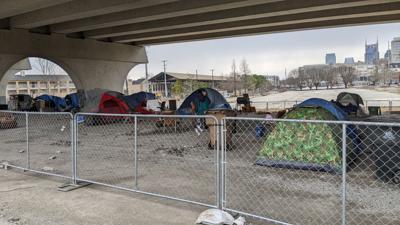

On Saturday, the city fenced off the area underneath the Jefferson Street Bridge that has been the location of a homeless encampment for many years.
Harriet Wallace, the public information officer for the Homeless Impact Division, says that all residents of the camp have been housed or placed into a "housing situation." It was part of a pilot program to house members of camps, and Wallace says they are ahead of schedule — the city's goal was to house members by mid-February. The Salvation Army has assisted with the effort.
Wallace says the plan was to wait until everyone had been housed to section off the area. She says they didn't kick people out — there was a "strategic and organized" effort to move people into safer and stable places. Not everyone is in a permanent home, and may instead be in places to help them with addiction or mental health services. All are known to the Homeless Management Information System (HMIS), and can receive further help.
The Scene visited the campsite and still saw at least five people at the camp. A section of the fence was open and allowed access to the tents that remained.
One man at the camp, who calls himself Alaska, says he was surprised to see the fence go up on Saturday morning, and that he hadn't heard any warning that it was going up. He likes the fence, and says it helps contain the camp's clutter. When asked if he was placed into a housing situation, he says he "didn't give his name" to outreach workers.
Reached for further comment, Wallace says that Monday is "the last day we pick up transition of the residents," and that the last resident of the camp should be relocated by Feb. 18. Anyone else at the camp that day will be placed into the coordinated entry system, which uses the HMIS to match people experiencing homelessness with the resources they need.
The pilot program sparked frustrations on Wednesday at the monthly Continuum of Care Homelessness Planning Council. Some members of the council said the program was being implemented without their feedback or a proper vetting process. Interim director of the Metro Homeless Impact Division Jay Servais said he had presented the plan in a previous meeting and that all campers under the bridge were known to the city.
Wallace says the Homeless Impact Division hopes to release a report on the pilot program by the end of next week.
Councilmember Ginny Welsch calls the fence "appalling," and says the program circumvented the city's coordinated entry system. Welsch and advocates have argued that because people get prioritized by needs and vulnerability, members of the camp are jumping the line.
Metro had announced the closure of the Jefferson Street Bridge camp back in June 2021, but some campers still remained.
Update: Open Table Nashville, a nonprofit that performs outreached to unhoused communities, released a statement after the fence was put up. "Closing this camp only attempts to remove visible homelessness from the downtown core and does nothing to competently address the complex and systemic issue of homelessness," the statement reads. "This action will only force individuals experiencing homelessness, both presently and in the future, to exist in places that are even more visible — such as on sidewalks, in door ways, and near business storefronts."
The organization also voiced its "support [for] Council Member Ginny Welsch’s motion to call MHID Director Jay Servais and MSS Director Renee Pratt to come before the Metro Council Human Relations Committee" on Monday, Feb. 14, at 3 p.m.
Open Table Nashville also criticized the plan in a lengthy statement released after the Homelessness Planning Council meeting.



Post a comment as anonymous
Report
Watch this discussion.
(0) comments
Welcome to the discussion.
Log In
Welcome to the discussion.
Keep it clean. Please avoid obscene, vulgar, lewd, racist or otherwise abusive language. Comments featuring hate speech or threatening or violent content will not be tolerated.
PLEASE TURN OFF YOUR CAPS LOCK.
Be truthful. Don't knowingly lie or mislead.
Be proactive. Use the “report” link on any comment that violates our comment policy.
Share with us. We'd love to hear your feedback.