


[Editor's note: We here at the Scene are blessed to work with J.R. Lind, in part because we get to experience — daily — his lengthy Slack screeds expounding his theories on a wide variety of subjects. For example, why The Bellamy Brothers' "Let Your Love Flow" is a Christmas carol, how Dirty Dancing is an allegory about the history of the American left after World War II, and why orderly bison are to blame for our city's transit woes. Rather than keep this bricolage of verisimilitude to ourselves, we've asked him to share some of his declamations with our readers.]
Remember when ramps were A Thing?
Some time between 2012 and 2014, fancy restaurants went absolutely ham-sandwiches over Allium tricoccum — sometimes dressing it up with less occlusive names like "wild leek" — and in 18 months, the price jumped more than eight-fold by the pound in many places. This came as a shock to those of us with Appalachian forebears, many of whom came out of the hills and into the cities, such as they were, in part so they no longer had to eat things like ramp. No doubt many guffaws were had in places like Flag Pond and Reliance, where they've been holding festivals for the ramp for decades.
The ramps' gussying-up came about a decade after the Tennessee General Assembly took time out from whatever it is they were doing and declared the tomato — technically per the code, "the delicious tomato" — as the state fruit, nodding to Nix v. Hedden. Kudos, by the way, to that long-ago legislature for leaving it open to interpretation as to the particular variety so honored and to its provenance. We need no fisticuffs between the legislators from Grainger and Lauderdale counties as to who produces the finest tomato.
Tomatoes are, of course, a delicious and essential part of any good Tennessean's summer diet. The tomato is also ubiquitous and isn't particularly "Tennessee," in the same way that milk — officially the state beverage — isn't particular to the Great State. Thus, naming the tomato the state fruit is a travesty nearly on par with naming the cave salamander rather than the hellbender as state amphibian.
Tennessee's true state fruit is the pawpaw, which — if there were any justice or convenient way to preserve them — would be fetching $20 a pound from weirdo New York chefs.
Pawpaws
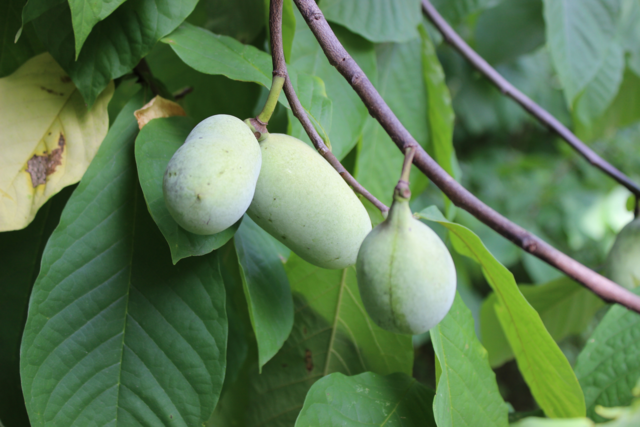
The pawpaw — which has numerous other names your grandma used, usually "[geographic place name] banana," though I like "hillbilly mango" — grows in a range from the Great Lakes dang near to Florida. Tennessee is smack-dab in the center of its natural range. The fruit of the pawpaw is the largest native fruit to North America, unless you're a dork and you say something like "but pumpkins are fruits." Yes, true. That being the case, please include a pumpkin in your kid's school lunch.
With a custard-like texture, the pawpaw tastes far too tropical to grow where it does, as it's some kind weird amalgam of the aforementioned mango and the banana. In fact, it's been said that it's the Hoosier banana's Caribbean flavor that inspired The Beach Boys to pen a song about a beach getaway to a midsize Indiana city (no one said this).
The pawpaw fruits in early fall, which would presumably be now if it hadn't been 95 degrees last week. Unless summer's devilish grip on September burned them all off, though, they should be available for picking around the first week of October, once their leaves turn from green to the distinctive rusty-yellow.
But you have to know where to look. Remember this ancient mnemonic which I just made up: Near the banks and by the planks.
Pawpaw trees love bottomlands near creeks and rivers when they are in more forested areas, and they tend to grow "clonally," which is how tree people say "if you find one, there's probably more." In less sylvan environs, like your backyard, they'll like formerly clear-cut areas, such as along fencerows, extant or not. The old-fashioned way to find the tree is to stand on top of a hill and scan for a patch of rusty-yellow on the edge of the woods or near a body of water.
There are some false friends out there who give off that distinctive color and, barring the early emergence of the fruit, you'll need other ways to find your quarry. The trunks are generally smooth, but sometimes they have those bumpy bits on them. The leaves are, again the parlance, "alternate and spirally arranged." In other words, a leaf on the branch won't have a partner on the other side; the next leaf will be pointing the other way. Because the leaves are wider on the end than they are near the branch, they tend to droop, looking rather like bananas themselves. The telltale sign is to smash up a leaf and smell it. It should smell like a bell pepper.
Even if you have yourself a pawpaw, there's no guarantee you'll get the fruit. "But J.R., in my backyard, there are bees and butterflies and hummingbirds and plants and birds and rocks and things and sand and hills and rain." Great reference, but that means diddly squat.
The pawpaw — as befitting its future as our state fruit — doesn't use fancy butterflies to pollinate. That's uppity. No, friends, our pal has truly foul-smelling flowers and counts on things like carrion beetles and blowflies and other poop- and corpse-loving insects. Mountain types (allegedly) used to toss chicken parts on the branches of pawpaws to encourage the bugs to do their business. So if you happen to be out in the spring and spot some bright-purple flowers that reek of rotting chicken backs, you might have a pawpaw. Or there might be a rotting chicken back in your irises. Either way, you should check it out.
So if it all comes together, what do you do if you actually have a fruiting pawpaw? Well, eat them, for one thing, but do it fast. At best, they'll keep for a couple of days, maybe a bit longer if refrigerated. They bruise easily and turn with the quickness, which is likely why they aren't showing up ramp-style on restaurant menus. They might be suitable for shipping if they can be hard-frozen quickly. So if you do have a patch (like sweet Nellie), a deep-freeze and a willing buyer, you're golden.
Were I to have my druthers, hunting pawpaws for fun and profit would be on a level with ginseng and morels, grove locations kept as secret as boomshaws are in Wilson County.
But I'll settle for the state fruit travesty to be rectified.



