
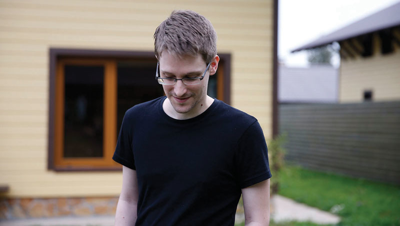
The NSA surveillance leaker Edward Snowden evokes mixed and confusing reactions. A poll last spring found Americans split more or less equally among those who think he did the right thing, those who think it was wrong, and those who aren't sure. More people want him prosecuted than don't. Yet when asked if Americans have a right to know about the surveillance programs Snowden's leaks revealed, people say yes by a 2-to-1 margin. The guy may not be winning popularity contests, but a lot of us are OK with the fallout from what he did.
Filmmaker Laura Poitras falls in that category, to judge from her absorbing new documentary Citizenfour. Poitras was already at work on a film about domestic surveillance when Snowden made contact in early 2013, telling her with no small measure of understatement that "this will not be a waste of your time." ("Citizenfour" is the handle Snowden used in those initial emails.) Reimagining her project to envelop Snowden and the Guardian journalists who first reported the story, Poitras made a film that is less polemic than character study, though the polemics are there. Despite telling The New Yorker "I don't go into films because I want to make an ideological or political point," Poitras' Citizenfour sounds a high-decibel level of alarm about privacy and surveillance.
The film's center, dramatically and chronologically, is the middle hour focusing on the fateful encounter of Snowden, the Guardian's Glenn Greenwald, and documentarian Poitras (behind her camera, occasionally heard but never seen) in a Hong Kong hotel room for eight days in June 2013. Poitras' camera was rolling from the start, giving us a front-row (bedside?) seat as history unfolds. Columbia Journalism School dean Steve Coll likens it to having footage of Bob Woodward's first parking-garage meeting with Deep Throat.
From this seemingly mundane procedural footage, we learn that extended sequences of a few people talking in a hotel room, working on laptops, watching television, munching on room service and taking an occasional phone call can be downright spellbinding. Some of the appeal is pure-form dramatic irony: We know more than they do — "they" in particular Greenwald, the intrepid journalist and commentator who will share Snowden's revelations with the world. The viewer knows too the significance (and danger) of the information Snowden is sharing, and watching Greenwald take it in makes for a fascinating kind of journalistic voyeurism.
It also provokes genuine suspense. Snowden tells Poitras early on, "I already know how this will end for me." If only. We know that in the short run Snowden winds up in his current exile in Russia, but the ultimate outcome of what we're witnessing — his noble perfidy, a two-word descriptor that perhaps Snowden's admirers and despisers both can live with — has yet to be written. Given the powerful and potentially ruthless forces behind the curtain of surveillance he's opening, that uncertain future looms large in the hotel room and on the screen — not just for Snowden, but for Greenwald and Poitras as well.
Perhaps most intriguing is the puzzle of Snowden himself, the unassuming guy in his late 20s who would touch off an intelligence-embarrassment maelstrom of Daniel Ellsberg proportions. In numerous lengthy close-ups, Poitras invites us to take a careful measure of this fellow, to decide for ourselves who he is and what he's about. Once Greenwald files a story that reveals Snowden's identity to the world, after several days in the hotel room, Poitras permits us to witness an especially trenchant moment: the expression on Snowden's face as he watches CNN report on him, the secret no longer safe, himself likewise. Is he the unassuming man of principle he wants us to think he is, so offended by NSA doings that he will sacrifice his freedom (and possibly his future) to right a wrong? Or is he a garden-variety narcissist who figured out how to parlay a security clearance into a one-man global reality show and left-wing celebrity? Of course, there's another unsettling possibility — that he's just a naïve young guy who couldn't tell the difference between whistleblowing and treachery.
Given Poitras' impressive body of work — Citizenfour completes a trilogy on the impact of the War on Terror that began with 2006's Oscar-nominated My Country, My Country (about the Iraq occupation), followed by 2010's The Oath (about Guantanamo) — the film's abundant technical merits are hardly surprising. It is visually sophisticated, at times clever, with a keen sense of drama in the compositions and effectively sparse use of music. One quibble: The last quarter of the film, once Snowden has gone underground in search of a safe haven, gets a bit disjointed as Poitras stitches together her larger argument about surveillance.
Still, an unusual element after the closing credits testifies to the need for the movie's existence: an acknowledgement of the encryption tools that made it possible. It's a chilling reminder that Citizenfour isn't just a documentary about a leaker who took some risks; the making of the film was itself an act of civil disobedience that placed in real jeopardy the people involved on both sides of the lens. Is Snowden a hero or a pariah? A patriot or a betrayer? Thanks to Poitras' courageous and essential film, you can look him in the eye and decide for yourself.
Email arts@nashvillescene.com.



