

Tensions were high at the Capitol this week as protests against a bill targeting immigrant students continued and Rep. Justin Pearson (D-Memphis) and Rep. Andrew Farmer (R-Sevierville) clashed over gun reform legislation in a House subcommittee.

Democrat-led gun control bills fail in committee as Pearson delivers impassioned plea related to his brother's death
However, the House Criminal Justice Subcommittee did give bipartisan support to newly minted Rep. Shaundelle Brooks (D-Nashville) for a bill honoring her son, Akilah DaSilva, who was shot and killed during the Waffle House mass shooting in Antioch in 2018. Akilah's Law would hold accountable people who provide a gun to someone who is not allowed to possess one by law. The bill saw testimony from Brooks' younger son as well as James Shaw Jr., who was able to wrestle the gun away from the shooter.
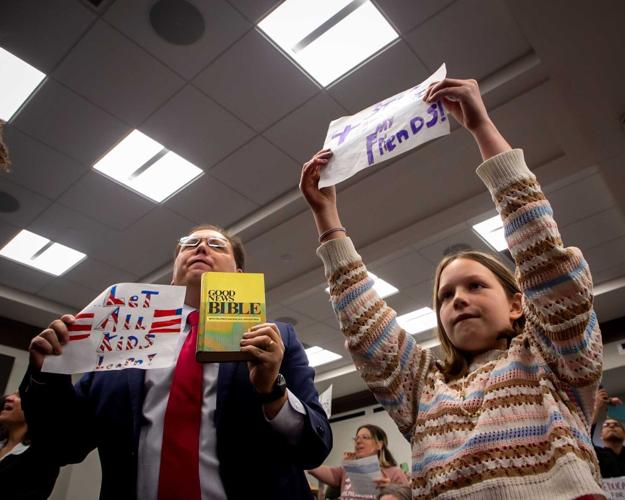
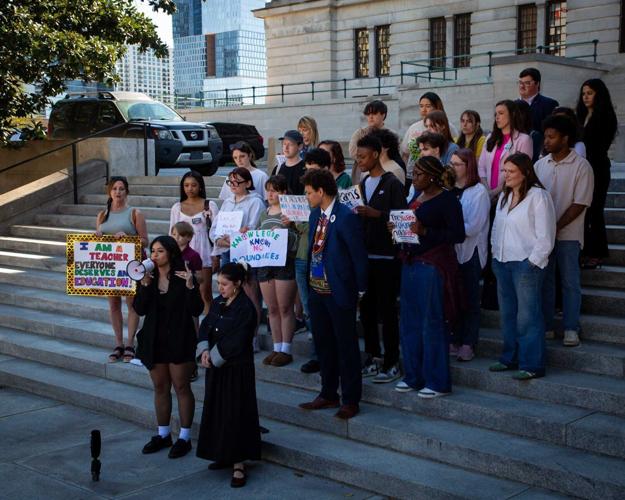
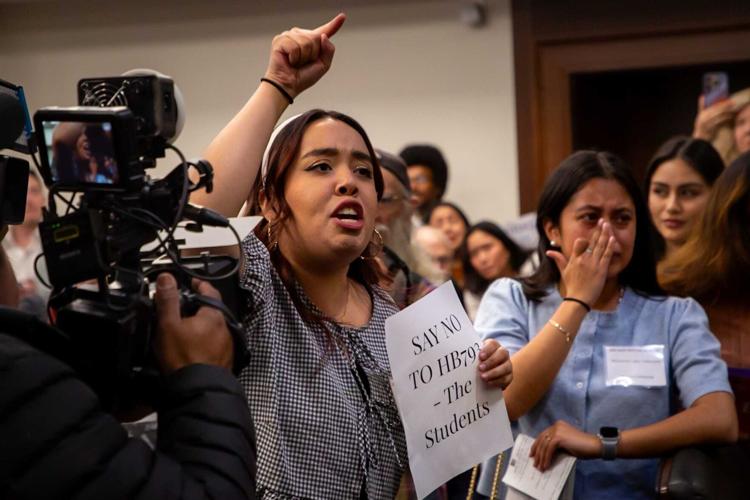
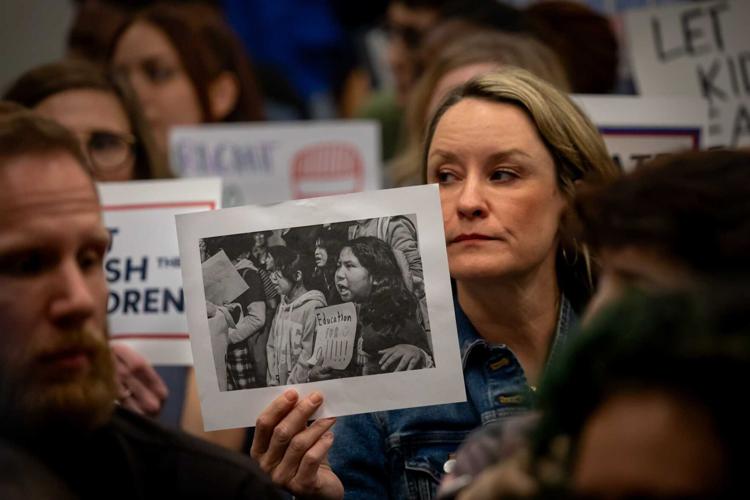
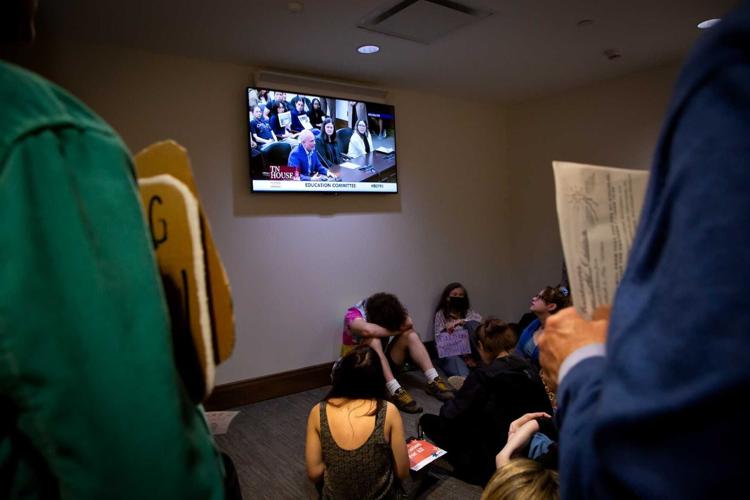
Dozens continued to protest HB 793/SB 836, a bill that would limit undocumented students’ access to public education. The legislation would allow local school boards to bar undocumented students from enrolling in public schools. An amended version of the bill that passed the House Education Committee on Wednesday would allow public schools to charge tuition for undocumented students.
The bill poses a challenge to Plyler v. Doe, a 1982 Supreme Court ruling ensuring the right to public education to all children regardless of their immigration status. Rep. Gino Bulso (R-Brentwood) called the ruling an “abomination” during Wednesday’s committee.
As the committee wound down, protesters rose from their seats and began singing and chanting, which led the lawmakers to take an abrupt vote and adjourn. The bill passed 11-7 with three Republicans crossing party lines to vote in opposition: Reps. Charlie Baum (R-Murfreesboro), Tim Hicks (R-Gray) and Mark White (R-Memphis). It will be heard next in the House Government Operations Committee on an undetermined date and the Senate Finance, Ways and Means Committee on April 1.
School Curriculum
Several bills working to alter public school curriculum advanced through the General Assembly this week. SB471 / HB178, sponsored by Sen. Janice Bowling (R-Tullahoma), passed the Senate and would establish family life curriculum that teaches students the “positive and personal societal outcomes” of earning a high school diploma, entering into the workforce or higher education, getting married and having children.
The Republican-led bill passed the Senate along party lines. Sen. London Lamar (D-Memphis) argued that it is not the role of public schools to teach this sequence of life events.
“As a woman in this body who has served, who has made history, who fights for maternal health, who loves her community — [I am] also a single mother who’s not married with a child,” Lamar said. “It is not our job to instill a curriculum to make kids feel bad about what situation they were currently born in or what situation they choose to decide to go into, like myself.”
The bill will be heard before the House Education Committee on April 1.
The Teen Social Media and Internet Safety Act, which passed the House this week, would require the Tennessee Department of Education to develop a curriculum for the instruction of social media and internet safety for students in middle and high school. This would include the teaching of time management and healthy behaviors on social media, negative effects of social media on mental health, distribution of information online and the importance of evaluating information generated by AI.

Protesters confront lawmakers during the March 26, 2025, House Education Committee, which passed a bill targeting undocumented students
Pre-K and Child Care
Sen. Charlane Oliver (D-Nashville) sought to enact the Universal Pre-K-Funding Act, which would have cut preschool costs for working families, in an effort to offer universal pre-K for every 4-year-old in Tennessee. That bill failed this week in the Senate Education Committee and the House K-12 Subcommittee.
During the 2024 legislative session, Oliver also proposed a series of bills that would reform the Department of Human Services’ Smart Steps program, which offers child care payment assistance for low-income families at participating centers. Those bills were ultimately shot down.

Protesters oppose HB 793, a bill that targets undocumented students
Health Care and Vaccines
After passing unanimously in the Senate, a bill now on its way to the governor’s desk would create an advisory task force to continue study of reimbursement rates for the providers serving those on state support, including the CHOICES program for seniors and those with disabilities. Sen. Becky Massey (R-Knoxville) explained that the task force replaces a previous time-limited task force and will offer yearly reports in an effort to “properly and adequately” pay direct support staff across the state.
“These are the folks that are serving our most vulnerable people,” Massey said.
A bill that would provide legal protections for people who don’t vaccinate their children passed the Senate and is headed to the House. SB 1389 from Sen. Bo Watson (R-Hixson) would prohibit health care providers who accept TennCare from refusing services based on immunization status. Child vaccination rates have plummeted in the past decade in Tennessee, and “freedom from vaccination” has been a theme in the Tennessee General Assembly in recent years. The Tennessee Department of Health confirmed a case of measles in Middle Tennessee in early March.
“TDH encourages consultation with your medical provider about measles prevention,” the organization states in a press release. “Two doses of the MMR vaccine are highly effective at preventing measles.”

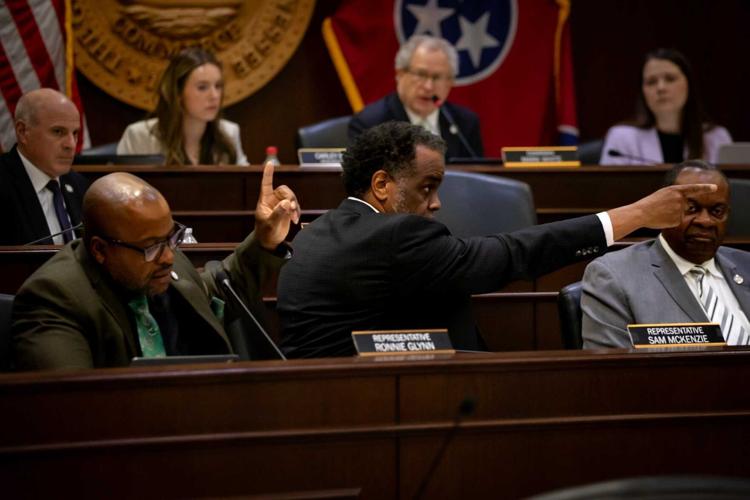
Democratic Rep. Sam McKenzie points at House Majority Leader William Lamberth (not pictured) as the lawmakers argue during the March 26, 2025, House Education Committee
Budget Amendment
Gov. Bill Lee’s administration revealed the details of its $345.9 million budget amendment this week. Commissioner of finance and administration Jim Bryson updated the Senate Finance, Ways and Means Committee on the changes to the budget. During the meeting, he acknowledged the slow-down in revenue as being a sort of return to normal. The numbers have nearly flattened but are still expected to grow by 2 percent.
“We had tremendous growth for about three years and now we have leveled off,” Bryson said. “The good news about this is we are not losing ground. The growth was not a bubble. It appears to be a permanent growth.”
After the changes in the amendment, the FY26 budget comes in at $59.76 billion — 1.3 percent less than FY25’s $60.56 billion budget. A majority of the funding for the amendment comes from $200 million of treasury earnings. Chairman Bo Watson (R-Hixson) made clear to the members that those earnings are due to money that had been set aside for the COVID-19 pandemic but remains unspent. Normal treasury earnings are usually around $5 million.
Next, the legislators will provide their own budget amendment and work to reconcile their spending priorities with those of the governor’s office before finally passing the appropriations legislation through both chambers.



