
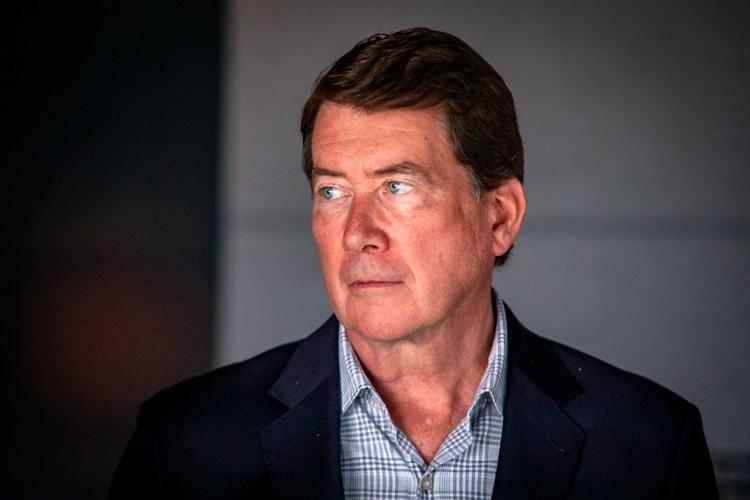



Republican U.S. Sen. Bill Hagerty began his statewide economic development tour in Spring Hill Wednesday by visiting Worldwide Stages, an entertainment production venue.
Hagerty also made stops in Shelbyville at the Musgrave Pencil Company and Southern Precision Machining as well as at automotive components supplier Meiwa in Lewisburg, which he helped bring to the state in 2013 as commissioner of the Department of Economic and Community Development.
Touting the leadership of Tennessee, Hagerty said he's proud the state is thriving and added that his colleagues in the U.S. Senate likely envy that. He recognized the creative talent in the state and its history in that regard. Earlier this year, Tennessee was the first state to protect artists' intellectual property against artificial intelligence with the Ensuring Likeness Voice and Image Security (ELVIS) Act.
"It makes complete sense, actually, that it would start here in Tennessee, because we have an industry here and people that are thought leaders in protecting intellectual property, particularly in the songwriting space," Hagerty said. "I'm proud that we take a leadership role in these sorts of things. It always seems to take longer at the federal level to get things done, but Tennessee, again, is setting the standard."
He said it's been difficult to pass legislation through Congress during an election season when Democrats — particularly Senate Majority Leader Chuck Schumer, said Hagerty — control the motion to the floor.
"I think it frustrates Tennesseans to no end that they see a congressional body like the Senate almost screeched to a halt," Hagerty said.

Sen. Bill Hagerty and Worldwide Stages CEO Kelly Frey talking with Spring Hill Mayor Jim Hagaman
As for how to help everyday Americans facing economic burden despite growth in the business sector, Hagerty said he recognizes people are deeply feeling that inflation is outpacing their wages.
"Even though economic development is working well in Tennessee, and I think the economy at a very basic and fundamental level is doing well, inflation has taken over," Hagerty said. "We've seen inflation like we haven't seen in 40 years, and that's because of the policies that have been adopted from day one by the current administration."
He claimed the U.S. GDP growth rate was twice that of any other major world economy before the pandemic, and added that under the Biden administration the U.S. has less of a competitive advantage. At one point, Hagerty said the country's Trump-era economy was growing at twice the rate it is today, which is not true. Hagerty was correct that the GDP growth rate of the U.S. was higher than those of other advanced economies pre-pandemic, but that is also still the case today.
Scene sister publication the Nashville Post reviewed data of the GDP from former President Donald Trump's time in office as well as President Joe Biden's current administration.
The growth rate in 2017, Trump's first year in office, was 2.5 percent. The rate increased to 3 percent in 2018 but returned to 2.5 percent in 2019. By the time Trump left office in 2020, the rate was -2.2 percent due to the pandemic.
Biden's first year in office saw the opposite extreme, with a growth rate of 5.8 percent in 2021 due to the economy's post-pandemic rebound. In 2022, the rate flattened to 1.9 percent and was back to the Trump-era level of 2.5 percent growth by 2023. While there's not yet a full year of data for 2024, the second quarter percent change in growth reported at the end of July was 2.8 percent.
As for how that stacks up to other countries, looking at the growth by dollar amount instead of percentage shows the U.S. economy's strength by comparison. But when using Hagerty's comparison of growth rate itself, the U.S. is not more than two times any major economy. The U.S. is outpaced by China in both the Trump and Biden years. The U.S. does beat the G7 countries, if that's the measure of major economies Hagerty was referencing.
Using pre-pandemic 2019 as an example, the U.S. GDP of 2.5 is greater than Germany's 1.1 percent growth rate or the 1.6 percent of the United Kingdom. But it's about on par with the 2.2 percent reported rate of Russia and South Korea.
In 2023, the 2.5 percent U.S. growth rate fell below Russia's and China's reported rates of 3.6 and 5.2 percent, respectively.
The U.S. rate isn’t quite two times more than Japan’s 1.9 percent rate, but it is nearly two times that of South Korea's 1.4 percent and significantly higher than the European Union's 0.5 percent rate.
This article was first published by our sister publication, the Nashville Post.



Post a comment as anonymous
Report
Watch this discussion.
(0) comments
Welcome to the discussion.
Log In
Welcome to the discussion.
Keep it clean. Please avoid obscene, vulgar, lewd, racist or otherwise abusive language. Comments featuring hate speech or threatening or violent content will not be tolerated.
PLEASE TURN OFF YOUR CAPS LOCK.
Be truthful. Don't knowingly lie or mislead.
Be proactive. Use the “report” link on any comment that violates our comment policy.
Share with us. We'd love to hear your feedback.