
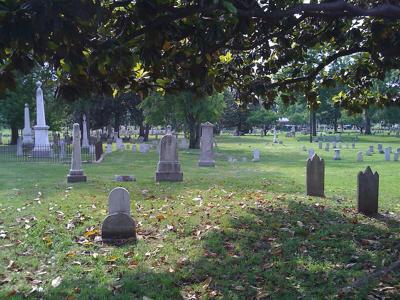


Nashville City Cemetery
Listen, I was going to write something about Rep. Bruce Griffey and his proposed bill in honor of Kyle Rittenhouse, but it’s only funny for two reasons: 1. Of course Tennessee lawmakers would want to honor someone who went to another state to shoot someone. Griffey could just go ahead and honor Andrew Jackson, but alas, that would mean admiring a Democrat. 2. Rittenhouse’s mom drove him to his shooting. This big old hero who “deserves” a law and a proclamation had a chaperone? Picture me laughing for 1,000 years. If I feel bad for Rittenhouse in the slightest, it is because he is not quite stupid enough for all this adulation to rest easy on him. And I think you can already see him struggling with the slow dawning realization that he has become a symbol for people he doesn’t like very much. But that’s just my opinion.
So I decided it would be more fun to dig back into the city’s database of enslaved people, which I mentioned last week. I picked Frankey Harrison to look at more closely. Frankey’s in the database because in her will she gave three people — Fanny, Elisha, and Eliza Francis — to her sister Dilcey Childress, and Frankey was a free woman of color. Even now, slavery apologists tend to point to these instances of Black slave-ownership as either proof that slavery wasn’t that bad or that, even if it was, Black people did it, too, so what are Black people so upset about? People more familiar with the circumstances of Black people owning slaves note that they often owned their own family members.
I couldn’t find a whole lot about Frankey other than her will. But her will is fascinating. Frankey died in early April 1850 and is buried in the City Cemetery. According to her will, she was Frankey Harrison, otherwise known as Frankey Curtis, and she was a free woman of color. The first thing we learn about her after that is that she owned property. She wanted one lot that she owned sold and the proceeds given to a dude named Wilkinson (I can’t read his first name) as “the balance due on a note he holds against me, being some three hundred dollars more or less and that he will consider himself satisfied and refunded for any money he may have paid as a security for the late John Harrison.”
Maybe I’m misunderstanding here, but it seems like either she borrowed money from Wilkinson to buy her husband, John, or John borrowed the money to buy her.
Frankey then wills another bit of property she has to her sister Dilsey, and admonishes her to sell it to “purchase and set free her son John now the property of the widow Childress of Florence Alabama.” Jesus, if that doesn’t tear your heart out, I don’t know what will.
Then Frankey tells Dilsey to use the remaining money from the sale and divide it equally “among the living children of my said sister Dilsey and a colored boy I have raised name Constant Day and a little white boy by the name of James Wesley, to all of them share and share alike.” Constant, though, can’t have his inheritance unless he stays with Dilsey and looks after her.
The same is true for the three aforementioned slaves. They will be freed upon Dilsey’s death, but Frankey wants Dilsey to be cared for until then.
Man, I wish I could find out more about Frankey. But even this little bit speaks so deeply to her wanting her family together and for her sister to be OK once Frankey wasn’t around anymore. She also seems to have opened her home to children who needed it. I couldn’t find any trace of Constant Day. James Wesley is not, as you might figure, an uncommon name, but there was one who later became a fireman who is roughly the right age to have been the boy in Frankey’s will.
As for Dilsey, I think I found her in the 1860 census. She was 99 years old. The census lists an Elisha Childress as a 44-year-old male living with her. The Elisha that Frankey willed to Dilsey was 33 in 1850, so I think it’s very likely that this is him, living as a free man and watching after Dilsey. The house is full of children and adolescents — another Dilcey (17), Mary (26), and Mary (10), William (9), Samuel (6), Esther (4), Ida (2) and the twins, Celeste and Elisha (5 months old). But if this is the same Dilsey, it means the son she had kept track of and who was enslaved in Alabama would have been in his 50s or 60s with these women still trying to free him. That is some determination.
But here’s the other thing the slave database can do. So we know Frankey’s last name was Curtis before it was Harrison. We know Dilsey’s last name was the same as the owner of her son, which may indicate that Dilsey had also been owned by the Childresses. No Frankey shows up in any of the inventories of any Harrisons in the databases, but check this out. When Rice Curtis died in 1803, he owned a woman named Franky and a woman named Dilcy, among many, many others. Franky stayed with Rice’s widow, hence perhaps her last name remaining Curtis. Dilcy went to Patsey Curtis. According to the book Marriages of Davidson County, Tennessee, 1789-1847, Patsy Curtis married Thomas Childress in 1805. This is them, right? Frankey and Dilsey owned by Rice Curtis and split up in 1803, but somehow remaining in touch and able to get free and watch out for each other? (Listen, I know there are a lot of Es popping up in these names and then dropping back out. It is what it is.)
Y’all, there’s never going to be a state proclamation for Frankey Harrison. But there should be. Is there a better story of what Nashville could be than get free and get others free? The fact that we can see these women’s freedom journey, at least in bits, from 1803 through to 1860 is really amazing.



