
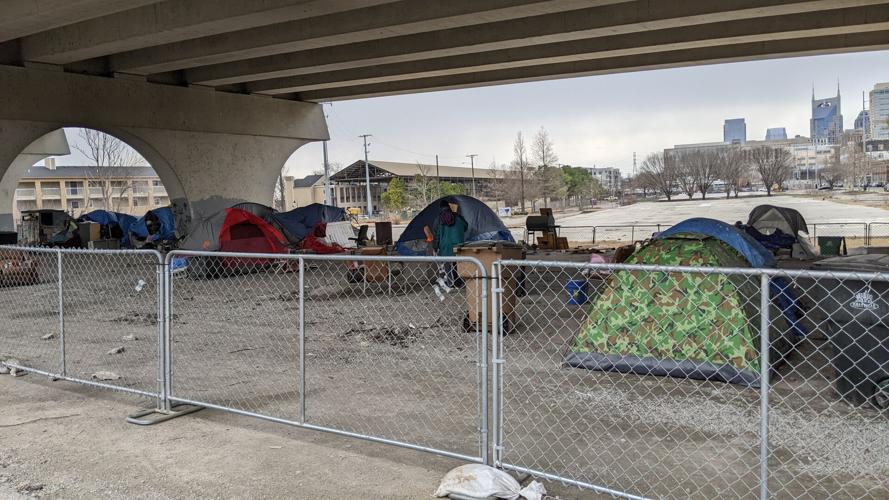

On Monday, a councilmember grilled the interim director of the Metro Homeless Impact Division over a plan to house people living in camps, echoing concerns from services providers that the effort has lacked transparency and bypassed proper procedures.
District 16 Councilmember Ginny Welsch, chair of the Metro Council’s Human Services Committee, spent nearly an hour asking interim director Jay Servais about the plan, as well as his understanding of the city’s system for managing data related to people experiencing homelessness. Joining Servais were the Homeless Impact Division’s assistant director April Calvin and Metro Social Services director Renee Pratt.
Members of the Continuum of Care Homelessness Planning Council say they did not know the Homeless Impact Division was enacting the plan, and that they had expected Servais to conduct a full presentation of the plan at the body’s monthly meeting on Feb. 9. Servais instead told them the plan was being implemented, and said he had presented it a month earlier with a request for comments to be submitted in following weeks. Members on the council say they still expected a fuller presentation in February.
Members of the Planning Council, which includes services providers, said the plan wasn’t following the proper vetting procedure and expressed concerns it could bypass the city’s coordinated entry system, which keeps track of people experiencing homelessness known to outreach workers and helps match them to services they need. Servais maintained that everyone under the bridge was known to case managers and outreach workers with The Salvation Army and that coordinated entry was not bypassed.
The arguments from that meeting continued at the committee hearing, with Welsch echoing those concerns and more. At one point, Servais commented that the hearing felt like a trial.
Some of the conflict seems to stem from differing understandings of the process. For example, Servais said that community input was received during a set of charrettes — or community meetings — hosted by Vice Mayor Jim Shulman on the topic of homelessness in December. Welsch said the charrettes weren’t presented as part of a Metro plan. Servais and Calvin also said earlier drafts of the plan were sent to members of the planning council before January, but that was contested as well — District 19 Councilmember Freddie O'Connell, also on the Homelessness Planning Council, said he didn't receive a copy until January.
Welsch also raised concerns that the plan allowed residents of the camp to bypass more vulnerable people experiencing homelessness, as identified by the city’s data management system. Kristin Wilson, the city’s chief of operations performance, addressed the concern, saying people who live unsheltered for years are often identified as highly vulnerable. She also voiced concern that the program at the Jefferson Street Bridge was a trial run for an effort to clear the camp at Brookmeade Park in West Nashville. Servais said there were no plans for Brookmeade Park at the moment. The Brookmeade camp has sparked consistent media attention, bolstered by outcries from nearby residents who say they can no longer use the camp due to high instances of crime, drug usage and trash pileup.
The group focused on the effort to clear the camp is Reclaim Brookmeade, and the language used by the group on Facebook and Twitter can range from calls for more housing to frustrated reports about crime and drug use at the park to complaints about Mayor John Cooper.
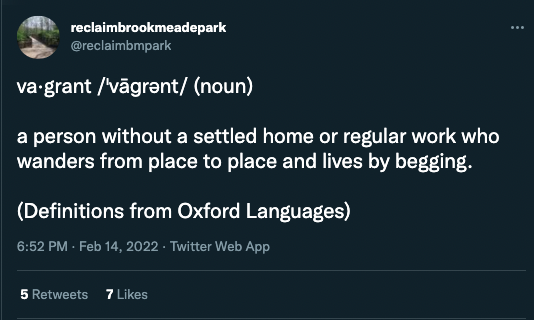
A tweet from the group’s account on Feb. 9 complained that Brookmeade Park was “closed only to residents of Nashville and taxpayers. Open for Vagrants.”
The Scene asked Reclaim Brookmeade founding member Rebecca Lowe about the tweet, and showed it to her for reference. “I don’t like that,” she said, adding that she didn’t think the term was proper. Lowe said she has "asked for civility” on social media accounts, and that the tweet would be removed.
Asked who manages the Twitter account, Lowe said “a number of people can access it” and that she rarely uses the account herself. The tweet was apparently deleted after the hearing; however, another tweet was posted hours later including the pronunciation and description of the word “vagrant.”
A few members of Reclaim Brookmeade were present at the hearing, sitting in pews alongside services providers. Reclaim Brookmeade folks at times clapped in support of Servais; the services providers did the same for Welsch’s questions. When Welsch said she was concerned Metro was trying to appease “the loudest white voices,” one person shouted “racist.”
Lowe said she is impressed with the job Servais has been doing, and that the response from services providers to the plan “baffles” her. Asked if she was disappointed there weren’t immediate next steps for Brookmeade, she said, “The last thing we want is for them to implement something that is going to be unsuccessful.”
Lindsey Krinks of Open Table Nashville, a nonprofit that conducts outreach to people experiencing homelessness, tells the Scene she is disappointed with the way the plan has been carried out. “It feels like too many people in our city leadership are interested in getting visible homelessness out of sight and not actually addressing the root causes of homelessness, like the lack of affordable housing in our community and other big systemic issues,” she says.
After the hearing, the Homeless Impact Division released a statement about reactions to the Jefferson Street Bridge plan, saying that while people are passionate about differing approaches, everyone shares the same goal of housing people. The statement also pushes back on claims and concerns: "Throughout this effort, no critical process was circumvented, although misinformation and misunderstanding to that effect has been circulated by some. In addition to signage, residents were personally informed of these efforts over the past 30 days. Residents are being directed to housing or hotel accommodations. There have been no arrests; no incarcerations; and residents are not being relocated to other outdoor communities unless they so choose."
The statement also describes the effort at Jefferson Street Bridge as a "draft" plan that won't be finalized until the Homelessness Planning Council offers input. The Scene asked for a definition of draft plan, and the Homeless Impact Division's public information officer replied:
Draft for us simply means preliminary. Our HID leadership modified this plan using inspiration from nationwide best practices, HUD [Technical Assistance] recommendations, some components of Houston's model, along with iteration from local successful models. The next step in this has and still is to get feedback from the Homelessness Planning Council before firming up the plan and making it our official tool for reducing homelessness at outdoor communities. This tool will and can be revised regularly.



Post a comment as anonymous
Report
Watch this discussion.
(0) comments
Welcome to the discussion.
Log In
Welcome to the discussion.
Keep it clean. Please avoid obscene, vulgar, lewd, racist or otherwise abusive language. Comments featuring hate speech or threatening or violent content will not be tolerated.
PLEASE TURN OFF YOUR CAPS LOCK.
Be truthful. Don't knowingly lie or mislead.
Be proactive. Use the “report” link on any comment that violates our comment policy.
Share with us. We'd love to hear your feedback.