
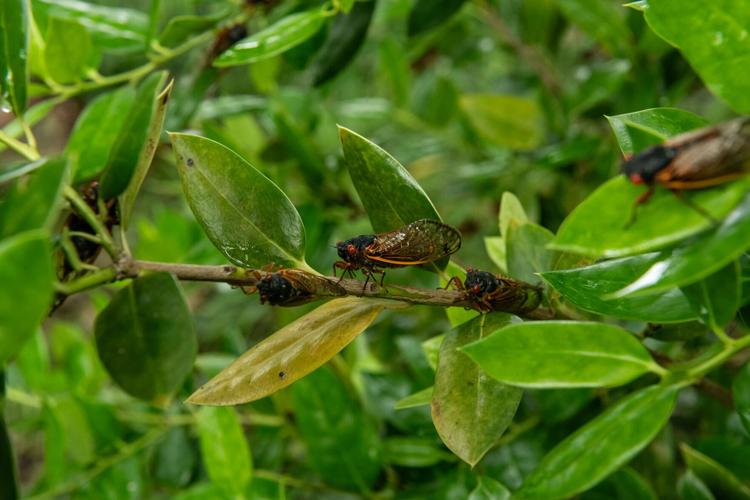
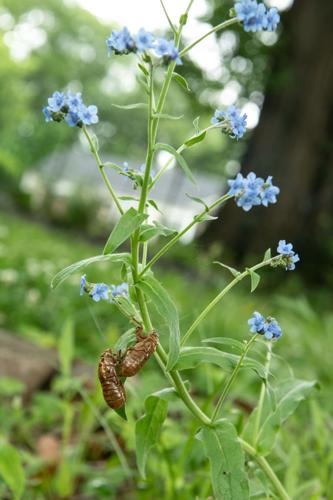
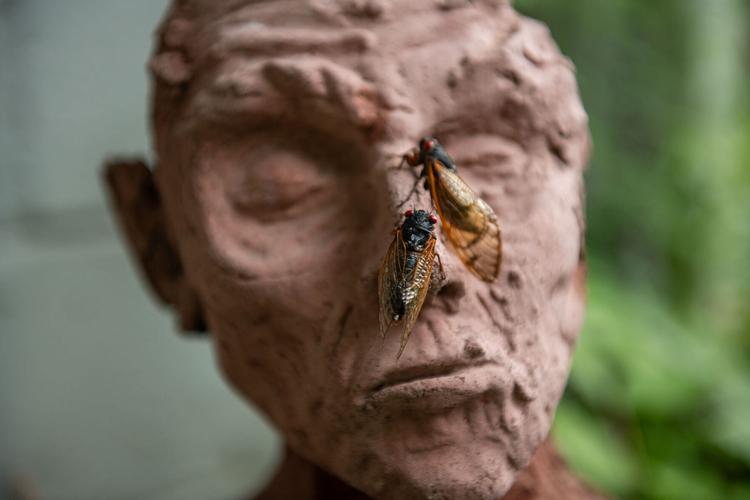
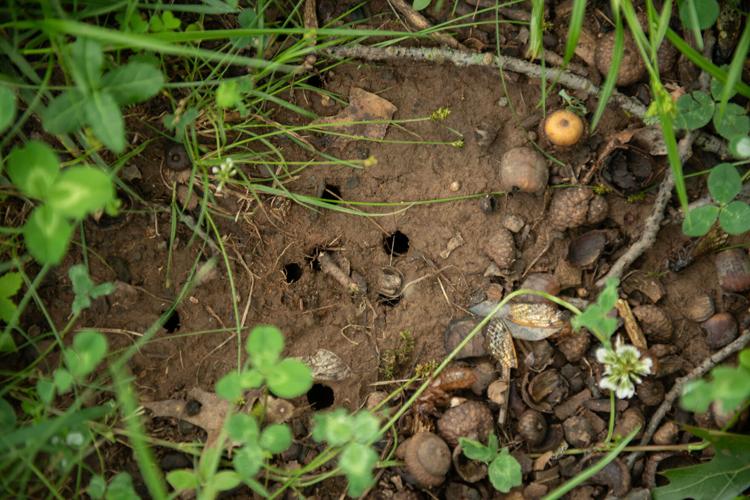

Periodical cicadas are pretty metal. Not to be confused with the annual “dog day” cicadas that pop up in late summer, periodical cicadas live underground for 13 to 17 years. They feed on tree sap before emerging from the soil, shedding their crunchy nymph carcasses all over, screeching to attract mates, and then dying before their offspring do it all over again. Like most metal-heads, they can be intimidating to some, but are pretty much harmless — and very loud.
But we at the Scene are journalists, not entomologists, so we reached out to someone who knows what they’re talking about. Enter Don Sudbrink, chair of the agriculture department at Clarksville’s Austin Peay State University, who has three entomology degrees including a Ph.D. from Auburn University.
Which brood are we seeing now?
This brood here in the Tennessee region and up into about middle Illinois, all through the South, is called Brood XIX and it is a 13-year cicada brood. So they come out every 13 years and mate and reproduce. And then once they produce their offspring, the nymphs go underground and feed on tree roots for 13 years and then do it again. There is another brood that's up in northern Illinois, Chicagoland area, that is called Brood XIII, but it’s a 17-year cicada. And so up north [it] takes more time for them to develop.
When they're underground, are they growing that whole time?
Mhmm. Slowly, slowly, slowly, slowly, slowly growing. So basically they start out and they’re little teeny tiny nymphs. Right now the females are laying their eggs up in the tree branches, and they're gonna develop for several weeks, and then sometime in July, they'll drop off, burrow into the ground, dig into these tree roots and just start feeding on them for 13 years. Just kind of drinking out the xylem sap. … And so when they do that, they drink and then they poop, and so they provide organic matter. They're pulling some juice out of the tree, but mostly it's not something that really drains the batteries of the tree.
Can they breathe when they’re underground?
Yeah. One of the things is they dig underground and they make burrows and holes to have air pockets and breathing. Unless it’s completely soaked, then they have to kind of move up closer to the ground. … People ask, “What's their purpose?” Well, they provide aeration for the soil because those little claws help them plow through the soil as they're moving up and down the root structure of the tree.
Can they harm people in any way?
Usually not. Unless, say, you're riding a motorcycle without any facial protection, you may get hurt that way, if you’re going really fast. … They don't bite. They have a straw-tube mouth that drinks plant juice. They don't want to mess with us, they can't sting us or bite us.
Can people eat them?
If anybody has a shellfish allergy — shrimp or crabs, crayfish, whatever — there's a pretty strong likelihood that they would have some kind of allergy to insects because they have the same types of proteins in their exoskeletons. So people can really get sick, anaphylaxis and other things like that, so it's not recommended for people who have any shellfish allergy to eat cicadas. That being said, people eat them all the time, usually they cook them. I have cooked them and eaten them myself and I'm alive and well. … Cooking them is the key. You can boil them, you can sauté them. We made them into a jambalaya once — it was good. … When you use the ones that are out, that are fully dark with the red eyes, they have a crunchy, chewy exoskeleton. You want to get the ones that first emerge from their shells. When that's the case, they're much more delectable and softer-bodied, like soft-shell crabs. … If there's a white fungus on the bottom, that's not a good one to eat, that's one to discard. … Make sure that they are well-cooked just like most foods that you get in the wilds.
[Editor's note: If you’re interested in eating nice crunchy cicadas, do additional research to learn how to spot fungus, consider the presence of pesticides and find cooking methods.]
Does construction and development affect cicadas?
Certainly. With the massive development that's gone on since the last cicada emergence in 2011, Metro Davidson area certainly has changed where certain cicadas come up. When you take down all the trees and pave it over, or just take down the trees, you remove the source of food for them, and those will die in that section. … Lots and lots of development, fewer cicadas is usually what that means, especially if you pave the road. … They're also done if the tree dies because that's the thing that's been feeding it. So once they take those trees out, that's it.
Why are they so loud?
These are insects that have evolved to have almost 100-decibel signatures. … If you're going to be around them for long periods of time, and right in the midst of them, they recommend ear protection. … It's like you're operating a leaf blower or a lawn mower, chainsaw, something along those lines. So ear protection if you're in that environment for long periods of time. But males are trying to attract females. That's what they've been doing for millions of years. And that is the successful call, at least for that particular female species. And so these tymbals — these vibrating membranes — it's one of the loudest of the insect species, and the longest-lived too.



