
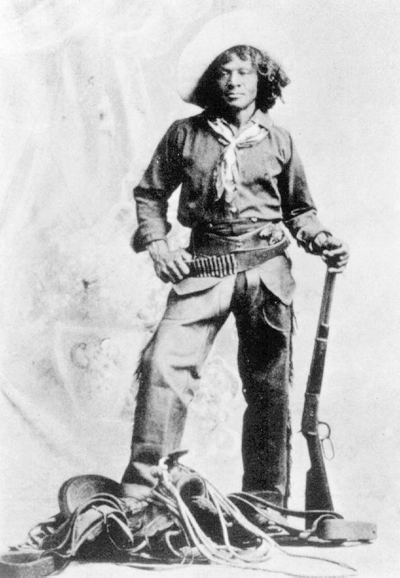


Famed Black cowboy Nat Love, aka Deadwood Dick
In my quest to find heretofore undiscovered headstones carved by William Edmondson, I also spent a great deal of time in Briarville. Like Lake Providence, Briarville was a Black village in rural Davidson County that is now mostly forgotten. With the exception of Briarville Road and the two cemeteries, I haven’t found anything in the area that distinguishes the area from larger Madison anymore.
The two cemeteries in what was once Briarville are the Benevolent Cemetery at the corner of Briarville Road and Shields Lane, and the Briarville Cemetery, in the woods behind Goodpasture. The Briarville Cemetery is full of Skruggs, Bates, Wimms and Vaughns. These families are all intermarried with the families in the Benevolent Cemetery — Shields, Goodrich, Love and such. There are quite a few Vinsons in both cemeteries. The Benevolent Society cemetery is in very good shape, and it contains one of two wooden grave markers I’ve ever seen in a Davidson County Cemetery, even though that used to be a very common way to mark graves. The Briarville Cemetery is in less-great shape, but it does appear that people are trying to tend it.
The last name Love has always struck me when I’ve been out there. As far as I can tell, these aren’t Rep. Harold Love’s kin. They are, instead, the people of Deadwood Dick himself, Nat Love.
Nat Love was one of the most famous Black cowboys to roam the West. You can read his autobiography here, if you want to know his exploits after he left Davidson County. But be fair warned: He’s a delightful storyteller and it will be easy to lose a couple of hours. For the purposes of trying to reconstruct some understanding of Briarville, here’s the important part:
In an old log cabin, on my Master's plantation in Davidson County in Tennessee in June, 1854, I first saw the light of day. The exact date of my birth I never knew, because in those days no count was kept of such trival matters as the birth of a slave baby. They were born and died and the account was balanced in the gains and losses of the Master's chattels, and one more or less did not matter much one way or another. My father and mother were owned by Robert Love, an extensive planter and the owner of many slaves. He was in his way and in comparison with many other slave owners of those days a kind and indulgent Master.
Before we go any farther, I just want to point out that, if you keep reading, Nat Love provides a very succinct takedown of slavery, so I think that we can read into Nat’s description of Robert the ring of truth. Robert probably was pretty OK compared to other slave owners, and as Nat later points out, the institution of slavery on Robert’s plantation was still incredibly and deeply brutal.
Here’s what we know about Robert. He was born in 1823 and died in 1911. He had a sister named Anna, who had a son, Anderson McGaughey. Anderson and his wife lived with Robert in the family home. Robert never married.
Robert inherited the land Nat Love’s family was enslaved on from his uncle, James Love. James was an early settler in Davidson County. He also never married. When James died, he gave the northern half of the plantation to his nephew, Nicholas, and the southern half to Robert. In 1850, James owned 38 slaves. The only other Love who owned slaves was a Richard Love, who had 15 slaves. Richard was still a slave owner in 1860, but was down to two slaves. James was dead (he died in 1852). W. Love — who I believe was Nicholas’ dad and the brother named William that James mentioned in his will — then owned 29 slaves. Robert, listed as R.E. Love, enslaved 22 people (for whom he had three dwellings). Nat, it would seem, was the 5-year-old Black male listed in the slave census under Robert’s name.
The thing about white antebellum men who never marry is that you can never be sure if it’s because they had no interest in women or if it’s because they didn’t need to marry the women they were interested in.
The Loves seemed very financially stable. Even after James’ death, his slaves seem to have been passed along to his heirs. In 1850, James owned four people of mixed race — a 30-year-old man, a 27-year-old woman, a 14-year-old boy and a 1-year-old girl. In 1860, Robert owned a 22-year-old mixed-race man (possibly the boy from a decade before), a 5-year-old mixed-race girl and a 1-year-old mixed-race boy. In other words, it’s very likely that all these enslaved people of mixed-race origins were born on the Love farms. In that case, it’s also very, very likely that the fathers of these mixed-race people were the white guys on those farms.
So, we know that Robert had a 5-year-old girl and a 1-year-old boy who were likely his children.
Check out his will from when he died in 1911:
I, Robert E. Love, having heretofore disposed of all my real estate by deed to my nephew, A. J. McGaughey, and his wife, Marina McGaughey, do make and publish this as my last will and testament as to the remainder of my estate, hereby revoking and countermanding all other wills by me heretofore made.
I give to my niece, Emmeline Lynes, of Water Valley, Miss. Fifty dollars ($50.00). I give to Bob Love, colored, fifty dollars ($50.00). I give to Mary Lou Love, colored, sister of Bob Love, colored, fifty dollars ($50.00).Robert Love and Bob Love? Also, Robert Exum Love passes into the Black Brierville community as a name. There’s one buried in the Benevolent Cemetery born half a century after this Bob. I think they’re all kin.
But I keep thinking about Briley cutting through this old community and how the new construction near the Nossi College of Art is encroaching on the Briarville Cemetery, and how easy it is for this history to vanish under the wheels of progress.
One of the greatest cowboys to ever live was born in a Black community just north of town. And that community grew in some of the most brutal conditions people have ever put each other in. Then people had to navigate complicated relationships with the people who had kept them in those conditions. All to have ordinary lives.
These days we all kind of have a good idea about how the placement of I-40 devastated North Nashville. But places like Briarville are now also under highways, and those losses are also immeasurable.



Post a comment as anonymous
Report
Watch this discussion.
(0) comments
Welcome to the discussion.
Log In
Welcome to the discussion.
Keep it clean. Please avoid obscene, vulgar, lewd, racist or otherwise abusive language. Comments featuring hate speech or threatening or violent content will not be tolerated.
PLEASE TURN OFF YOUR CAPS LOCK.
Be truthful. Don't knowingly lie or mislead.
Be proactive. Use the “report” link on any comment that violates our comment policy.
Share with us. We'd love to hear your feedback.