
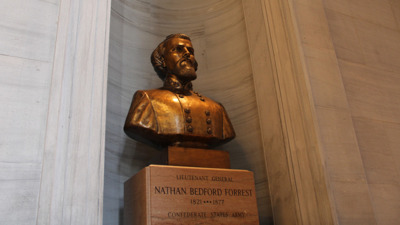


The bust of Nathan Bedford Forrest in the state Capitol
It’s easy to imagine an alternate reality in which Gov. Bill Lee responded differently to the revelation earlier this year that he had dressed as a Confederate soldier and participated in “Old South Week” parties while he was a fraternity member at Auburn University. In this alternate reality, he doesn’t even have to be all that courageous.
Having been confronted with the racism and ignorance of his youth, Lee could have apologized, expressed his regret and explained his growth. And then he could have done one more thing: He could have called on the state he’d just been elected to lead to avoid repeating his mistake — the mistake of cosplaying and celebrating racist traitors — and advocated for the repeal of laws that mark special days honoring people like the former Confederate general and Ku Klux Klan leader Nathan Bedford Forrest.
Alas.
On July 13, according to a proclamation signed by Lee, Tennessee observed Nathan Bedford Forrest Day. It’s one of six special days of observance that the governor is to proclaim, according to state law — and one of three related to the Confederacy. (The other two are Robert E. Lee Day on Jan. 19 and Confederate Memorial Day on June 3, which also marks the birthday of Confederate President Jefferson Davis.)
Our state’s little holiday quickly drew the attention of the national media and served as a reminder of the way that Tennessee just can’t quit the man who oversaw the massacre of hundreds of surrendering black Union soldiers at Fort Pillow. Forrest’s bust remains on display in the state Capitol. And of course there’s that 25-foot statue of him on private property near I-65 just south of town, the one where he appears on horseback looking like a coked-up undead clown.
The whole episode is upsetting — to call it an insult to black Tennesseans is an understatement — but it was not surprising to local political observers. The proclamation Lee signed is the same one his predecessor, Gov. Bill Haslam, signed eight years in a row. But this governor’s shrugging reaction to questions about it was especially galling.
"I signed the bill because the law requires that I do that and I haven’t looked at changing that law," Lee told The Tennessean last week.
He reiterated, according to the daily: "I haven’t even looked at that law, other than knowing I needed to comply with it, so that’s what I did. When we look at the law, then we’ll see."
The mind reels at all the horrible things that have been justified in this state, and many others, with feeble words like those: I haven’t even looked at that law, other than knowing I needed to comply with it, so that’s what I did.
Moreover, if the controversy over Lee’s college days and sustained protests at the Capitol over the Forrest bust didn’t prompt Lee and his staff to “look at the law,” then what will?
Lee’s comments reveal a convenient passivity. When presented with the opportunity to show an ounce of political courage — to call for an end to statues and days honoring men like Forrest, or to stop the execution of a reformed man like Don Johnson, whom the state put to death in May — the governor throws up his hands. He’s just following the law. It’s not for him to interfere. When presented with the opportunity to, say, push through a voucher plan for Tennessee’s schools, he suddenly feels less passive.
The governor is not alone when it comes to conveniently forgetting about his power and influence. Over the weekend, one day after Tennessee’s observance of Nathan Bedford Forrest Day, President Donald Trump hurled a vintage racist attack at four black and brown Democratic congresswomen, telling them to “go back” to the countries they came from (even though three of the four were born in the United States). As of this writing, not a single member of Tennessee’s Republican congressional delegation has denounced his comments or even acknowledged them at all.
Update (4:50 p.m.):
In an interview with WKRN-TV, Lee says he'll be working to change the law requiring the governor to proclaim July 13 Nathan Bedford Forrest Day. Four days after he told The Tennessean "I haven't looked at changing that law" and "I haven't even looked at that law," Lee told the station: “I want to share my heart about this. I didn’t like it, and I want to explain why I didn’t like it and why I didn’t want to sign it. There are parts of our history that are painful particularly to African Americans.”



Post a comment as anonymous
Report
Watch this discussion.
(0) comments
Welcome to the discussion.
Log In
Welcome to the discussion.
Keep it clean. Please avoid obscene, vulgar, lewd, racist or otherwise abusive language. Comments featuring hate speech or threatening or violent content will not be tolerated.
PLEASE TURN OFF YOUR CAPS LOCK.
Be truthful. Don't knowingly lie or mislead.
Be proactive. Use the “report” link on any comment that violates our comment policy.
Share with us. We'd love to hear your feedback.