
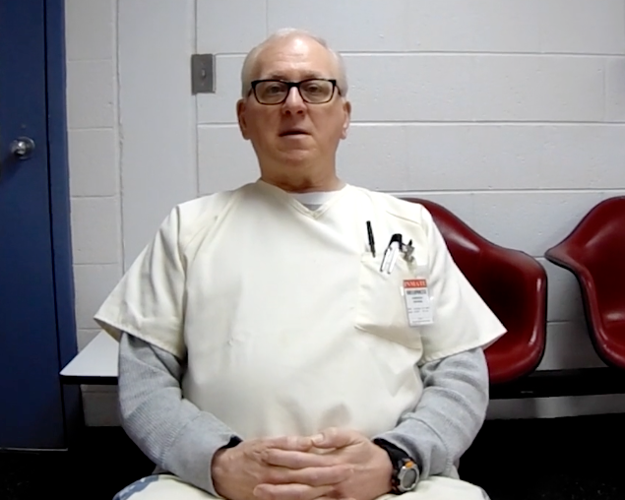


Don Johnson
Near the end of their application for clemency on behalf of Don Johnson, the man Tennessee is scheduled to executed on May 16 for the murder of his wife Connie Johnson in 1984, Johnson's attorneys sum up their case for mercy. They cite his "remarkable transformation" and the forgiveness of the person closest to his crime, Connie's daughter Cynthia Vaughn.
"This is a case for which clemency was designed," Johnson's attorneys Thomas Dillard and Rev. Charles Fels write. "While, Don Johnson's death sentence may be legally acceptable under all of the analytical considerations of dispassionate law, it is not morally right-in the words of Alexander Hamilton it would be "unduly cruel." The remarkable transformation that Don has made warrants mercy. Cynthia Vaughn, the person with the greatest claim on his life, deserves to have her forgiveness honored. She should not have her own healing journey ended with an unnecessary and unwanted execution. Don Johnson should not have his journey from the darkness into the light ended in the death chamber."
Three men sought clemency from Gov. Bill Haslam before their executions last year, but they were all denied. Now just months into his first term, and less than 45 days before Johnson is to be executed, Gov. Bill Lee has received the 21-page application that begins with these words: "Please spare the life of Don Johnson." You can read the application here.
They rely heavily Vaughn's forgiveness of the adopted father who was convicted of killing her mother (which was the subject of a Scene story in 2017). In her own words, Vaughn describes the 2012 visit during which she found reconciliation with Johnson after nearly 30 years:
I proceeded to release almost 3 decades of anger, resentment, and pain on him and he never once looked away from me as I told him how his actions on December 8, 1984 changed my life forever. Tears were in his eyes as I told him of my childhood. Tears ran down his cheeks as I reminded him of all that I missed out on in life, not having had my mother around. Simple things that most people take for granted, like the birth of my child, my mother wasn't there. Graduation from high school, my mother wasn't there. When I got married, my mother wasn't there.After I was finished telling him about all the years of pain and agony he had caused, I sat down and heard a voice. The voice told me, "That's it, let it go." The next thing that came out of my mouth changed my life forever. I looked at him, told him I couldn't keep hating him because it was doing nothing but killing me instead of him, and then I said, "I forgive you."
Vaughn is requesting a meeting with the governor.
But the clemency application also emphasizes Johnson's acknowledgment of his crime — "Don was by his own later admission, a liar, a cheat, a con man and a murderer" — and his subsequent redemption. After hearing an inmate speaking about Jesus in the Shelby County Jail while he awaited trial, Johnson became drawn to Christianity. He was later baptized on death row and has since become an ordained elder in the Seventh Day Adventist Church.
The attorneys also note that 35 death row inmates have submitted requests for mercy on Johnson's behalf.
Like so many of the men on Tennessee's death row, Johnson's childhood was marked by abuse. He was beaten by his step-father and spent time in two Tennessee juvenile institutions with notoriously bad conditions. In detailing this, the attorneys note that Johnson does not blame his upbringing for the crimes he would later commit. But, they argue, it would be impossible for an outsider not to consider the effect it had on him.
Don Johnson does not place blame for his subsequent wrongs on his father, on Jordonia, or on Pikeville. He takes responsibility for his own actions. However, those who can observe his life from the outside can easily see that the evil under which he 10 Dr. David Dzik, Hamilton County Juvenile Court Commission Report to Governor Ellington, September 15, 1969. Id. 19 lived had a profoundly negative impact. What is most remarkable about Don Johnson's life story is not that he ended up on death row following a loveless and hate·filled childhood, it is that he overcame that childhood to become the man of God he is today.
Johnson also wrote at length about his life and his time in prison when he
responded to Gawker's Hamilton Nolan in 2015as part of the site's Letters from Death Row series.
Johnson’s legal team will hold a press conference at 3:00 p.m. today at Riverside Seventh Day Adventist Church. They have also set up a website for his clemency effort.



