
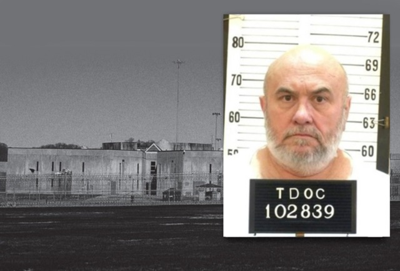


Around 4 p.m. Thursday afternoon, Kelley Henry sent word to Riverbend Maximum Security Institution. She needed Edmund Zagorski to call her immediately.
Henry is a supervising assistant federal public defender based in Nashville who represents death row prisoners. Zagorski is the man who had been scheduled to die at 7 p.m. Thursday night, as legal arguments about his fate swirled around him. A federal appeals court had granted him a stay of execution, but that could be lifted at any moment, and prison officials were proceeding as if they were going to carry out the execution. Zagorski, who had been on death watch in an 8-by-10-foot cell next to the execution chamber since Monday night, was in the middle of his final meeting with a spiritual adviser when a guard told him his lawyer needed him to call.
Huddled in her downtown office with her team of lawyers, Henry answered her cell phone and put Zagorski on speaker phone.
"Ed, the governor has given you a reprieve until Oct. 21," Henry said.
“I don’t understand what that means," Zagorski responded. "Does that mean I’m not gonna die tonight?”
"You’re not going to die tonight,” Henry said.
Asked how Zagorski responded to that news, Henry recalls his response — gallows humor in the most literal sense.
"Make sure these people know that,” Zagorski said.
The reprieve granted by Gov. Bill Haslam on Thursday halted what would have been Tennessee's second execution in as many months, a revival of the state's death penalty which had been dormant for nearly a decade. The week leading up to the scheduled execution was marked by legal whiplash.
On Monday night, following a ruling from the Tennessee Supreme Court upholding the state's controversial lethal injection protocol, Zagorski signed an affidavit declaring that he wanted to be executed in the electric chair. State officials said he was too late, and told Henry they intended to execute Zagorski by lethal injection. That prompted Henry to file a motion in federal court on Zagorski's behalf, arguing that the state should be blocked from using lethal injection and compelled to use the electric chair. Zagorski is one of 42 currently on death row who has the right to choose between the two methods because he was convicted before the state adopted lethal injection. On Wednesday evening, the United States Court of Appeals for the Sixth Circuit granted Zagorski a stay of execution based on claims that he received inadequate legal representation during his trial and sentencing. The state quickly moved to challenge that stay, asking the Supreme Court of the United States to lift it and allow the execution to proceed. Meanwhile, Zagorski was asking the high court to stay his execution and hear the case brought by dozens of death row prisoners arguing that Tennessee's lethal injection protocol amounts to torture.
With Haslam's reprieve — apparently intended to give executioners time to prepare to use the electric chair — Zagorski is spared for the time being. Prison officials said Thursday they would be moving him from death watch back to his cell on death row within 24 hours. But barring a change of heart on the part of the governor — who has said he will not grant Zagorski clemency — Zagorski will still die in a matter of weeks. Shortly after the reprieve was announced Thursday evening, the Supreme Court rejected all of Zagorski's requests. The court declined to hear the case over Tennessee's lethal injection protocol, and lifted the Sixth Circuit's stay, clearing the way for Zagorski to be executed after Haslam's reprieve expires. Henry tells the Scene that the earliest Zagorski could be executed is likely Oct. 29. The governor's reprieve is effective until Oct. 21, at which point the state Supreme Court will have to set a new execution date. That date must be no sooner than a week after it is set.
As remarkable as yesterday's 11th hour events were to observers, Henry and Joe Ingle have seen this drama play out many times before. Ingle, a United Church of Christ minister, is the spiritual adviser who was with Zagorski when news of the reprieve broke. A regular visitor to death row prisoners across the south since 1974, and in Tennessee in particular since 1990, Ingle first met Zagorski at the old Tennessee State Prison known as The Walls. They bonded, he says, when Ingle helped get a doctor in to see Zagorski for an issue the inmate was having with his wrist. Ingle echoes what fellow prisoners, death row staff and others who have supported clemency for Zagorski say about the man — he "looks out for other people, he doesn’t make many requests himself.”
“Although this sounds like ‘how can this minister say this?’ it’s true," Ingle says. "Since his time on death row, he’s just been a prince of a guy.”
Ingle has been meeting with Zagorski each day since the condemned man was moved to death watch. On Thursday, they were scheduled to have their final meeting from 3 p.m. to 5 p.m., ahead of the scheduled execution at 7 p.m.
Ingle says he and Zagorski talked about “a whole range of subjects” and “he gave me a few messages he wanted me to deliver to the guys back on death row.” Henry, too, tells the Scene that Zagorski had been spending his days on death watch sending final messages. He can't write, Henry says, so he'd been dictating thank you notes to people who had helped him over the years. Many of those notes were delivered Thursday, Henry says, with the expectation that Zagorski would be executed shortly after sundown.
"He didn't want to leave without expressing gratitude," Henry says.
One message Zagorski had for his fellow death row prisoners, Ingle says, was related to Zagorski's decision to forego his final meal before the execution. Ingle relayed the same story that had been told to the Scene by a death row prisoner who passed it on through a regular visitor. Last weekend, before Zagorski was moved to death watch, more than a dozen of the men on death row pulled together whatever ingredients they could get their hands on and made pizzas to share in a last supper of sorts with Zagorski.
“That meant the world to him," Ingle says. "He said, ‘that was my last meal.’ "
Zagorski had been notably positive during his time on death watch, Ingle says. And did not have any doubt about his decision to be executed in the electric chair.
“He was very clear about this electrocution," Ingle says. "He felt deeply, as all the guys do, that the lethal injection protocol that the state has come up with is barbaric and is torturous. And we saw that with Billy Irick.”
Ingle is familiar with the controversy around various lethal injection protocols. In 1982, Ingle went to Texas to plead with then-Gov. William Clements not to allow the execution of Charles Brooks Jr., partly out of concern over the use of a new execution method: lethal injection. The execution went ahead, though, making Brooks the first American prisoner executed by lethal injection.
“So from 1982 to 2018, I have watched this lethal injection protocol grow more and more macabre and tortuous until we have arrived in Tennessee now at something that is just beyond the pale in terms of barbarity,” Ingle says.
Ingle was a little more than an hour into what was to be his final conversation with Zagorski when a guard came in to tell the inmate that his lawyer wanted to speak to him. Another guard appeared to tell Ingle that the visit was done, despite the fact they were supposed to have nearly an hour left.
Zagorski assumed the news was bad, that the stay had been lifted and that he was about to be executed. Ingle says they said a quick prayer and said goodbye.
A short time later, riding in a car with his wife to celebrate the brief reprieve over dinner, Ingle reiterated his plea to the only man who can save Edmund Zagorski now.
“I would ask Gov. Haslam to grant this man clemency because he truly deserves clemency," Ingle says. "It’s a matter of grace. And grace can be exercised by Gov. Haslam for Ed Zagorski. He has a perfect institutional record. Everybody who’s known this man for the last 34 years vouches for him."
He continues: "Before this, he did some bad things. There’s no doubt about this. Incidentally, I don’t think he killed those two people he’s convicted of killing but that’s another story. He did do some bad things and he was a marijuana dealer, there’s no doubt about it. But for the last 34 years he’s lived an impeccable life on death row. And if clemency is to mean anything, it should be given to people who maintain those kind of records on death row. Otherwise, why would you maintain a perfect record if it doesn’t mean anything to a governor? So I would hope Gov. Haslam would reconsider and realize that the same grace that God has given us should extended to Ed Zagorski, because I’m sure God’s done it and if God’s done it then the state of Tennessee can do it as well.”



Post a comment as anonymous
Report
Watch this discussion.
(0) comments
Welcome to the discussion.
Log In
Welcome to the discussion.
Keep it clean. Please avoid obscene, vulgar, lewd, racist or otherwise abusive language. Comments featuring hate speech or threatening or violent content will not be tolerated.
PLEASE TURN OFF YOUR CAPS LOCK.
Be truthful. Don't knowingly lie or mislead.
Be proactive. Use the “report” link on any comment that violates our comment policy.
Share with us. We'd love to hear your feedback.