



The state of Tennessee is renewing its effort to execute condemned prisoners, scheduling three executions for this year.
Two of those executions will almost certainly be delayed, as the two men involved have yet to exhaust their appeals. But Billy Ray Irick, who was convicted in 1985 of raping and murdering a 7-year-old girl in Knox County, has fewer options remaining to keep him out of the death chamber. An order from the Tennessee Supreme Court on Thursday scheduled his execution for Aug. 9.
Public records obtained by the Scene suggest Tennessee officials ran into legal trouble acquiring the lethal injection drug pentobarbital and that the state is pressing on toward Irick's execution date despite internal warnings that a new cocktail of lethal injection drugs might not work properly.
Those documents are also cited in court filings submitted Thursday — ahead of the Supreme Court's order — on behalf of five death row inmates who intend to challenge a new lethal injection protocol the state adopted earlier this month. The new protocol calls for the use of a three-drug cocktail, including midazolam, vecuronium and potassium chloride, as a plan B if the state's preferred lethal injection drug isn't available. Tennessee's old protocol called for the use of pentobarbital.
In March 2017, The Tennessean reported that the state did not have any pentobarbital, although Tennessee Department of Correction officials said the state would be ready to carry out an execution if one was scheduled.
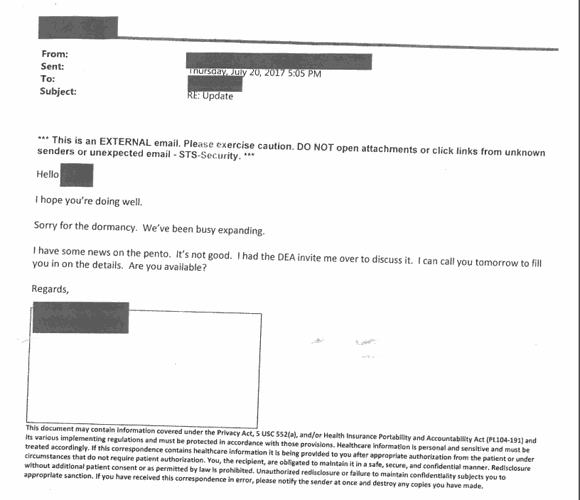
In an email obtained by the Scene, sent on July 20, 2017, someone outside the state government writes, "I have some news on the pento. It's not good. I had the DEA invite me over to discuss it."

State law shields the identity of individuals and manufacturers involved in supplying lethal injection drugs, but the email includes disclaimers indicating it came from someone working to acquire and / or supply the state with the drugs. Emails in the months that followed indicate state officials began moving toward a multi-drug cocktail.
In a Sept. 7 email, another individual writes, "so the word from the powers that be is that they first want to try to find midazolam and then go from there if there [sic] none out there to get."
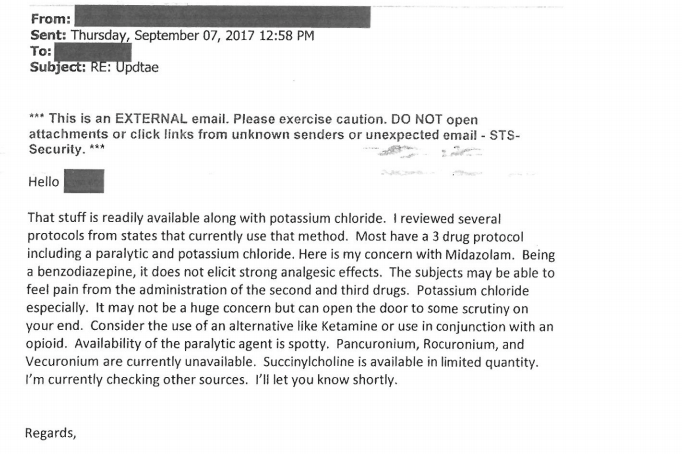
A reply hours later, again from someone apparently outside of state government working to acquire or supply the drugs, says "that stuff is readily available along with potassium chloride." But the individual goes on to raise concerns about the drug.
"Here is my concern with Midazolam," they write. "Being a benzodiazepine, it does not elicit strong analgesic effects. The subjects may be able to feel pain from the administration of the second and third drugs. Potassium chloride, especially."
Emails show officials initially indicated an interest in looking into the availability of other drugs but eventually went ahead with purchasing midazolam along with the other drugs in the cocktail. One document, apparently from the supplier, shows the state was quoted $100,000 for drugs for 20 inmates and subsequent invoices show purchases of more than $40,000 worth of drugs.
The court filings cite several "botched" lethal injections that involved midazolam, including Oklahoma's disastrous execution of Clayton Lockett in 2014, which was halted after 33 minutes. Lockett ultimately died from a heart attack.
"Given the State's adoption of a new lethal injection protocol just last week, this Court should not set any execution dates," Irick's attorney Gene Shiles writes in the filing.
That's done now, but Irick has been here before. Aug. 9, 2018 is his third execution date in less than four years.



Post a comment as anonymous
Report
Watch this discussion.
(0) comments
Welcome to the discussion.
Log In
Welcome to the discussion.
Keep it clean. Please avoid obscene, vulgar, lewd, racist or otherwise abusive language. Comments featuring hate speech or threatening or violent content will not be tolerated.
PLEASE TURN OFF YOUR CAPS LOCK.
Be truthful. Don't knowingly lie or mislead.
Be proactive. Use the “report” link on any comment that violates our comment policy.
Share with us. We'd love to hear your feedback.