
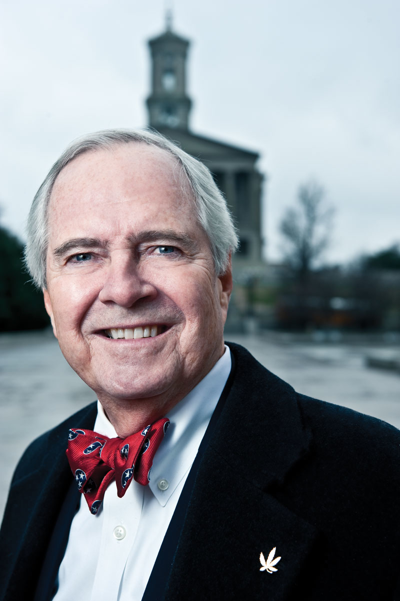


Paul Kuhn at the state Capitol.
On a blustery winter afternoon, Paul Kuhn is nattily attired in a gentleman’s long coat, an impeccable dark-blue suit and a white shirt starched so crisply the cuffs look like paper chain. In his collar, there’s a neatly folded bow tie bearing the three-star emblem of Tennessee. On his lapel, there’s a gleaming gold pin representing a much broader symbol: a cannabis leaf.
“I’ve been at this a long time,” Kuhn says.
Nothing could be farther from the stoner stereotype than a successful conservative investment advisor with the dress code and courtly manners of another era. And yet here stands Kuhn, until last month the national chairman of the National Organization for the Reform of Marijuana Laws, the country’s oldest and best-known lobbying organization fighting the drug war’s most senseless strictures.
To say it was a good year for Kuhn and NORML is an understatement. To the nation’s astonishment, two states, Colorado and Washington, voted to legalize marijuana last November. It was a sea change from the evil-weed paranoia that dominated the previous century, stoked by government propagandists (with a little help from alcohol and tobacco companies). Kuhn calls this moment “the tipping point” — a shift in public favor against policies that have incarcerated millions of nonviolent offenders and burned through hundreds of billions of dollars.
He once shared those views, as a Vanderbilt student in the 1960s on an ROTC scholarship and later in the Navy as part of a tribunal that adjudicated drug charges. Nobody asked for tougher sentences, Kuhn says — and then he went to business school at Indiana University and started reading up on the drug. When he finally tried it himself, he says, decades of anti-pot hysteria disappeared in a puff.
That started his work with NORML, for which he not long ago received lifetime achievement honors. His acceptance speech is worth printing in its entirety: “I have worked so long on this issue that my youthful indiscretion has become my lifetime achievement.”
Asked what led to the shift in voters’ attitudes, he credits education and the onset of younger generations more sophisticated about marijuana’s use and potential.
“I know there are Republican lawmakers who have firsthand knowledge of the benefits of medical marijuana,” Kuhn says, pausing to demonstrate a favorite prop: a coffee-can sized receptacle of high-grade medical marijuana, designed to house 300 government-grown and -delivered joints. “Note the instruction to ‘Use 10 cigarettes per day as directed,’ ” he observes.
He says it with a chuckle, but his belief in its positive effects is no laughing matter. Medical marijuana eased his wife Jeanne’s suffering in the late stages of terminal cancer. “Legal medicines are far more lethal,” Kuhn says, lamenting how far the U.S. lags behind other nations in research. But he is emphatic that it will come to Tennessee.
“Eventually,” he adds. “We still can’t even buy wine in grocery stores.”
The People:
The Model Citizen: Karen Elson
The Cook: Tallu Schuyler Quinn
The Busker: Mike Slusser
The Cleaner: Sharon Reynolds
The Mobilizer: Remziya Suleyman
The Believer: Theron Denson
The Maker: Zoe Schlacter
The Animators: Magnetic Dreams
The Buyer: Kelly Anne Ross
The Arthouse Ambassador: Sarah Finklea
The Picker: Rory Hoffman
The Singer: Ruby Amanfu
The Educator: Ellen Gilbert
The Air Drummer: Steve Gorman
The Artist: Martin Cadieux
The Chef: Yayo Jiménez
The Futurist: Ken Gay
The Commissioner: Many-Bears Grinder



