
Editor's note: Guest contributor Holly McCall is a veteran communications strategist and Democratic political operative sharing her insights into local politics. She did not work on any campaigns mentioned in this article except where disclosed below, but she did contribute politically to John Ray Clemmons' and Jeff Yarbro's election campaigns.
The 2014 election gave Nashvillians several interesting races for General Assembly seats. Carson "Bill" Beck, a Madison lawyer, replaced longtime Democratic House leader Mike Turner after a highly competitive three-way primary. Darren Jernigan survived a challenge from former state Rep. and Metro Councilman Jim Gotto.
But the chattering class focused on the elections of Jeff Yarbro to the Tennessee Senate and John Ray Clemmons to the House of Representatives.
Few were surprised by Yarbro's victory, after he nearly beat venerated District 21 Sen. Douglas Henry in 2010, just missing by a handful of votes after a recount. Clemmons' election, however, did stir buzz. After placing third in a 2009 Metro Council race, Clemmons came back to aggressively thrash 28-year incumbent Rep. Gary Odom — who didn't seem to know there was an election going on — in the August 2014 primary.
Remember the early 1960s identical-twin sitcom The Patty Duke Show and its theme song, "One pair of matching bookends, different as night and day ... "? That could apply to Yarbro and Clemmons. Both were raised on farms — Yarbro in Dyersburg, Clemmons in Wilson County. Both attended Ivy League universities — Harvard for Yarbro, Columbia for Clemmons.
Both are attorneys. [Full disclosure: Yarbro's wife, attorney Tyler Yarbro, has represented the Scene on occasion.] Both have strong liberal credentials: Yarbro worked on Al Gore's 2000 presidential campaign, Clemmons interned for George Stephanopoulos. Both are progressives who replaced legislators many Democrats had come to view as Blue Dog dinosaurs.
Now one year after their elections and with another legislative session looming, the chattering class is informally evaluating the two new legislators' first year in office, in both substance and style.
Consider the environment in which they operate. As Democrats, the two are in the minority among a Republican supermajority. They spent their first year scrapping to be effective legislators for their urban districts without the safety in numbers that GOP freshmen currently enjoy.
"It's extremely tough to be a Democrat in the legislature now," says former Democratic House Caucus Chair Mike Turner, who did not overlap in the legislature with either man. "If you are too tough, there's retaliation from the other side, so there's a temptation to be too quiet, and that's a mistake."
Being quiet wasn't an option. With only five Democratic senators out of 33, and 26 representatives out of 99, the two freshmen had no choice but to step up. Yarbro found himself elected Senate Democratic Caucus chair.
"My first year, I sat back and listened, but these two didn't have that luxury," says House Minority Leader Craig Fitzhugh.
As Yarbro himself points out, his very first day in the Senate, he was the only Democrat on the committee deciding the future of Insure Tennessee.
"Right out of the box, we had to fight those who were against it, and that was reflective of the rest of the year," Yarbro says.
There's general agreement from both sides of the aisle that both young Turks were as effective as minority caucus members could be, regardless of tenure. In the upper chamber, Yarbro managed to pass 14 bills into law, no small feat. Down the hall, Clemmons sponsored 14 bills and passed three of his major five bills.
Among the year's triumphs was an affordable housing bill on which the pair collaborated, giving a metropolitan government the authority to acquire property through delinquent tax sale and convey it to nonprofits for affordable housing.
Other victories weren't so obvious, Yarbro says.
"People send us to the legislature to get things accomplished, and that's what I've tried to do," he says. "Some successes weren't publicly visible. Getting Insure Tennessee out of committee and giving it momentum — even though it ultimately failed — was a victory."
Clemmons says managing to get any bills passed in such a partisan environment was a pleasant surprise.
"Going in, I honestly didn't think I'd be able to pass a bill," he says.
One bill was especially satisfying to Yarbro. The former MTA board member and AMP Bus Rapid Transit supporter filed legislation reversing the bill that helped kill Nashville's BRT project. That earlier bill, drafted by the GOP, required any bus rapid transit line on a state road to get approval from the state legislature. [Editor's note: The author of this article worked on The Amp project for MTA.]
Clemmons has also been a vocal proponent of better public transit for Nashville. He introduced a bill asking for a needs assessment of public transit in the state. Neither bill passed in the 2015 session, but the point is to keep swinging for the fences.
"They both asked the questions that needed to be asked about policy," says Mary Mancini, chair of the Tennessee Democratic Party and Yarbro's 2014 primary opponent. "They uncover so much with their styles of questioning."
Both rely on their legal skills in researching bills and parrying the opposition, by their own accounts and those of their peers.
"I like working with lawyers as legislators. I like the mentality they bring," says Fitzhugh, who himself practiced law before entering the field of banking.
But everyone has detractors, and as the saying goes, the nail that sticks up gets hammered down.
"The opposition says [Clemmons] is too aggressive and too much like a trial lawyer," Fitzhugh says, adding he does not think that's the case.
There's also a marked difference in style, though neither cops to having one. Some Capitol Hill and Legislative Plaza insiders, who not surprisingly don't want to be named, say Clemmons comes across as too partisan. They describe him using terms such as "firebrand," "showboat" and "pugilistic." Even Fitzhugh, a fan, says Clemmons is more likely to go out and hold a press conference without asking for blessings first, whereas Yarbro runs his traps with his seniors first.
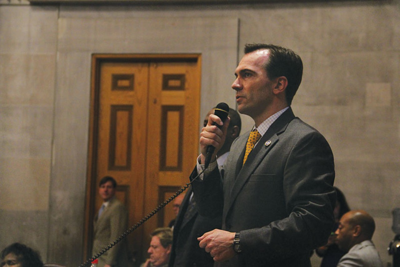
Their differences are evident on first impression. Yarbro hews to traditional, Brooks Brothers-style navy suits paired with classic red, patterned ties. Clemmons favors narrow-cut, fashion-forward suits and doesn't shy away from bright ties. Clemmons' style sense, in fact, offends some old-school members of the legislature, including one who even said — off the record — his pants are too tight.
"When you are in the minority, you don't get heard, and you've got to do things to be heard," says Republican Rep. Glen Casada of District 63 in Williamson County, defending Clemmons. Yarbro "is in leadership and has to be more subtle in his partisanship."
"It's a stylistic question," says a local strategist familiar with both legislators. "John Ray understands where he is in the scheme of things, and he's more creative in his pursuit of issues.
"His thought is, 'I might not be able to get this passed as a Democrat, but at least I can get them to pay attention if I use these five tactics.' "
Yarbro is more the "inside" man, the same observer says.
"Jeff tries to build relationships behind the scenes. He makes friends and drives a different agenda," says the strategist. "Jeff will grab your shoulder, say, 'Hey, buddy' — you just want to do things for Jeff because he's so nice."
Yet Yarbro's detractors cite his need to be liked as a flaw — as a sign that he's not aggressive enough.
"Jeff's greatest strength is also his greatest weakness," says Metro Nashville school board member Will Pinkston, an early supporter of Yarbro's who admits his enthusiasm has waned. "He wants everyone to like him, but you have to give up congeniality to get things accomplished."
Surprisingly, most of this criticism comes from within their own party. Despite the bitter partisanship driving wedges between factions — as one longtime political observer tells the Scene, "You can fly your big Democrat flag and everybody in Nashville will love you, but everyone else will hate you" — colleagues across the aisle give them high marks.
"[Yarbro] has really big shoes to fill, because he's ended up succeeding Douglas Henry, one of the great public servants," says District 22 Sen. Steve Dickerson, a Republican. "He's a really bright guy, and when we disagree, his positions are well-reasoned and thoughtful.
"On the other hand, he's clearly the loyal, spirited opposition and will plant his flag."
Casada describes both of the new lawmakers as thoughtful, articulate individuals.
As for what's next, Clemmons has already filed a piece of legislation for the coming session to prohibit handguns in public parks or professional sports arenas, even with a handgun carry permit.
The two will also surely grapple with issues that recur year after year. Those with statewide implications include health care, privatization of government services — Clemmons has been on a listening tour of the state to hear government employees — and addressing endemic problems in Tennessee prisons. The last item is one Yarbro particularly intends to press.
Dickerson says the two may just be starting their second years as legislators, but their strong start ensures they can ward off challengers — from their own party, anyway.
"They will probably never get a general election opponent that can stand up to them," he says. "They can both have as long a legislative career as they want."



Post a comment as anonymous
Report
Watch this discussion.
(0) comments
Welcome to the discussion.
Log In
Welcome to the discussion.
Keep it clean. Please avoid obscene, vulgar, lewd, racist or otherwise abusive language. Comments featuring hate speech or threatening or violent content will not be tolerated.
PLEASE TURN OFF YOUR CAPS LOCK.
Be truthful. Don't knowingly lie or mislead.
Be proactive. Use the “report” link on any comment that violates our comment policy.
Share with us. We'd love to hear your feedback.