
From the parking lot behind the building at 532 Eighth Ave. S., and looking northeast, there's a panoramic view of the proud evidence of a thriving city—sparkling office and residential buildings, the Gaylord Entertainment Center, the Country Music Hall of Fame. The pristinely restored Shelby Street Bridge and the recently completed soaring Gateway Bridge arch across the Cumberland to the Coliseum, the upper decks of which are easily seen from this vantage point; tall cranes mark the bustling construction site of what many anticipate will be Nashville's most magnificent structure, the $120 million symphony hall.
All of these skyline markers represent promises made and fulfilled for those who call Nashville home. But, as those who gather daily and nightly in the parking lot just a few blocks away know all too well, not everyone who lives here actually has a place to call home. On any given day in Nashville, more than 3,000 men, women and children find themselves on the street, looking for shelter from the night. They are the human body and face of unfilled promise and promises broken. They are the mentally ill, the physically disabled, the sick and injured, the abused and traumatized, the orphans, the widows, the formerly institutionalized, the addicted, the developmentally challenged. They are the working poor, doing backbreaking day labor that earns them a paycheck so meager that it can't support even one person, let alone a family. Often, they are simply the innocent victims of unforeseen circumstances, walking the tightrope between getting by and falling off, with no safety net below them to break their fall.
While scores of Nashvillians drive past this building on a daily basis, barely noticing it's there, thousands more have made a deliberate, intentioned path to the Campus for Human Development, site of The Guest House, Respite Care, Odyssey and Room in the Inn. They come—those who have a home and those without—seeking a place of learning and teaching, of faith, forgiveness, healing, reconciliation and, most of all, love.
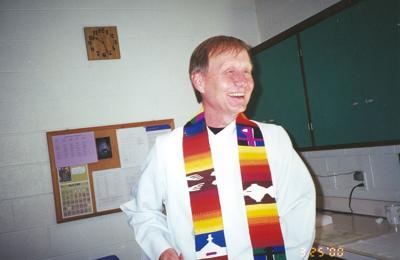
Standing at the gate is Charles Frederick Strobel, director of the campus and founder of Room in the Inn. He's known as "Charlie" to his family, friends and staff, and simply as "Father" to the homeless. A passionate advocate for the least among us, he's a man with a mop of unwieldy hair who's more often than not dressed in grubby, faded jeans and a T-shirt or tattered sweatshirt. Clearly, he's not a fashionable fellow. Nor can he tell a joke to save his life, those he helps are quick to say.
What he does do is implore the fortunate not only to look, but also to see. Shining a light through the darkness of despair, the blindness of ignorance and the neglect of complacency, he beseeches all of us to heed the simplest and most universal words of God, however we conceive of this higher power: love one another. All the while, this modest man stands also at the edge, struggling with the tension between telling the story of the campus and those it serves, and calling attention to his work and thus himself.
"Charlie is a natural in this life, in this world," says Rev. Becca Stevens, pastor of St. Augustine Episcopal Chapel on the Vanderbilt campus and a close friend of Strobel's. "That's why he moves freely with the homeless as well as with people of power. He walks with grace and is unafraid to speak the truth. If you know him for any length of time, he will eventually ask you where you are in the Scriptures. That's where he lives."
In that case, Strobel most often lives in Matthew 5, the chapter in which Jesus delivers the Sermon on the Mount, offering in verses 3-11 the familiar beatitudes that include the reminder that blessed are the meek, the merciful, the pure in heart and the peacemakers.
"I probably quote Charlie more from the pulpit than any other person I know," Stevens says.
"All of our stories are there, in the Scriptures," Strobel says. "If you can locate yourself there, you're in great company, you're not alone, other people have been there. It's all about God. We are the story, and God is the plot."
Strobel's story began March 12, 1943, on Seventh Avenue North in Germantown, then a tightly knit neighborhood of blue-collar multigenerational families. The third of Mary Catherine and Martin Strobel's four children, he still lives in the house where he grew up. His father had been crippled in a childhood accident and was known as "Mutt" among family, friends and co-workers at the Nashville Fire Department, where he worked in dispatch. On Dec. 21, 1947, Mutt Strobel passed away, either from pneumonia or a heart attack. His widow was left with four children to raise: 8-year-old Veronica, 7-year-old Jerry, 4-year-old Charlie and 18-month-old Alice.
"Momma gathered us around her and told us, 'God will take care of us, and your father will watch over us, and we have to stay together,' " Strobel recalls. "She kept him alive for us through the years by reminding us what he stood for; if we did something wrong, she would tell us he would not approve, and if we did something well, she told us he would be proud. She always reminded us that we didn't have it as hard as some people, and when people were kind to us, she would be so grateful and explain that people don't have to be nice."
In keeping with the tradition of taking care of the families of fallen brothers, the Nashville Fire Department hired his mother to work in headquarters as the department's first female employee. Mary Catherine's two maiden aunts, Aunt Molly and Aunt Kate—who had mothered her after her own mother died in a fire when she was a baby—came to live in the home to care for the children while Mrs. Strobel worked and tended to countless people in need. "You couldn't contain my mother," Strobel recalls with a wistful smile. "She was involved with everything. She'd go to church in the morning, visit someone in the hospital, go to the soup kitchen, drop some clothes or a sack of groceries off to a family after work. She knew life was precious; she couldn't bear the thought of anyone being alone without someone to care for them."
Like other white Catholic children in the neighborhood, Strobel attended services and was schooled from first through eighth grade at Church of the Assumption, just a block from his home. It was in the parish yard of the church that he first experienced racial injustice. "I was about 7 or 8 and playing in the yard, and met a black boy my own age named Tony Winston. His family lived in the house where Monell's restaurant is now. He told me he was Catholic, and I asked him where he went to school; he said St. Vincent's, which was on 18th by Fisk University. I asked him why he didn't go to Assumption, and he just said, 'Because I go to St. Vincent's.' When I went home and told Momma I met a boy named Tony, she said, 'Oh, the Winstons are a very nice family.' I asked her why he didn't go to school with me, and she simply said, 'Because he goes to St.Vincent's.' I didn't need anyone to tell me this was very wrong. There were two evils there: that 100 years after the Civil War, racial segregation was legal, and that the church didn't take the lead in ending it."
There was another childhood experience that helped shape Strobel's convictions and work. A black man had converted a barn-like structure behind a neighboring house into a two-room tarpaper shack for his family. Strobel recalls that the man got up at dawn every morning to work his day job delivering coal; after supper at home, he left again and worked as a janitor until midnight. "He did this six days a week...but was never able to make enough money to get out of that place and buy a real house. When I grew up and heard people say that the poor were lazy and didn't want to work, that was not my experience, my frame of reference, at all."
It was in eighth grade that a Sister at the school asked him if he'd ever considered the priesthood, and he replied that he had. She advised him to pray about it. "At first, when I thought about being a priest, it wasn't necessarily to help people, but because the priest was at the altar and closest to God," Strobel says.
Close to his heart, then and now, was baseball. As a kid, he went as often as he could to Sulphur Dell, the city ballpark for the minor league team, just three blocks from his house. "You could see the lights and hear the crowds. I just loved baseball." Stan Musial, the renowned left-fielder for the St. Louis Cardinals, was his boyhood hero, and along with thoughts of becoming a priest, he dreamed of being a major league ballplayer. "It was watching games at Sulphur Dell by myself that I learned not only the game, but the game within the game. That's what makes baseball so compelling to me, the subtle nuances."
After graduating from Father Ryan in 1961 and accepting that he wasn't destined for greatness on the diamond, he entered the seminary at St. Mary's College in Kentucky. From there, he went to graduate school at Catholic University in Washington, D.C., and encountered an all-new world.

Strobel founded homeless outreach nonprofit Room In The Inn in 1985
"Up until then, from the time I was born through college, everything was just a fuller experience of a world view that included God, family, church and school. It was comfortable, and it worked for me. Then I came to Catholic University in Washington in 1965, and everything changed. If I could choose any time in the last century to be in the nation's capitol, it would be those years when I was there. It was when everything began to be reexamined and challenged. There were tremendous changes in the church, the struggle for civil rights, for racial equality, the war on poverty, the Vietnam war," he recalls.
Strobel came back to Nashville and was ordained at the Cathedral of the Incarnation on July 31, 1970. Though he had prayed consistently in seminary that he would one day work with the poor, he was assigned to Immaculate Conception parish in Knoxville as associate pastor, and to teach school at Knoxville Catholic High School. It wasn't the easiest transition, nor the best fit for the idealistic and radicalized young priest. "Just the year before, I had been outside the institution, then suddenly I was inside, and young students were questioning me. I was not a very good teacher; by October, I had taught them everything I knew, or at least that's how it seemed to me."
After two years, Strobel took a leave of absence to open a Knoxville office of the National Conference of Christians and Jews; in 1975, he came back to Nashville as associate pastor of Holy Rosary in Donelson before being named pastor of East Nashville's Holy Name Catholic Church in 1977. There, his story took a dramatic turn, one that began innocuously enough with a peanut butter and jelly sandwich.
"When I came to Holy Name in 1977, we didn't see 'homeless' people, but there were poor people. People would come to the door of the church hungry, and we would make them peanut butter and jelly sandwiches. I remember telling the church secretary that I thought all we could do was hand out sandwiches. But, beginning in 1980, as national policy changed, the needs became greater—under the Reagan administration, programs for the poor were cut, and mental hospitals were emptied, many of [those turned out] Vietnam veterans suffering from post-traumatic stress syndrome. In 1983, Margaret Don at St. Henry asked if I would be interested in starting a soup kitchen. She recruited other congregations to come and cook, and that was the start of Loaves and Fishes."
Simultaneously, there were many other faith-based groups ministering to the poor, and The Salvation Army and Union Rescue Mission had long provided temporary shelter to those in need. But in the winter of 1985, from the window of his bedroom in the rectory beside Holy Name, Father Strobel saw a larger need, and a different way to write the story. He could see people sleeping in their cars through the cold winter night, seeking some semblance of safety in the parking lot of the church. Unable to reconcile their need with his comfort—and a warm building with plenty of unused space—he invited them inside to sleep.
His church was willing and congregants were supportive, and other groups stepped in to help, bringing cots, blankets and food. The winter passed, and by spring, there were enough people involved in the rudimentary shelter to keep it going. Matthew 25 was started at another site and remains one of Nashville's most successful permanent shelters for the homeless, offering job training and counseling for working men.
But it wasn't enough to shelter the hundreds who would be out in the cold in the winter of 1986. Strobel wrote a letter to the editor of both daily papers, explaining the concept of opening houses of worship to Nashville's homeless population. It was published, and by Thanksgiving of that year, four other congregations joined Holy Name.
But just weeks after the expanded program began, an unspeakable tragedy struck the Strobel family. On Dec. 9, while making her volunteer rounds, Mary Catherine Strobel went missing; two days later, her body was discovered in the trunk of her car. A man who had escaped from a prison mental ward was later charged in her murder and several others.
The front page of the Dec. 14 Tennessean reported that more than 1,000 people—most of whom Mary Catherine had personally touched—gathered for her funeral service. The family—led by Father Charles Strobel—called on them to forgive. "We know the answers are not easy and clear, but we still believe in the miracle of forgiveness," Father Strobel was quoted as saying. "And we extend our arms in that embrace.... There are still needs all around us, and we must attend to those needs."
At Catholic University, and many times after that, people would question Strobel's opposition to the death penalty. "How would you feel if someone close to you was murdered?" they'd ask. He always replied that he hoped he would feel the same way, never imagining he would ever be put to the test. "When Momma was killed, there was not one doubt in my mind what we needed to say as a family," he recalls. "Not only was capital punishment contrary to who she was, but it was against everything we were taught."
By the same token, with Room in the Inn in its nascent stages, he was asked how to go on. But the answer was clear: if it was worthwhile doing before her death, then it was certainly worth doing afterward.
Nonetheless, Strobel frankly admits that the first several years after his mother's death were the darkest period of his life. "Looking back, I think that the homeless helped save my life," he says. "It's like when children get sick; the mother can't get sick, because she has to care for her children. I was so depressed, I would have stayed in bed if I hadn't heard them calling at the gate, 'Please, let me in.' "
Before the winter ended, perhaps inspired by the story of Mary Catherine Strobel's generous life, there were 31 congregations participating in Room in the Inn (RITI), taking in a dozen to 15 men or women each on their nights. The Salvation Army gave the program space in a building downtown, then in 1987 RITI moved into a dilapidated city-owned building at Sixth and Demonbreun, where the Gaylord Entertainment Center is now.
More congregations entered the fold, growing to 68 in 1987, 98 the next year and more than 100 the year after that. Its growth meant that it could serve 175 to over 200 people per night.
As the need grew, so did the services offered, rendered by volunteers and a staff of two: Strobel and Madeleine DeMoss, a member of Holy Name who first began at RITI by bringing doughnuts for breakfast. In 1991, the Guest House—which shelters men too drunk to be guests of RITI—was established; before that, they would have been arrested and taken to the drunk tank, a procedure that tied up the arresting officer for two to four hours and placed the men themselves in danger of assault and injury. In 1992, they expanded their staff to three, with the addition of Rachel Hestor.
The campus continued to grow. Respite Care answered another need, serving ill or injured homeless just released from the hospital. Odyssey is a residential program for men suffering from addiction but committed to sobriety. It's rooted in recovery, therapy, education, employment, case management, spirituality, recreation, leisure, artistic expression and community living.
In 1995, when the city needed the RITI building for the arena, they moved the nonprofit to its current space at 532 Eighth Ave. S., merging services with a group called Faith Organizations in Covenant for Understanding and Service. The merged entity became the Campus for Human Development, which Strobel and his colleagues feel accurately describes the space: a campus implies a place of hope, opportunity and learning, and human development means growth, change, process and possibilities.
The campus continued to grow. Respite Care answered another need, serving ill or injured homeless just released from the hospital. Odyssey is a residential program for men suffering from addiction but committed to sobriety. It's rooted in recovery, therapy, education, employment, case management, spirituality, recreation, leisure, artistic expression and community living.
In 1996, the Metro Health Department, which had operated a service center for the homeless next door, offered the campus $200,000 a year to take over those services. That amount has never increased—and was almost cut from this year's city budget. Meanwhile, costs of operating those services are now $335,000, a figure the campus supplements.
On any given night, there might be 50 to 60 people living in "this postage-stamp space," as Strobel calls it. While the residential area is quiet during the day, the rest of the campus bustles. All visitors first encounter the reception desk in the "support area," where questions are answered and bus passes, clothing vouchers and IDs are distributed. The area sees roughly 300 people a day. In the "day room" are seating and tables, computers, a telephone, a lending library and a large-screen television. Anyone using it must be engaged in a productive or positive activity. Phone messages—taken by voice mail—are posted for 30 days on a bulletin board. Likewise, mail—for up to 1,000 people—is distributed in the mornings and is held for 30 days. There is a campus store, where participants can redeem tickets for toiletries, articles of clothing and sundries.
From November through March, Room in the Inn operates daily. Beginning around 5 p.m., buses, vans and private cars creep down the alley and pull into the parking lot, where they idle to stay warm as they await their passengers. During the half-hour or so that volunteers and guests mill about, they exchange greetings and hugs, take part in good-natured banter and offer expressions of concern amid a convivial din not unlike that of any social gathering. And that is the point—and the great success—of Room in the Inn.
"Room in the Inn is about hospitality," Strobel explains. "It should be no different than a dinner party, sitting together at a table. It is Eucharistic—the Last Supper in a different format."
Though a very small number of congregations have had to leave the program because elderly members could no longer provide the necessary services or for other logistical reasons, the great majority return year after year, with many on board for well over 10 years. Still more are needed, because almost every night, there are some who will find no room in the inn. "There is never enough," Strobel says, clearly saddened. "Never enough blankets, clothes, beds. But there is always enough love."
What the Campus lacks in aesthetics—"We may not have nice things, but we make what we do have nice," says Day Team member Mary Wilder—it makes up for in love, kindness and respect. Not only is there always enough, there is plenty to spare from the 25-person paid staff, every one of whom first came onto the Campus either as a volunteer or as a participant.
Melvin Scates, who recently married, is a deacon in his church, has gotten his GED and is now a shift manager at The Guest House, where he often found a bed when he was homeless. He spent nearly 10 years on the streets, despite having family here. A drug addict, he had been suspended from the campus more than once. "I would come down here to take a couple days off from being in the jungle of the streets," he says. "We formed a relationship, me and Madeleine and Charlie. They always saw more in me than I saw in myself. Charlie believes what is bad can be made good, he always puts hope there for you, he never puts doubt in your mind, and it all comes from love. I got a job as a roofer, and I got clean. One day I came down here to see my friends, and Charlie and Madeleine offered me this job."
From the Guest House office, Scates can see the parking lot, where men and women who have no jobs mingle during the day with others coming off shift or with campus volunteers. "I look at those people out there, and I know them, they are me.... You can come in or stay out. It's your choice. But someone has to provide the door. That's what Charlie does, that's what the campus does."
In the past two weeks, both the city and the state have announced major initiatives to combat the problem of chronic homelessness. Philip Mangano, executive director of the U.S. Interagency Council on Homelessness, calls the problem a "national disgrace." Whether Nashville's 10-year strategic plan to "end homelessness" will prove productive is an open question, but Strobel and other longtime advocates are encouraged. Still, Strobel insists that housing should be established as a right for every citizen—and not just a need.
Though nearly everyone at the campus calls Strobel "Father," he actually left the priesthood in 1998. He still finds it difficult to talk about. As he became more and more involved with the campus, he had less time for the church. His successor, Father Joe Sanches, who has known Strobel since they were students at Catholic University and came on board at Holy Name before Strobel left, says he's a prophetic man who stands on the church periphery but is the conscience of both the church and this community. Sanches feels that part of Strobel's frustration with the church was that "it didn't support his mission. So he was torn. This was so important to him, he saw it so clearly as his mission, almost God's plan for him, that he had no choice but to devote himself entirely to that," Sanches says, adding playfully, "Still, I think that if he could have done anything, he would have been a major league ballplayer."
The team is now called the Grey Sox—named for their hair color, not their footwear—and it gives Strobel great joy. "Baseball is therapy to me," he says. "When I'm on the field, nothing else matters. It is so important because it is not important. It's just the best game in the world."
Strobel hasn't retired his gear or uniform, though at 62 he doesn't cut quite the same figure as some of his younger teammates. When he returned to Nashville after grad school, he played softball for nearly 20 years, but only because there was no organized baseball. One day, he saw a notice in the paper about an amateur league forming, and he went to the tryouts, figuring he would be on the 50-and-over team. But he discovered that he was the only one in that age group or the next one down who showed up. League officials went to Plan B and held a draft. Strobel was the last player picked, and he acknowledges his team that first year was terrible, losing every game by huge margins.
The following season, with the first draft pick, they chose Lenny Frenette, an excellent ballplayer who'd recently moved to Nashville. "They were pathetic," Frenette remembers. "They were such a terrible team, it was awful. I told them that if they wanted me to play, we would have to put together a better team." Determined to improve their standings—and keep Frenette on the roster—they recruited better players and went from worst to first, playing in tournaments in Florida and on Doubleday Field in Cooperstown. And Strobel pulls his weight, Frenette says. "He's gotten better every year; we play against 18-, 19-, 20-year-olds, and Charlie can still hit an 80 mph fastball. He loves it more than anyone."
The team is now called the Grey Sox—named for their hair color, not their footwear—and it gives Strobel great joy. "Baseball is therapy to me," he says. "When I'm on the field, nothing else matters. It is so important because it is not important. It's just the best game in the world."
Asked what position he plays, Strobel laughs. "Anything that will get me off the bench." But one official says Father Strobel has a hard time turning the other cheek. Strobel, who could talk the ears off a snake, has even been thrown out of a game for arguing the calls. "He was at bat in the bottom of the ninth, his team was down about 18-3. I was calling strikes, and he was seeing balls. The third time he did it, I called it a strike, he argued, so I threw him out. I think he honestly believed they had a chance," umpire Mike Ipsen says.
A chance. In Strobel's view, everyone deserves a chance, and a second chance and a third. Even more, everyone deserves love, and if those are offered together, who knows what miracles might occur? It was a lesson he learned early in his priesthood, thanks to a cantankerous, mentally ill man who had become the bane of his existence.
"When I was first at Holy Name, there was a man there named Doy; he was an impossible problem for me," Strobel recalls. "He came every morning at the crack of dawn to the rectory and rang the bell, which would wake my dog and wake me. All I wanted was to sleep a little longer, but Doy would not be ignored. He was rude and verbally abusive to other congregants. Whenever I tried to do something for him, he would shoot me the bird. Momma used to tell me that Doy was my ticket to heaven. It was so frustrating, I didn't know how to change him, rehabilitate him."
When renowned social activist Dorothy Day—who had replaced Stan Musial as Strobel's hero—died, her obituary contained a quote that was an epiphany for Strobel. She noted that the poor and the homeless had been studied and researched to death, but that all they needed was love.
"I realized that I had failed to see him as my brother," Strobel says. "I couldn't ask Doy to change for me. I just needed to love him. Immediately, it all changed. He stopped ringing the doorbell, he stopped cursing at me. It was a lesson I've never forgotten."
Strobel's view is that we're all put on this earth preparing to die. "We are the only species who knows that we will die, that everything else will go on but that our time on this earth is short. So, what do you do with that time? Do you want to just get all you can while you are here, or do you want to make a difference to others, to leave the world a better place?"
Strobel, whose immeasurable grace and generosity is tempered by moments of sly irreverence and humor, hopes those who leave this world before him will carry a message. "One time I was with Charlie as he was with a man who was dying," Becca Stevens remembers. "The whole family had gathered around, everyone had shared and spoken, said prayers, the end was clearly near. Charlie leaned down to the man to say what would probably be the last words he would hear. I thought he would say something very profound or something from the Scriptures. I leaned in closer to hear, and this is what Charlie said: 'Hey, when you get there, tell God I'm doing the best I can.' "



Post a comment as anonymous
Report
Watch this discussion.
(0) comments
Welcome to the discussion.
Log In
Welcome to the discussion.
Keep it clean. Please avoid obscene, vulgar, lewd, racist or otherwise abusive language. Comments featuring hate speech or threatening or violent content will not be tolerated.
PLEASE TURN OFF YOUR CAPS LOCK.
Be truthful. Don't knowingly lie or mislead.
Be proactive. Use the “report” link on any comment that violates our comment policy.
Share with us. We'd love to hear your feedback.