
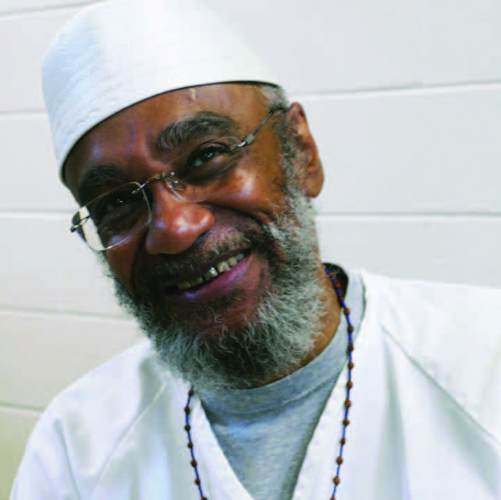


Abu-Ali Abdur'RahmanPhoto courtesy of Bradley MacLean
As the state prepares to execute Stephen West on Thursday, a death row prisoner from Nashville will be preparing for a new court hearing in his case. The matter is urgent: The prisoner, Abu-Ali Abdur’Rahman, is scheduled to be executed less than a year from now, on April 16, 2020.
With that date looming and the state showing no signs of slowing the recently revived death penalty machine, Metro Nashville Criminal Court Judge Monte Watkins will hear arguments on Aug. 28 that Abdur’Rahman’s trial was marred by a prosecutor’s racial discrimination in jury selection. Abdur’Rahman’s attorney, Bradley MacLean, filed a motion to reopen his client’s post-conviction appeals in 2016, and Watkins granted him a hearing. But the motion lingered without a court date — until now. MacLean will ultimately be seeking a new trial. Abdur’Rahman will almost certainly never be released from prison — along with the death sentence, the 1987 jury handed down two consecutive life sentences for other charges. He was also convicted of second-degree murder in 1972 for killing a man who’d threatened to rape him while they were both in federal prison. But if MacLean is successful, he could keep Abdur’Rahman out of the execution chamber.
Abdur’Rahman, a black man, has been on death row for 32 years, since he was convicted of killing Patrick Daniels and attacking Norma Jean Norman during a robbery. On paper, his life before he arrived on death row looks very similar to that of the men with whom he’s shared a prison unit for more than 30 years. As a young boy, Abdur’Rahman suffered brutal physical and sexual abuse and was made all the more vulnerable by mental illness.
But MacLean says what makes Abdur’Rahman stand out is the utter mess that was his original trial.
“Everything that could go wrong in a capital case went wrong in Abu’s case,” MacLean tells the Scene.
As he put it last year in a clemency petition to then-Gov. Bill Haslam (an updated version of which will be submitted to Gov. Bill Lee): “This is the only Tennessee case in which the death sentence was upheld even though all reviewing judges have found, and the prosecution has not disputed, that defense counsel’s performance was constitutionally deficient. In every other case in which judges agreed that the defense attorney’s performance was constitutionally deficient, the death sentence was vacated. In Abu-Ali’s case, his trial lawyers’ failures were extreme.”
“This is an extraordinary case in which Abu-Ali’s trial was fundamentally unfair and unreliable due to the grossly inadequate legal representation provided by his defense attorney combined with the egregious prosecutorial misconduct committed by the lead prosecuting attorney,” MacLean later adds.
The man who represented Abdur’Rahman in his 1987 trial agrees with MacLean’s assessment of his own work. Lionel Barrett says he was carrying an unreasonable caseload and admits he never should have taken the case. He told ABA Journal in 2011 that he did “everything I could have done wrong” and that the burden of that failure led him to leave his career as a lawyer.
“Abu-Ali is on death row because of me,” Barrett told the publication. “I failed him. I have no excuse. This is the only case in my entire career that I would do anything to be able to do over again.”
Barrett’s inadequate representation will not be the focus of the hearing later this month. But MacLean says it’s crucial context for what will be.
“The fact that the lawyer didn’t do his job is a factor because it allowed [Assistant District Attorney John Zimmermann] to do all the shit that he did,” MacLean says.
In his 2016 motion, which will be updated for the new hearing, MacLean argues that Zimmermann had discriminatory intent during jury selection when he struck two prospective African American jurors. Pointing to contradictions between the prosecution’s stated reasons for striking those jurors and “the truth derived from the record and the prosecution’s own notes,” MacLean argues that Zimmermann was relying on “false, racist stereotyping” of black people. MacLean argues that in the case of one prospective black male juror, Zimmermann falsely claimed the man “appeared uneducated” and “had a reduced intellect.”
Zimmermann’s record since Abdur’Rahman’s trial would appear to back up MacLean’s characterization of his conduct back then.
In a November 2015 letter to the Tennessee District Attorneys General Conference, Davidson County District Attorney Glenn Funk highlights and disavows comments Zimmermann made at an annual conference. In one instance, Funk writes, Zimmermann said “he would strike jurors with a 37215 area code, an affluent part of town, if the case involved people from ‘the inner city’ because ‘in Nashville, rich people don’t care about what happens in East Nashville.’ ”
Funk goes on: “While the racial implications in the previous comment were inferential, his next statements were blatant advice to use race in jury selection. Specifically, Mr. Zimmermann described prosecuting a conspiracy case with all Hispanic defendants. He stated he wanted an all African-American jury, because ‘all Blacks hate Mexicans.’ ”
More recently, Zimmermann — who is now a prosecutor in Rutherford County — was accused in a lawsuit of targeting Egyptian business owners, falsely claiming they were selling illegal “marijuana derivatives.” All charges related to the bogus busts — known as “Operation Candy Crush” — were later dropped.
Another factor that could make all the difference for Abdur’Rahman is who will be on the other side of the courtroom later this month. Although for decades lawyers from the state attorney general’s office have represented the state in proceedings related to Abdur’Rahman’s case, this hearing is in a Nashville criminal court. Court documents indicate that Funk’s office will be handling the hearing, although they declined to comment on the pending proceeding.
In five years as Nashville’s district attorney, Funk has never sought the death penalty.



