
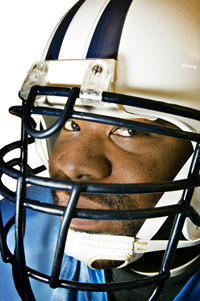
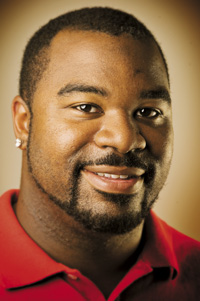
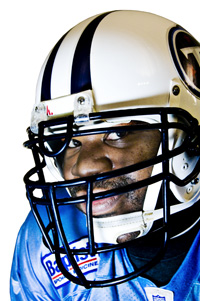
In a very short span of time, the Titans’ Albert Haynesworth has gone from one of the most vilified names in America to one of the most valuable players in the NFL. Last October, Haynesworth was crucified by the league, the national media and his own team for stomping on the head of an opponent who lay prone and helmetless on the field after the end of a play.
The act made him a pariah. The 26-year-old instantly became the favorite whipping boy of every pundit with a microphone, notebook or soapbox in the land. Besides a very public shaming, the attack cost him a small fortune in fines, playing time and salary.
Fourteen months later things are very different in Haynesworth’s world.
Until an injury sidelined him last month, he was probably the best defensive tackle in the game. His performance has been nothing short of explosive as he’s terrorized quarterbacks and offensive linemen from Jacksonville to Oakland. In his absence over three of the last four weeks, the Titans’ defense has gone from one of the most feared in the league to being as effective as a screen door on a submarine. When he returned to the lineup against Texas last Sunday, the defense regained its impenetrability and the team snapped its three-game losing streak.
Early in the season, Sports Illustrated called the 6-foot-6, 320-pound Haynesworth “the best DT in the NFL right now.” Many believe that, even with a nagging injury, he still is.
Haynesworth says—and very much wants fans to believe—that he’s put that dreadful incident from last season behind him and turned a corner professionally. This is an important time for him. His team’s playoff hopes hang by a thread, and they need him to continue playing like a rocket-fueled freight train if they hope to get to the post-season promised land.
It’s also a contract year for the defensive tackle. If he continues to impress, the Titans could extend an already lucrative deal. If they don’t re-sign him, there are any number of teams who could use a thunderbolt-fast, 320-pound, game-changing juggernaut.
But doubts persist.
Haynesworth’s maturity and work ethic have been a question since his days as a college player at the University of Tennessee. As a Volunteer he had a habit of throwing tantrums, scrapping with teammates and not quite giving 100 percent on the practice field. Some of that behavior followed him to the NFL. In his second season, he couldn’t make it through training camp without fighting teammate Justin Hartwig.
And then came last October and the stomp seen ’round the world.
Haynesworth says that the experience gave him a chance at reflection. He claims to have used the incident and its penalties as an opportunity to regroup and take a new approach to the game. Looking back on that time, he admits that it changed his life and insists that a new chapter has opened.
“I heard a coach talk about it,” he says. “A Hall of Famer who coached the D-line. He said that defensive linemen were on the borderline of insanity. Because that’s how you have to play the game. But I don’t really go that far now…the old Albert Haynesworth died with that and a new one is born.”
To understand Albert Haynesworth, it’s first necessary to understand the role of a defensive tackle in the National Football League. DTs, as they’re known, have a grueling, intensely physical job that requires them to collide with enormously strong opponents on every single play.
A defensive line has two tackles. They line up opposite the quarterback, generally on either side of the ball. On running plays, the offense’s job is to try and move the ball through the defensive line by manhandling the DTs out of the way. This creates gaps for running backs or tight ends to zip through. The DT’s job is to push back at the offensive linemen and, at the very least, remain unmoved. On a passing play, the roles are somewhat reversed, with DTs trying to move the offensive linemen so that smaller, faster, “defensive ends” can run through the gaps and flatten the quarterback before he can throw the ball. The superb Kyle Vanden Bosch is the defensive end who lines up next to Haynesworth on the right side.
On any given play, a good defensive tackle will either have to absorb a tremendous amount of force without being moved or unleash a lightning-quick, rhinoceros-strong charge that will overpower his opponent. Albert Haynesworth is just such a player.
“Brute force,” he says, describing his playing style. “Physical. Just get at them. No finesse.”
It’s not a glory position. Most DTs don’t rack up gaudy numbers or end up on ESPN’s SportsCenter highlight reel. Still, Haynesworth’s work is unmistakable. One of the most remarkable aspects of his play is that he’s often double-teamed. It takes twice as much force to stop him, and often that isn’t enough.
In week five of this season, the Tennessee defense had its back to the wall in a crucial early game. It was first down and the Atlanta Falcons were standing at the Titans’ goal line with two minutes to go. The Titans had a seven-point lead, which hardly seemed safe. The Falcons called a running play, and before their quarterback could flip off the ball, Haynesworth launched himself into the offensive line, sailed over a mammoth offensive guard and center and grabbed Falcons quarterback Byron Leftwich. Leftwich hurriedly tossed the ball backward to a teammate, who quickly fell for a nine-yard loss. Titans linebacker Keith Bullock called Haynesworth’s move “flat-out the best play I’ve ever seen by a defensive lineman.”
In week seven against the Texans, Haynesworth made another game-changing play. With a minute left in the first half, he separated from the offensive line just as quarterback Matt Schaub let go of the ball. Haynesworth kept coming, leaving his feet, extending his arms. He landed squarely on Schaub with every one of his 320 pounds, crushing the quarterback into a pile of shoulder pads and twisted limbs on the turf. Haynesworth was flagged for a personal foul, and Schaub limped off of the field. He would not return to the game, needing an MRI on his hip.
“I’ll tell you what,” Schaub’s coach said after the game. “Matt’s just beat up.”
A few weeks before that, Haynesworth was in trouble with NFL officials for a bone-shattering hit that he delivered to Jacksonville Jaguars running back Maurice Jones-Drew. Haynesworth tackled Jones-Drew for a one-yard loss, slamming him to the ground on his head in what league officials deemed unnecessary roughness. The team was penalized 15 yards on the play, and Haynesworth was fined $5,000. After the game, he was asked if he would turn the ferocity of his tackles down a notch. “I’m not going to be any gentler or whatever,” he replied. “Maybe I’ll just help them up.”
A few weeks later, Haynesworth registered three sacks against the Carolina Panthers, who had their worst offensive day of the season.
Unfortunately, the Carolina game would be Haynesworth’s last performance for a while. He hurt his right hamstring and would not play for the next three Sundays. While he was gone, the Titans’ defense made a strong case for Haynesworth’s indispensability. What had been the stingiest running defense in the league—allowing only 66 yards per game—turned into a sieve, allowing 166 yards on the ground the first week Haynesworth was out.
The next week against Denver on a Monday night was no better, with no-name running backs breaking up the middle—exactly where Haynesworth usually plays—for big gains.
That’s not to say that Haynesworth is the entire Titan defense. Vanden Bosch and Bullock are Pro Bowl-caliber players. The Titans’ offense has also struggled lately, making it hard for the defense to keep games close.
Still, says Duncan Stewart, who hosts Prime Time Sports on WLAC radio, “The linebackers miss him so much. You get Randy Starks [Haynesworth’s replacement] as opposed to Albert Haynesworth, and he’s just not occupying two people.”
When Haynesworth returned to the lineup last Sunday, he accounted for only two tackles, but he clogged up running lanes with his speed and size all day and was instrumental in enabling the defensive ends and linebackers to make plays.
Even though Haynesworth spent three weeks on the bench, he still leads his team in tackles for a loss. That says a lot about the way he approaches the game. He doesn’t merely stop ball carriers, he hits them with an immutable force that propels them not just down, but backward.
In the past, this force has been both indiscriminate and reckless.
Haynesworth played college ball from 1999-2001 at the University of Tennessee after being recruited out of Hartsville, S.C. When he chose UT, it was considered a coup for the program, as Haynesworth was one of the most highly coveted high school players that year, making ESPN’s top 100 high school players list.
“Even back then I remember Albert looking like an NFL player,” says Brent Dougherty, who covered the Volunteers as a reporter while Haynesworth was there and now co-hosts Prime Time Sports along with Duncan Stewart. He recalls that Haynesworth looked ready to play at the highest level, “even as an 18-year-old high school senior.”
But when Haynesworth strapped on the orange and white, Dougherty says that his play was disappointing.
“He came to Tennessee and everybody thought, ‘OK, this kid is going to be dominant,’ and he just wasn’t. At times he was, but it was almost like he could just turn it on and off.”
Haynesworth had tremendous ability but was often injured.
“If a game went by where Albert didn’t at some point roll around on the field with the clock stopped and people tending to him, it would be a complete shock to everybody,” Dougherty says.
Early in his UT career, he also became known for throwing sideline tantrums during games, flinging his helmet into the air, once even shoving an assistant coach.
On one occasion, after Haynesworth was the victim of a late hit by a teammate in practice, he stormed off the field in anger. Moments later, he returned holding what newspapers called “a long pole,” intending to exact physical retribution. He had to be restrained by coaches, including Volunteers head coach Phillip Fulmer and other players.
Haynesworth says that youth and a feeling of displacement contributed to his bad behavior at UT. “I left home at 17,” he says. “From a small town with 30,000 people to [a place with] 250,000 or 300,000.… I mean, the number of people on campus was the size of my town…. I had to adjust to that.”
He also says that a sense of pride is part of his attitude. “My mom never wanted anybody to push us around. You need to stand up for yourself. So that’s where all of that came from. You know, you could only take so much before you have to stand up for yourself. You don’t want to be a wimp or anything like that…. Man, we always fought in school, grade school and all that stuff. She said that if somebody hits you, you gotta hit them back.”
In 2002, the Titans drafted him in the first round and gave him a $6 million signing bonus. The next year he was involved in another melee, that one after he kicked a teammate in the chest during a preseason practice session.
Haynesworth says that, once again, he was simply immature.
“Being 20, getting drafted, getting handed millions of dollars, you’re on your own…. It’s just different…. But you know, after the learning curve you adjust to it.”
As he speaks, the big man turns pensive, his hands folded before him, head bowed. He doesn’t watch his listener but fiddles with his cell phone, not anxious but still not fully at ease with what he’s saying.
“It’s hard,” he continues. “Being a professional they expect you to know it or to do it or to be it or whatever. You don’t really have anybody to help you. Once you get it down, I mean, you might have a couple of old guys [on your team] who might help you but, you’re blessed if you get that…. I always kept to myself. I never really expressed myself to anybody. I was always being protective for some reason. Never wanting to show weakness.”
And then last year, Haynesworth became the most hated figure in the NFL.
In the third quarter of a game against the Dallas Cowboys, he stomped on the helmetless head of Dallas center Andre Gurode, who was on the field defenseless after the end of a play in which Dallas scored a touchdown.
A media shit storm ensued. Talk radio hosts, ESPN analysts and newspaper columnists all began wagging fingers and tongues, condemning Haynesworth and calling for his head. He would receive the longest suspension for an on-field incident in league history: five games without pay. It would cost him close to $190,000 in salary.
After the game he told the media, “What I did was disgusting. It’s something that should never happen. I mean, I’m not a dirty player. I don’t play dirty. I have respect for the game. What I feel like is I disgraced the game, disgraced my team and disgraced my last name.”
Sports talker Dougherty was in that press scrum and remembers a genuinely contrite Haynesworth. “He looked concerned for Gurode, he looked concerned for himself moving forward and I totally bought into it and I gave him the benefit of the doubt. I continue to do so.”
In person, Haynesworth is disarmingly personable. Neither arrogant nor jaded, there is a soft quality about him and a genuine curiosity about the greater world outside of football. It’s hard to square this set of descriptors with the man who opened up a bloody wound in Andre Gurode’s head that required 30 stitches and nearly cost him his right eye.
Dougherty also wrestles with this dichotomy. “Knowing Albert through the years and knowing how he is off the field, I just had a hard time thinking it was the same person.”
Haynesworth echoes the sentiment. “I’m totally different,” he says. “I don’t even go back to that. It’s a totally different life, it seems like.”
In some ways, Haynesworth concedes, the suspension may have been good for him professionally.
For the first time in many years, he could watch the game from the outside in and begin to make adjustments to his playing style.
“I’m not complete yet,” he says. “I’m not done.”
Already one of the top run stoppers in the game, Haynesworth believes that he can become a threatening pass rusher, getting to the quarterback faster and creating more opportunities for the defense.
“In this league it’s good to be a run stuffer,” he says. “But you get more recognition for being a pass rusher. To be good at both would put me in an elite group.”
When asked how he hopes to improve this part of his game, Haynesworth laughs and say, “I don’t know! I’m trying to figure that out…. It’s like an art.”
His coaches see him making steps in the right direction. Titans defensive coordinator Jim Schwartz, who has been heaped with praise for his unit’s success, says Haynesworth has worked hard on technique this year, but he’s also quick to credit the entire defensive line for the team’s early success.
“Albert has done great work, especially with his hands,” says Schwartz. “But all of those guys have really come together as one on that side of the ball and are reading offenses extremely well.” He then adds, “Are we done here?”
Haynesworth says that he aspires to play like the Oakland Raiders’ Warren Sapp, a 13-year veteran and future Hall of Famer who’s one of the most dangerous defensive tackles ever to play the game.
“I wish I could have my pass rush game like Sapp,” Haynesworth says. He particularly admires Sapp’s ability to get to the quarterback again and again. “For a defensive tackle to have 10 sacks [in a season], that’s a lot,” he says of Sapp, who has had 10 tackles or more in four seasons.
Though Haynesworth has missed three games this season, he already has five sacks.
One difference between Sapp and Haynesworth is about 25 pounds.
“You don’t see a whole lot of power pass rushers,” the Titan says, referring to his smash-mouth style of play. “You see a lot [pass rushers] beat them with speed or quickness, but you rarely see them do it with power…. Brute-force guys that can just run over people, you don’t really see that too much. To get sacks that way is awesome—like, ‘Oh my God, he just crushed that guard or center.’ You don’t see that a whole lot. So to do that 10 times like that would be unheard of almost.”
To make this happen, he’s started focusing on his technique and strength. “You have to set them up and play them a certain way the whole game,” he says of the players who line up against him. “Then when the game is on the line, you bust out a whole new pass rush. I might just keep playing you outside,” he says, referring to the way he comes at an offensive lineman. (“Outside” refers to the opposing lineman furthest from the quaterback.)
He rises to demonstrate, stepping forward on a left diagonal, leading with his bread-loaf-sized hands. “I keep playing you outside, never come back inside. Then, say it’s the fourth quarter, two minutes left. They’re in a spread offense, throwing the ball a lot.” He gives a sly grin. “I might rush you like I’m going outside….” He steps forward and to the left again. “…club you on the outside….” He swings his massive, trunk-like arm in the air toward his listener’s head. “…and then come inside! You haven’t seen that the whole game, so you didn’t know it was coming. That was my whole plan,” he says raising his eyebrows and waving a finger, as a teacher would. “I set that move up…. It’s like a whole other game, a game within a game.”
So far, Haynesworth’s focus on technique seems to be paying dividends. He was an early favorite for the Pro Bowl, and if he can get healthy and stay motivated he should be able to continue his career year.
But some are saying that’s a pretty big “if.”
“I just hope that his injury is legit, that his motor is on and that he wants to sign a career deal and wants to be an All-Pro for years to come,” says WLAC’s Duncan Stewart. “But I gotta’ tell you, I have my doubts.”
Stewart says that though Haynesworth has five sacks this year, in the past five years he’s only managed nine sacks total.
“I pray to God that if they do re-sign him, that he doesn’t go back to the old Albert next year, where he [only] plays when he wants to…. Before this year Albert Haynesworth was an underachiever in pro football.”
Haynesworth has a rich life off the field. He and his wife Stephanie have three children, and together they own an online travel company, haynesworthtravel.com. He’s clearly started planning for life after football.
“After football, I’ll be getting into real estate,” he says. “We have our construction company, so we’re going to do some developments around here.”
He wants to build suburban luxury housing. Whole neighborhoods of it.
“My goal is to build a neighborhood like The Governors Club,” he says, referring to the exclusive Concord Road development made up of palatial houses flanking a “private Arnold Palmer” golf course. “Say I came up with the idea,” Haynesworth continues, “and then put some nice amenities in there.”
Haynesworth is full of ideas. Though men of his size and job description often have a reputation for being lesser intellectual lights, Haynesworth is no dummy. While many professional athletes use their largesse to help charities, Haynesworth is savvy about where his money goes.
“I like charities, but I don’t like charities,” he says. “Because you can give somebody $100,000, but you’re not going to see all of that $100,000 applied to something. That’s why I like to go directly to the source. If I give $10,000, I want to see 10 or 15 computers bought. I want to see what I paid for.”
He says that, eventually, he’ll start his own foundation—“The Haynesworth Foundation or something”—so that he can see to it that charitable donations get to those who need them. In the meantime, on the Monday after the Titans play the Chargers, Haynesworth and his wife will host their second annual March of Dimes benefit dinner at Mafiaoza’s. Last year they raised $60,000 for the charity.
While Haynesworth likes to help folks in need, his real off-field passion is very fast boats. He owns a 47-foot speedboat named Outer Limits that has twin 1,000-horsepower engines. He takes it joyriding on “Poker Runs,” a semi-competitive club circuit.
He once saw the competition turn deadly. Three years ago on Lake Michigan, Haynesworth was cruising along with friends at about 120 miles an hour when, out of nowhere, another speed boat, similar to the one he has now, raced past them “like we were standing still.”
A few seconds later, the boat tried to take a sharp turn and disintegrated in a huge splash. When Haynesworth and his crew pulled up seconds later, there were bodies and empty lifejackets in the water.
They fished one of the wrecked boat’s passengers out. “He was split open here,” Haynesworth recalls grimly, drawing a line with his finger from side to side, just under his belly. “His intestines were spilling out. I took off my shirt and I had to push his intestines back in.” Meanwhile, somebody who knew CPR tried to revive the man, but it was too late. “He died on the back of the boat.”
Haynesworth says that he’d never take the kind of risk in a boat that would get him killed, but he loves the sport and spends a good deal of his off-season on the water. “It’s a real rush,” he says.
But these diversions worry some observers, who think that he may not be passionate enough about the game that’s made him rich, famous and, at times, notorious.
“He’s a very bright guy who’s got interests way beyond the football field,” says WLAC’s Stewart. “In my opinion, that inhibits him ,because football’s not his only interest in life…. You talk to him for five minutes and you realize that this is a guy who’s extremely bright and isn’t about grunt work. I think he might be a little mercurial.”
Haynesworth of course denies this. He claims that his passion for the game has never wavered and that he wants to stay in with the Titans long-term.
“I like this team,” he says. “I like the coaches, and we’re doing a lot of things right.”
No matter where he ends up next year, he says that his main residence will always be Nashville.
“We’re really taking to Nashville,” he says. “We really like it….We have so many ties here it’s just unbelievable. It’d be hard to let go.”
If Haynesworth can leave behind the mistakes of his past and continue to play at an elite level, the Titans will do everything to make sure that letting go isn’t a problem he has to face. With just four games left in the season and a playoff birth hanging by a thread, this could be the most important moment in Haynesworth’s young life. If, as he insists, the past is past, than he has his work cut out for him.
Haynesworth is done giving apologies. It’s time to play football.



