


John Jay Hooker, the perennial Tennessee candidate, activist and gadfly who nevertheless remained one of the state's most prominent political figures, has died at the age of 85.
After a public battle with cancer, which he turned into one last crusade over the politics of dying, Hooker's passing means the loss of another towering figure from Nashville's past. In the irreplaceable Hooker were joined the gifts of an orator, persuader and constitutional scholar, an indefatigable scrapper, a patrician who defended the interests of working people, a charmer and a rascally wit — a man whose concerns as well as his appearance could be termed Lincolnesque.
His record is full of losses, but Hooker's legacy will draw more from the fact that he didn't give a damn how many he racked up. Undeterred, he ran five times for governor — twice as the Democratic nominee — and four times for U.S. Senate, losing every time. Those campaigns were often vehicles for the causes he cared about, some of them complicated or obscure enough that only a figure as magnetic as Hooker could draw attention to them.
Among those was his fight to hold the state to the words of its constitution, which he believed intended for judges to be elected directly by voters, rather than appointed by the governor and put before the voters later through retention elections. He lost that fight. He stood up for civil rights and opposed the war in Vietnam when both stances were deeply unpopular in the rural South. He railed against the influence of out-of-state money and shadowy contributors in elections long before campaign financing and reform became an issue.
The story of John Jay Hooker includes much more, of course. A respected attorney's son whose marriage to Tish Fort essentially cemented his status as Nashville royalty, Hooker was a member of the famous Vanderbilt Law School class of 1957 — along with John Hollins Sr., who passed away earlier this month, as well as Jim Neal and George Barrett.
He went on to serve as special assistant to Attorney General Bobby Kennedy. His name is the link between the founding of health-care giant Hospital Corporation of America and the insurgent 1992 presidential candidacy of Texas billionaire H. Ross Perot. He briefly owned a chain of fried chicken restaurants — a business venture that ended badly, to say the least — and would later become part-owner and publisher of the late Nashville Banner, the conservative afternoon daily that had been his nemesis during the 1970 gubernatorial campaign. That arrangement too ended shortly after, and not smoothly.
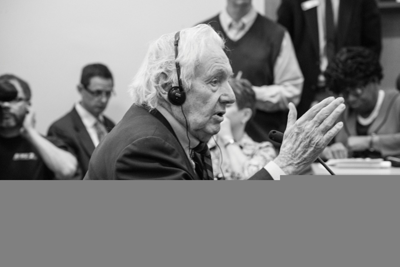
Hooker's final fight was with cancer but also, yet again, with the state of Tennessee, over his right to "die with dignity." After he was diagnosed with Stage IV metastatic melanoma in January of 2015, he would spend the final year of his life arguing that he had the right to end it. He testified at the legislature in support of a bill legalizing doctor-assisted suicide in Tennessee and pressed the matter in court.
"The right to die is a liberty right," he told the Scene in November, after the state Supreme Court declined to hear his case before it went through the regular appeals process. "And for the same reason that you have the right to put your dog down, you’ve got the right to put yourself down. The government doesn’t own you and doesn’t own your dog. And so whatever the semantics are, you can say euthanasia or whatever. It’s a liberty right, and that’s what Thomas Jefferson talked about. If the power is in the people, they have the right to exercise that power. They didn’t get that power from the Constitution, but from God Almighty."
He lost that fight too, but he fought the same way he had time and time and time again. He embodied a generation, and a political class, who understood political capital had no value unless you were willing to risk it all when it mattered. No one, however, risked it so many times for so many honorable defeats. One could disagree with John Jay Hooker, or even defeat him, but you couldn't take away his will to fight.



