
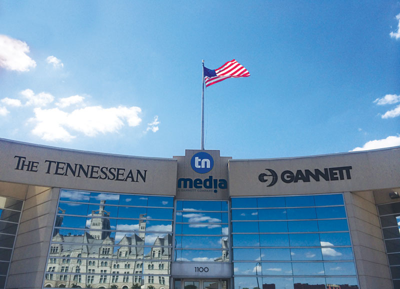

Chas Sisk had had enough.
The Tennessean had just fired Sisk and the entire staff of the paper the day before and asked them to reapply for their jobs. The reorganization was announced in the paper by executive editor Stefanie Murray as a "bold step forward in our evolution."
But in a meeting with Tennessean management the next day to provide answers about the changes, Sisk asked a different question: When was the soonest he could accept a severance package from the paper and leave?
Sisk has been a loyal Tennessean reporter, rising from the business desk to become the paper's Capitol Hill reporter, among the most important beats in a political town. He has bristled in the past at suggestions that staff cuts, which have come annually for the last six years, have eroded the paper's ability to cover the city and state.
This time, though, the indignity of the move — and the 15 percent across-the-board gouge that Gannett has mandated for the staff of all of its newsrooms — was too much.
"Cathy and I have been expecting the company to make this move for about a year now, so we've been quietly laying some preparations," he wrote on Facebook. "It's not going to be an easy few months, but a clean break makes more sense than struggling through a newsroom reorganization that I want no part in."
That reorganization is occurring companywide as Gannett, the nation's largest newspaper chain, prepares to split into two different companies early next year. Broadcast and national digital assets will be on one side; newspapers will be on the other. Between them, however, lies a massive gap in revenue and outlook. TV and sites such as Cars.com and Career Builder are growing, while the publishing side has been flat to down. The cuts on the publishing side are designed to make the new company more attractive to investors.
"I think it's a logical thing to do and has become all the more so over the last year or two," says Rick Edmonds, media business analyst at the Poynter Institute. "Even much more so after the disappointing results newspapers generally have had over the first six months of the year."
Gannett follows Tribune, A.H. Belo, News Corp. and Time Warner in separating its functions — and thus taking away the protection that broadcast and entertainment profits have provided print operations in the past decade.
What will that mean for Nashville? Murray attempted to explain in a column on Aug. 5.
"I'm confident you'll love the end result: we're promising a stronger, more interesting Tennessean delivered by a highly engaged group of journalists who care about Nashville," she wrote. "The bottom line is that we're embarking on an ambitious project to create the newsroom of the future, right here in Nashville. We are testing an exciting new structure that is geared toward building a dynamic, responsive newsroom. This is a 'reset' for us, an entirely different way of operating that gives us more reporters and columnists and puts them even closer to the communities they cover. Our goal is to empower them to be more focused on YOUR needs and interests."
If that sounds like a sales pitch, it is.
That idea of "more" is an important marketing move. The Tennessean will add reporting staff by cutting managers and photographers. In the paper and on social media, Murray has emphasized her assertion that there will be more boots on the ground.
In reality, The Tennessean is restoring only a few of its losses from the past few years. By the Scene's count, at least six reporters have left since last summer, with only a couple replaced. And if you count the cuts the company has made in Nashville — Gannett reduced its companywide workforce from more than 46,000 in 2007 to 33,850 last year — adding reporters at this point doesn't begin to make up for all the eliminated positions.
And now those reporters' editors will largely be gone. The people who are leaving — like longtime photo editor Tom Stanford — are not visible in the same way as their subordinates, whose bylines and photo credits appear daily. The company is betting that you won't miss them, and that losing a layer of editing won't matter.
"I share your concern, and I think a lot of readers do, about this whole business of posting directly to the Web," Edmonds says. "I don't know that there's so much of a record of that in print papers, but really in both places, readers are very quick to notice odd spellings and the rather shocking state of copy that hasn't been edited by an editor. Is that the last straw that's going to cause people to stop reading a website or a paper? I don't know."
In off-the-record conversations — staffers would only talk anonymously for fear of jeopardizing their chances to get a job in the new newsroom — Tennessean personnel described the climate at 1100 Broadway as "horrific" and "morose." Attempts by Murray to lighten the mood in various meetings after the announcement were met with silence and sometimes anger.
"I think she's tone-deaf," one longtime staffer says of Murray, who demoted executive editor Maria De Varenne to the position of news director in preparation for the new structure. More than one reporter noted that Murray is generally perceived as a nice person, but seemed to have no clue how to react to the veteran staff's anger at being forced to reapply for their jobs.
If Murray is excited about building what she calls the "newsroom of the future," reporters who see the behind-the-scenes work of editors hustling on Election Night, churning out deadline-beating Titans packages or planning advance coverage don't see this as an opportunity. They see what will be missing, particularly in a print edition that still has significant readership and provides substantial revenue. By multiple accounts, The Tennessean was profitable last year, with profits reaching well into eight figures.
"You don't do more with less," one reporter says, noting that if there was deadwood in the newsroom, it was hard to see with people routinely working 10- and 12-hour days.
If the cuts are bad, and maybe bad for the city, why doesn't someone step up and buy the paper? It's a complicated question.
First, the company's current structure entangles many different layers. Simply buying the newspaper wouldn't necessarily bring the real estate or printing assets with it.
Second, the value of Gannett as a company — currently trading at more than 6 times EBITDA (earnings before interest, taxes, depreciation and amortization) — is significantly higher than investors have paid recently for newspapers or chains. Warren Buffett bought Media General's assets in 2012 for 3.2 times EBITDA. That's a big gap in value.
Former Tennessean and USA Today publisher Craig Moon says that even if the publishing company is valued lower by Wall Street — at, say, 4 times EBITDA — it still has to make financial sense for investors.
"Currently, the issue is paying the tax," Moon says. Gannett would likely demand that any buyer cover its tax bill. "The multiple you'd be paying for a particular newspaper asset, it wouldn't be attractive to anyone who would view it as an investment. You would have to have someone who didn't need a return on the investment."
The problem, he notes, is that "there's not really rich people who think that way. They're rich for a reason — they've made really good investments." Buffett bought close to the bottom, which goes a long way toward explaining why he has a net worth estimated by Forbes at more than $60 billion.
Also complicating any sale is how the paper would be produced. In an effort to cut costs, many chains, including Gannett, have centralized production functions into hubs. That cost would have to be factored back into the sale of the paper, as staff and systems would be required to function as an independent entity. Any buyer would also have to find substitutes for the traffic from Cars.com and Career Builder, too.
Rumors have floated for two years that potential buyers, including a couple of former publishers, have sought to buy The Tennessean from Gannett. The Scene asked Moon, one subject of those rumors, if he had made an attempt. He said no.
"I don't think anyone has really looked at any ... it gets back to that old thing of, if you could buy an asset at a good price and you could make it a good investment, then I think there's a lot of people that are interested," Moon says. "Maybe when the company changes over and the tax basis changes, Gannett might have an epiphany and sell at a lower price."
Most recently, though, Edmonds says Gannett has been a buyer, not a seller.
"The idea of the Gannett papers being readied for sale perplexes for me a bit," he says about the spinoff. "The notion that they might sell some papers to invest in some others, that's quite reasonable, and in fact they have sort of been getting little pieces. Gannett has 10 or 15 fewer papers than it did a decade ago."
So for the time being, it appears The Tennessean will move forward with its current ownership. And that means the time for Murray's newsroom of the future is now. It's a far cry from John Seigenthaler's newsroom, admittedly a product of a different era. In the weeks since his passing, the former Tennessean editor and publisher's name has been invoked often by reporters and readers in Nashville — as a symbol of quality journalism, and as proof of what deep institutional knowledge brings to the coverage of a city.
More than one Tennessean staffer noted the irony of being led into the future by a group of leaders so new to Nashville. For her part, Stefanie Murray has offered nothing but optimism in her public statements.
"Nashville is a vibrant, growing city. And just as it is experiencing a resurgence, so is The Tennessean," Murray wrote to readers. "We've been in this community for more than 100 years, and we're continually reinventing ourselves — just like Nashville itself."
That said, when Nashville native Seigenthaler took over as editor at age 34, he had more than a decade at The Tennessean under his belt, even deducting a couple of years spent serving in the Kennedy administration.
The top three leaders in the Tennessean's newsroom of the future have less than five years there — combined.
Email editor@nashvillescene.com.



