



Any movie that tells the life story of Hank Williams is already competing with a far better film. Not The Last Ride, the 2012 indie drama that re-creates his infamous car trip to Valhalla on New Year's Day 1953, with E.T.'s now-grown Henry Thomas playing the doomed passenger. Certainly not Your Cheatin' Heart, the sanitized-for-your-protection 1964 biopic where none other than George Hamilton plays the gaunt (but tan!) honky-tonk legend.
Don't bother searching IMDb — the movie hasn't been made.
The movie screens in black-and-white, on your eyelids, the moment you hear the spectral nasal wail of Williams' voice on a song like "I'm So Lonesome I Could Cry." He is pale, shrouded in shadow, or isolated onstage in a cone of light: an artist too fragile for this world. Or the movie screens in color, cut to the breezy swing of "Move It On Over" — this one a hell-raising saga of thrown chairs and waved pistols and emptied bottles.
The Hank Williams movie that plays in your head is film noir. The Hank Williams movie that plays in your head is a love story. The Hank Williams movie is a cautionary tale, a musical melodrama, a tragedy. Every country music fan — hell, every music fan — has his own. And with every new telling that parcels out new information, revises the record or floats a new theory, either about his short life or his endlessly chewed-over death, that movie heads back to the hippocampal cutting room.
"Could Hank Williams really have been all things to all men, or has the lack of knowledge been used as a blank screen onto which fantasies can be projected?" music historian Colin Escott once wrote. "Are the simple, manageable images an excuse for not coming to terms with the unwieldy fragmentary nature of a person's life, particularly a life so full of contradictions as Hank Williams's?"
It's a question that could be put to any biopic of a music hero, a genre that's become a boom industry since 2004's Ray and 2005's Walk the Line — popular successes that went on to win acclaim and Oscars. But it's especially pertinent in talking about I Saw the Light, the new film adapted from the 1994 Williams biography by Escott with George Merritt and William MacEwen.
Over the years, Williams, like many an artist who did his legend the favor of dying young, has been embraced as an emblem of many things: artistry stoked by suffering, rebel-yell belligerence, misunderstood genius, the honky-tonk cult of true experience. I Saw the Light, opening Friday in New York, Los Angeles and Nashville's Green Hills megaplex before expanding wide April 1, has elements of both the tortured-artist and rambunctious-hothead versions of the Hank Williams legend.
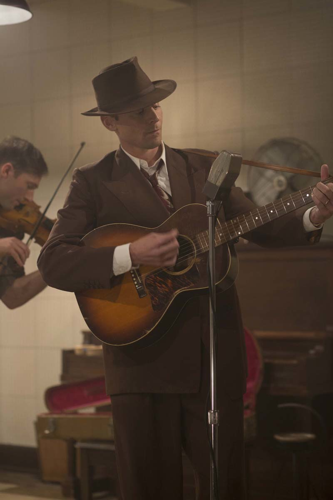
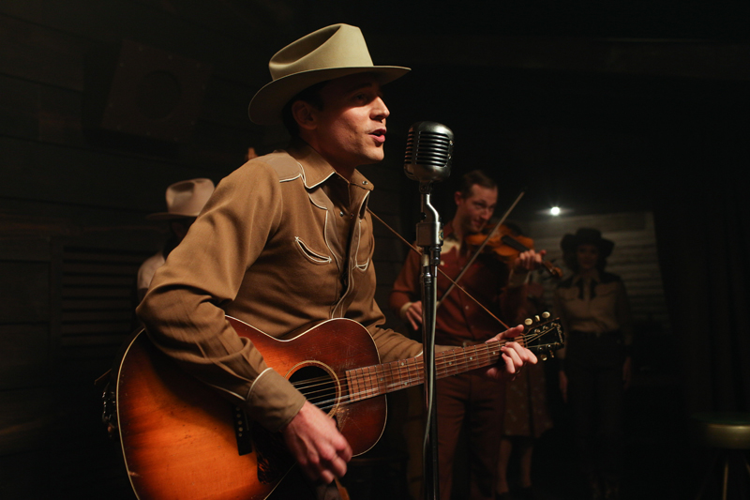
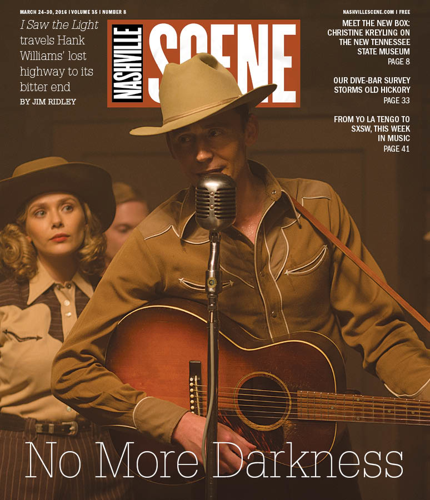
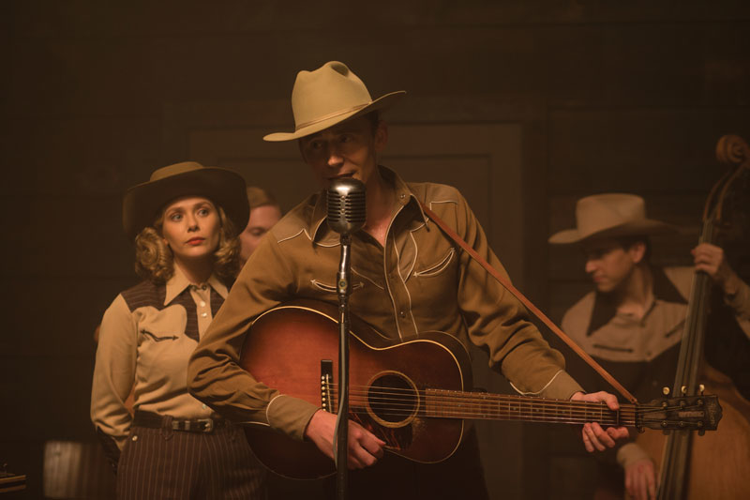
But the movie, written and directed by Marc Abraham, is best when it simply suggests how it might have felt to share the same atmosphere as an artist who altered the century's popular music and changed Nashville's fortunes. In that, it's given a crucial boost by two people. One is cinematographer Dante Spinotti, Michael Mann's longtime collaborator, who makes every molecule of the re-created past (shot mostly in Louisiana) seem present and alive. The other is the movie's Hank Williams, Tom Hiddleston, a choice that was hotly debated on the Internet when announced in 2014.
Early clips did little to quell the skepticism, as Hiddleston bravely tested his chops in public while he prepared with the movie's executive music producer Rodney Crowell. But the British actor best known as the Loki of the Marvel Cinematic Universe, and for excellent turns in movies as diverse as Guillermo del Toro's underrated Gothic fantasy Crimson Peak and Terence Davies' gorgeous romantic drama The Deep Blue Sea, didn't approach the role as a Hank Williams imitation. Even though he mastered the singer's peculiarly hunched stage moves and fruit-ninja strumming style, he was more interested in scraping away the layers of varnish to find a man.
"He was a young guy trying to make his way in the world," Hiddleston said in October at the Loews Vanderbilt the morning before the movie's local premiere. "He was a husband and a father, and it sort of expanded a quote that I later found in a documentary by an old-friend contemporary of Hank's called Danny Dill. He said legends don't know they're legends when they're being made. They're just people — they're just folks. And I realized there was a really simple humanity in it that I wanted to excavate, but also celebrate his extraordinary talent and represent his struggles and his demons."
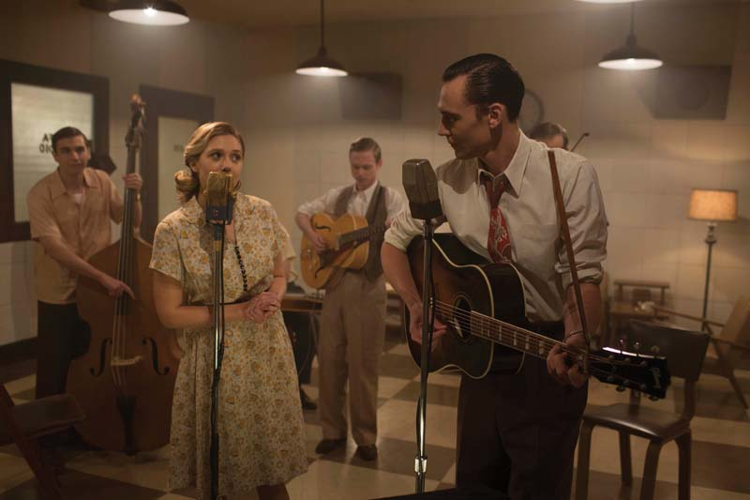
Abraham, a veteran producer who made early films with red-hot directors Zack Snyder (Dawn of the Dead) and James Gunn (Slither) and produced one of the best movies of the Aughts, Alfonso Cuarón's Children of Men, bristles at the term "biopic" to describe I Saw the Light. The movie covers the years between his marriage in 1944 to first wife Audrey Sheppard, played by Elizabeth Olsen in a volatile yet empathetic performance, and his death at age 29 nine years later. It's a relatively short time frame for a biography, yet long enough to cover his relationship with Nashville publisher-songwriter Fred Rose (Bradley Whitford), his rise to stardom and stormy history with the Grand Ole Opry, and some of the greatest songs ever written in any genre.
"I try to always avoid things like childhoods and a lot of the tropes that fall into them, but it still hasn't stopped people from calling it a biopic — and it's legit, you know," Abraham said at the Loews Vanderbilt last fall (joined by Olsen, who made note of his natty scarf on a chilly Saturday morning). "You know what it is? As a writer, I'm not very good at writing heroes. I mean that. Like, I would be the worst guy to hire to write Mission Impossible. What I'm interested in is the flaws of our lives.
"I've lived long enough to have met some of the finest people and most highly considered and evolved individuals, and in fact, the more evolved they are, the more likely they are to admit that they're flawed. If you were to talk to the Dalai Lama or listen to any of his podcasts or anything, which I do, or Thich Nhat Hanh or any of those kinds of people, that's the first thing they talk about — [that] life is suffering and how hard the battle is to be a good person and follow the right things."
In the intro to his biography, Escott says he wrote the book to try to lock down facts while witnesses were still alive — the better to separate the truth, or as much as could be ascertained, from the myth-making that had already overtaken the real Hank Williams like layers of showbills plastering over a photograph. The mythologizing process began almost instantly upon his death, starting with an unseemly grab for his personal effects. According to Escott, Williams' adoring but hard-boiled mother Lillie hardly waited for the body to cool before ordering, "Don't let anything happen to the car."
As rival Mrs. Williamses toured in his wake, and pulp biographies and Hollywood fogged his memory, Hank Williams the man receded from view. In his place rose a figure as wooden as poor old Kaw-Liga, a totem of romanticized hard living and hard loving. He also became an equally rigid symbol of hillbilly-music purity and authenticity, even if one of the most striking features of his music was its dependence on the blues and the influence of black singers. "Are You Sure Hank Done It This Way?" was the litmus test Waylon Jennings laid down, one of a cistern-deep catalog of songs supposing what Hank did or would have done.
If it's true that there's a Hank Williams to suit every fancy — outlaw-country prototype, repentant sinner, sensitive artist, instigator of what his beloved little Bocephus would one day declare "Family Tradition" — the man's own artistry made it possible. Put another way: It's not any one of those facets that makes Hank Williams such a compelling figure. It's the presence of all of them in the same driven man: the comically henpecked spouse of "Move It On Over" coexisting with the bitterly wounded cuckold of "You Win Again," or Luke the Drifter's bleak tribulations alongside the spiritual exultance of "I Saw the Light."
From the evidence Escott presents, Williams was often a hard figure to like — always alert for slights, possessed of a sequoia-sized chip on his shoulder, capable of offering a fellow performer a song and snatching it back because "it's too good for you." That's to say nothing of the excruciating back pain that often left him crumpled in agony, or the drinking or pill-popping that alleviated it, at least until he upped the dosage so high they too failed him. His marriage to Audrey was unholy deadlock from its gas-station outset, beset by mutual infidelities and exacerbated by her demands that he support her "singing" career.
The scenes between Hank and Audrey are some of the movie's best, in part because Olsen captures the competitive streak that fueled their attraction as well as their friction. Olsen's performance extends more sympathy than the first Mrs. Williams usually gets, finding pathos in the gap of painful delusion between her ambitions and her abilities. Even so, when Olsen's Audrey is on screen, it's clear she believes Hank is the supporting player in her movie. She took her cue from Escott's description of their performances together, like their marriage, as a battle for domination.
"We recorded the song together, and when we were recording it, I was thinking of that quote, and I was trying to sing louder," Olsen remembers. "Every time Tom was leaning into the mic, I was just getting louder in the recording studio, because that is exactly right. They would fight for who could be heard the loudest."
And yet she believes their love was as genuine as their rancor.
"I thought the tragedy of Hank and Audrey was that they loved each other a lot, and they were young and they had pressures that people have in relationships, but then they had extra pressures of all of a sudden having huge success and attention on them. And so there were so many things working against them. But I think at the heart of it they had this deep, deep love for each other.
"You see personal photos of them that aren't published that I got to see in the archives — the Hall of Fame Museum preserves [them] for the family, on behalf of the family — and they're really happy in a lot of photos, and they're having a joyful time, and they're not posing because it's going to be in a magazine or something or a newspaper. And there's no way he could have had so much pain and sorrow because of a hurt from love if they didn't have the love — even though they were so young and maybe quick to pull the trigger, I guess."
While the movie avoids lurid excess, though, it does so almost to the extent of sanding away the rough edges that give Williams' vocals and phrasing their playful, almost malicious zest. The movie's so eager to absolve Williams of being a bitter, hateful drunk that it scarcely acknowledges the charges, let alone the evidence. This Hank may come across as substantially nicer, but he's also substantially less compelling, except for the flashes of menace and fathomless darkness in Hiddleston's performance.
On the other hand, Hiddleston so has the singer's haggard, haunted look — especially when he's fronting the Drifting Cowboys, played on screen by actual Nashville players such as Wes Langlois and Michael Rinne from Steelism as well as Joshua Brady and Lipscomb alum and baseball player turned actor Casey Bond — that some moments deliver the spine-tingling you-are-there sensation people want from music biopics: the satisfied wish to get a sense of what history might have been like in the moment.
There may never be a single film that gets at the many contradictory sides of Hank Williams, either as an artist, a husband, a father or a man. But I Saw the Light at least gives us a sense of how it might have felt to watch his Cadillac pass through the sleepy South, and to feel the chill it left in its wake.



Post a comment as anonymous
Report
Watch this discussion.
(0) comments
Welcome to the discussion.
Log In
Welcome to the discussion.
Keep it clean. Please avoid obscene, vulgar, lewd, racist or otherwise abusive language. Comments featuring hate speech or threatening or violent content will not be tolerated.
PLEASE TURN OFF YOUR CAPS LOCK.
Be truthful. Don't knowingly lie or mislead.
Be proactive. Use the “report” link on any comment that violates our comment policy.
Share with us. We'd love to hear your feedback.